
In 2026, raw data is no longer an asset; it is a retail liability. While the average trader drowns in the 1 billion monthly API calls processed by CoinMarketCap, professional desks use precise algorithmic filters to isolate signal from noise. Accessing institutional grade crypto data is the only way to navigate a market where tokenized real-world assets have surged to $30.9 billion as of May 2026. You likely feel the weight of information overload and the frustration of latency that puts you seconds behind the smart money. It's a common struggle in a landscape where the CLARITY Act compromise, reached on May 1, 2026, is finally defining the rules of the game.
We agree that manual research is a failing strategy. This guide will teach you to master the technical standards of professional market intelligence and filter institutional signals from retail noise. We'll analyze the specific pricing tiers of providers like Kaiko, break down the impact of the SEC's May 4 no-action letters, and show you how to automate trend identification to reclaim your time. 5 data tiers. 1 definitive resource. Let's begin.
Key Takeaways
- Define the transition from speculative retail indicators to high-precision quantitative infrastructure.
- Identify actionable liquidity and market intent using Depth of Market (DOM) analysis and order book heatmaps.
- Audit data providers for sub-millisecond latency and direct exchange feeds to validate true institutional grade crypto data.
- Deploy AI agents as automated gatekeepers to filter global noise and isolate high-probability market signals.
- Shift from manual research fatigue to 24/5 automated monitoring that mirrors professional institutional execution.
What is Institutional Grade Crypto Data?
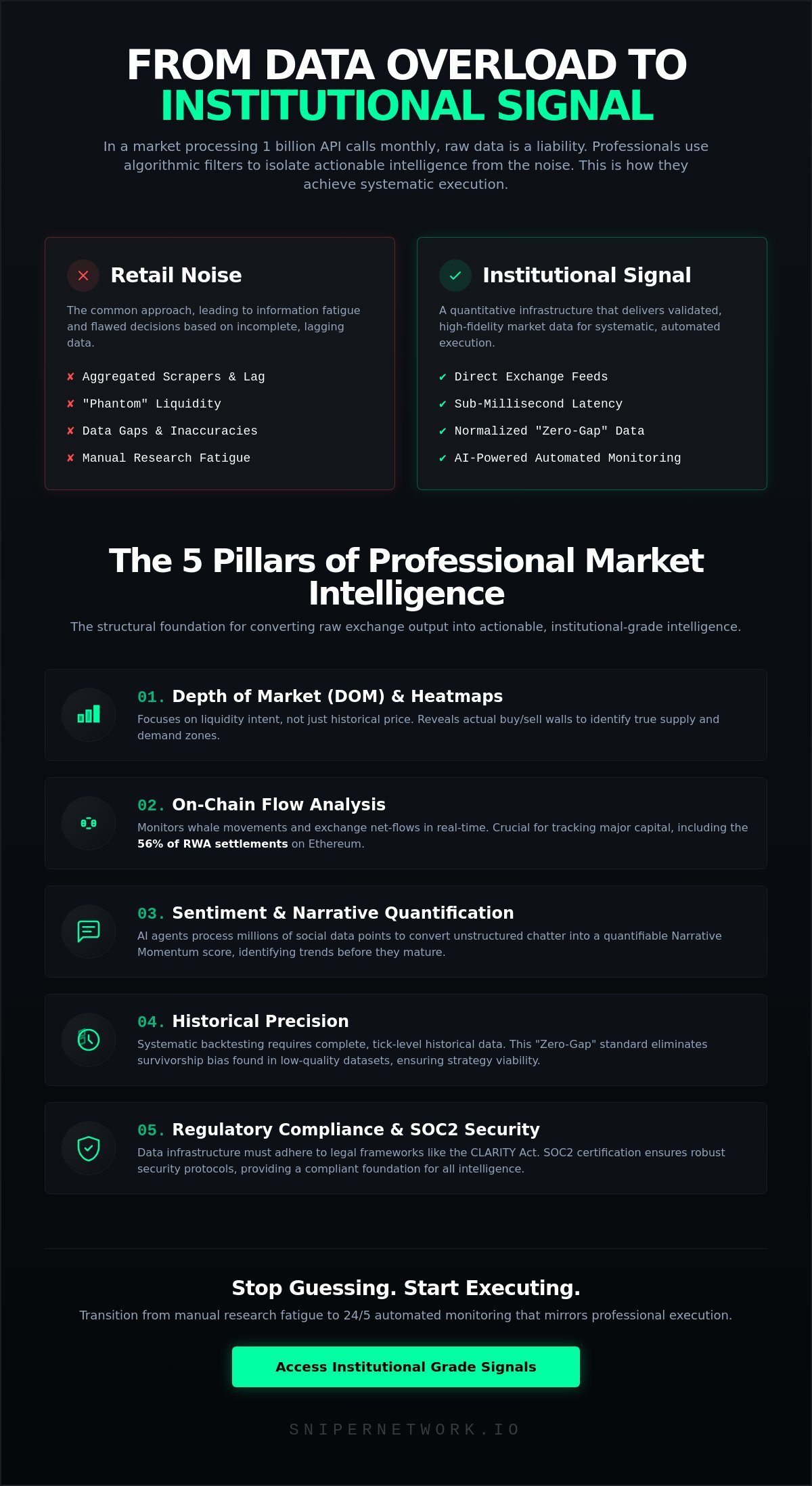
Professional market intelligence is not a luxury; it is a technical requirement. In the 2026 landscape, institutional grade crypto data is defined as multi-source, normalized, and sub-millisecond validated market information. It represents the shift from "retail indicators" to "quantitative infrastructure." While basic charts provide a general overview of What is Cryptocurrency? and its price history, they lack the depth required for high-frequency execution. Institutional data provides a high-fidelity reconstruction of global liquidity across 790+ exchanges. It eliminates the "phantom liquidity" often found in free trackers.
99% of free trackers fail the institutional stress test. These tools typically rely on aggregated scrapers that introduce significant lag and data gaps. In a market where tokenized real-world assets have reached $30.9 billion as of May 2026, these inaccuracies lead to catastrophic slippage. Data integrity is the only defense in high-frequency environments. Professional desks do not guess. They use validated signals that have passed rigorous outlier detection and cross-exchange verification protocols. This is the difference between speculative gambling and systematic execution.
Normalization and Standardization
Fragmented exchange data is a liability. Every exchange uses unique schemas and reporting standards. Normalization is the process of cleaning this noise into a single source of truth. "Zero-Gap" data is mandatory for backtesting systematic trading frameworks. If your data has holes, your backtest is a lie. High-tier providers use sophisticated outlier detection to ensure that flash crashes on low-volume exchanges don't poison the aggregate signal. This level of precision ensures that institutional grade crypto data remains actionable even during periods of extreme volatility.
Latency and Execution Speed
Speed is binary. You're either first or you're irrelevant. Sub-millisecond delivery is the baseline for professional intelligence. This requires a transition from polling REST APIs to maintaining persistent WebSocket streams. REST APIs are too slow for 2026 market speeds. Co-location is also critical. By placing servers in the same data centers as exchange matching engines, such as GCP Tokyo, traders can reduce network jitter. This infrastructure ensures that the signal you see matches the current state of the order book. Without sub-millisecond validation, you are trading on a ghost of the market's past.
The 5 Pillars of Professional Market Intelligence
Quantifying the digital asset landscape requires more than surface-level price tracking. Real-time execution depends on a multi-layered infrastructure that validates every tick. Institutional grade crypto data is built on five structural pillars that convert raw exchange output into actionable intelligence. These pillars ensure that the signals you receive are not just fast, but mathematically sound and legally compliant. Access these verified market signals to bridge the gap between retail speculation and professional desk performance.
- Pillar 1: Depth of Market (DOM) and Order Book Heatmaps. This focuses on liquidity intent rather than historical price. Heatmaps reveal where "buy walls" and "sell walls" are actually positioned.
- Pillar 2: On-Chain Flow Analysis. We monitor whale movements and exchange net-flow in real-time. Tracking 56% of RWA settlements on Ethereum requires high-fidelity on-chain monitoring.
- Pillar 3: Sentiment and Narrative Quantification. AI agents process millions of data points to convert social noise into a Narrative Momentum score.
- Pillar 4: Historical Precision. Systematic backtesting requires tick-level data. This eliminates the "survivorship bias" found in low-quality datasets.
- Pillar 5: Regulatory Compliance and SOC2 Security. Institutional-grade data demands strict adherence to legal frameworks and robust security. SOC2 certification ensures our infrastructure protects sensitive information, providing a compliant and secure foundation for all market intelligence.
Data Overflow vs. Signal Intelligence: The AI Filter
Raw data is a liability. As of May 2026, CoinMarketCap tracks over 2.4 million assets across 790 exchanges. This volume creates a "Data Paradox" where excessive information actually degrades decision quality. Accessing institutional grade crypto data requires an algorithmic gatekeeper to convert this chaos into execution. Without an automated filter, the individual trader is buried in noise. Professionals don't hunt for data; they subscribe to pre-validated intelligence.
AI agents act as the primary filter for modern desks. They monitor 10,000 active coins 24/5 to isolate actionable trends. This system replaces manual searching with a stream of validated signals. It moves the user from a state of constant research fatigue to a position of clinical execution. In a market where the CLARITY Act is tightening reporting standards, having an automated filter is the only way to maintain a competitive edge.
The Problem with Manual Research
Manual research is a failure of scale. A typical retail trader loses 12 to 14 hours weekly attempting to synthesize conflicting signals from different platforms. Human interpretation is inherently flawed; emotional bias triggers premature exits or late entries. Retail signal groups compound this issue by offering manual, unverified calls. These groups are the opposite of institutional grade crypto data. They often provide lagging indicators that turn followers into exit liquidity for sophisticated players. 5 AI agents. 8 signal filters. This is the only way to outpace the manual crowd.
Machine Learning in Pattern Recognition
Machine learning identifies multi-timeframe confirmations with sub-millisecond precision. These systems use signal filters to prevent false breakouts by cross-referencing price action against liquidity depth. The 8-layer validation framework cross-references order book depth, whale movements, and narrative momentum across eight distinct timeframes to confirm market intent. This ensures that every trigger is backed by a quantitative consensus rather than a single technical indicator.
Competitors often provide raw CSV files for manual analysis. This approach is fundamentally flawed. Downloading a 500MB dataset of historical ticks doesn't provide an edge; it creates a processing bottleneck. By the time a human cleans and analyzes the data, the market opportunity has vanished. Institutional grade crypto data must be pre-processed. It should arrive as a validated signal, not a spreadsheet. This allows you to focus on risk management while the silent engine handles the technical heavy lifting in the background.
Evaluation Framework: Choosing Your Data Partner
Longevity is a legacy metric. While some providers claim trust based on a 2013 launch date, modern execution demands technical validation rather than historical presence. Selecting a partner for institutional grade crypto data requires a rigorous audit of their underlying infrastructure. This framework provides the specific criteria used by professional desks to vet market intelligence sources in 2026. Data must be verifiable; trust is a byproduct of transparency.
- Step 1: Verify the Source. Direct exchange feeds are the baseline. Avoid providers relying on aggregated scrapers; these introduce 500ms of unnecessary latency and frequent data gaps.
- Step 2: Assess the Latency. True real-time intelligence requires WebSocket streams. If the provider only offers REST API polling, they're providing a historical record, not a live signal.
- Step 3: Check for Non-Custodial Integration. Professional tools shouldn't touch your assets. Security is maintained through API permissions, not direct custody.
- Step 4: Evaluate Actionability. Raw CSV files are a processing bottleneck. Look for processed reports that deliver validated signals ready for immediate execution.
- Step 5: Transparency of Methodology. Providers must disclose their backtesting logic. Black-box systems are a risk; quantitative proof is a requirement.
Non-Custodial Intelligence Standards
Institutional grade tools must never require asset custody. This is a non-negotiable security protocol. The "Your API key, your funds" mantra ensures you maintain total control over your capital while the intelligence engine operates in the background. This architecture aligns with the SEC's March 11, 2026 Memorandum of Understanding on digital asset coordination; it prioritizes user protection through technical boundaries. You can see this Sniper AI Weekly framework in action, where intelligence is delivered without ever requesting wallet access.
Technical Infrastructure Checklist
Security and reliability are quantified through technical standards. All data transmissions must utilize AES-256 encryption to prevent interception. Uptime is the ultimate institutional standard; anything below 99.9% availability is unacceptable for professional trading. Because crypto markets operate without a closing bell, 24/5 monitoring is the minimum requirement to align with global institutional hours. This ensures that the system validates every market shift while retail participants are offline. ◈ 5 AI agents. 8 signal filters. 99.9% uptime. Access professional market intelligence to secure your technical edge.
Sniper AI Weekly: Executing on Institutional Intelligence
Sniper Network functions as the technical bridge between elite trading floors and the individual desk. It automates the extraction and processing of institutional grade crypto data, replacing manual research fatigue with a streamlined intelligence workflow. The system deploys 5 AI agents that monitor global markets 24/5. This constant surveillance ensures that no significant liquidity shift or narrative pivot goes undetected while you're offline. It mirrors the sub-millisecond execution speed of professional engines by removing the human bottleneck from the discovery phase.
The workflow follows a strict logic of Action-Result. Raw data is ingested from direct exchange feeds across 790+ venues. The system then executes three critical processing steps to ensure signal purity:
- Ingestion: Consuming real-time WebSocket streams from global liquidity hubs to prevent data gaps.
- Validation: Applying 8 signal filters to remove "phantom liquidity" and wash trading noise.
- Synthesis: Converting institutional grade crypto data into actionable weekly reports that highlight high-probability trends.
This output isn't a speculative signal group; it's a quantitative summary of market intent. It allows you to execute with the same technical precision as a professional desk without the Bloomberg terminal budget. You don't need to spend 14 hours a week staring at charts when the heavy lifting is automated.
Automated Narrative Tracking
Our infrastructure is co-located in GCP Tokyo to ensure a sub-millisecond edge over retail-grade trackers. AI agents monitor high-tier sources like Reuters and social sentiment feeds to quantify narrative momentum in real-time. This systematic approach eliminates the emotional bias and FOMO that typically lead to poor retail entries. By the time a trend reaches general social media, the Sniper engine has already validated the signal and identified the liquidity walls. Busy traders benefit from these data-driven insights because they provide clarity in a market of 2.4 million assets.
Start Your Institutional Journey
Transparency is our primary trust marker. We offer a "No Card Required" trial to allow users to verify the engine's accuracy without friction. Integration is designed for speed. You can apply these insights to your existing Bybit or exchange setup immediately. We never hold your funds. We never request your private keys. The engine operates entirely in the background, providing the data while you maintain total control. ◈ 5 AI agents. 8 signal filters. Sub-millisecond validation. Experience Institutional Grade Intelligence today and secure your position in the 2026 market.
Secure Your Technical Edge in the Algorithmic Market
The window for manual market interpretation is closing. As 2026 progresses, the delta between retail noise and professional execution lies entirely in your choice of infrastructure. You've identified that institutional grade crypto data isn't merely about raw speed; it's about the technical standards of multi-source normalization and the clinical precision of 8-layer signal validation. Relying on fragmented exchange feeds is a structural liability that professional desks don't accept. Success is now a function of your filtering capacity and the integrity of your signals.
True market intelligence requires a system that validates every tick while you're offline. 5 AI agents. 24/5 automated monitoring. By adopting a non-custodial framework, you maintain the "Your API, Your Funds" security seal while accessing high-tier intelligence co-located in GCP Tokyo. This transition from manual data hunting to automated intelligence is the final step in professionalizing your individual desk. Don't let latency or information overload dictate your performance. Access Sniper AI Weekly Intelligence to secure a validated stream of market signals. Your journey toward technical precision starts here.
Frequently Asked Questions
What makes crypto data institutional grade?
Institutional grade data is characterized by sub-millisecond latency, direct exchange feeds, and multi-source normalization. Retail trackers often rely on aggregated scrapers that introduce 500ms of lag. Professional desks require "Zero-Gap" datasets to eliminate phantom liquidity and wash trading noise. This infrastructure ensures every signal is validated against the actual depth of the global order book.
How does AI improve institutional crypto analysis?
AI agents automate the filtering of 10,000+ active coins to isolate actionable trends. They process millions of data points from Reuters and social feeds to quantify narrative momentum. This eliminates the emotional bias inherent in manual analysis. 5 AI agents. 8 signal filters. This system identifies multi-timeframe confirmations with a speed that manual research cannot replicate.
Is institutional grade data expensive for individual traders?
Costs for institutional grade crypto data vary based on depth and delivery. Enterprise software like Kaiko averages $28,500 annually as of May 2026. While high-end plans are priced for large firms, individual traders can access modular intelligence subscriptions. These services provide a technical bridge without the five-figure Bloomberg terminal budget.
What is the difference between raw data and market intelligence?
Raw data is a liability consisting of unprocessed JSON feeds or massive CSV files. Market intelligence is the refined output of an algorithmic filter. It converts 1 billion monthly API calls into validated execution signals. Professionals don't hunt for data; they subscribe to intelligence that has already passed through rigorous outlier detection.
Can I use institutional data for automated trading?
Automated trading requires high-fidelity data as its primary fuel. Without sub-millisecond validation, your execution logic will trigger on stale price action. Institutional data provides the WebSocket streams necessary for real-time order book reconstruction. This ensures your systematic framework executes with the same precision as a professional quantitative desk.
Why is non-custodial data important for security?
Non-custodial standards protect your capital by ensuring the intelligence engine never has withdrawal permissions. Security is maintained through technical boundaries and API encryption. This aligns with the "Your API key, your funds" protocol. It allows you to leverage advanced market signals while maintaining 100% control over your assets.
How often is institutional crypto data updated?
Updates occur in sub-millisecond intervals through persistent WebSocket connections. This is a technical requirement for 2026 market speeds. Co-location in GCP Tokyo reduces network jitter and ensures data arrives with minimal delay. If your feed relies on REST API polling, you're trading on a ghost of the market's past.
What is the best way to backtest with institutional data?
Backtesting requires tick-level historical data to ensure accuracy. Using smoothed candle averages leads to survivorship bias and unrealistic results. High-precision institutional grade crypto data allows you to test strategies against actual liquidity depth. This ensures your framework is resilient during periods of extreme volatility and flash crashes.