Raw market data is no longer an asset. It's a liability. With 14,000 cryptocurrencies active in 2026, the volume of noise creates a paralysis that hides high-conviction narratives. You've likely realized that basic technical analysis bots produce more false signals than actionable entries. To maintain a professional edge, you must deploy an ai crypto trend scanner that prioritizes institutional-grade validation over signal volume.
We agree that information overload is the primary barrier to technical precision. This article provides the framework to separate market noise from actionable intelligence using systematic AI scanning technology. 5 AI agents. 8 signal filters. You'll learn to isolate early-stage trends while maintaining strict non-custodial security protocols. We'll examine the multi-agent architectures and data filters required to secure a consistent weekly edge through automated, clinical execution.
Key Takeaways
- Identify how an ai crypto trend scanner parses multi-exchange data to detect narrative shifts and liquidity flows beyond basic technical analysis.
- Review the technical architecture of elite scanners, featuring sub-millisecond data ingestion and Claude AI sentiment parsing for institutional-grade precision.
- Differentiate between high-noise raw signals and validated market intelligence to improve risk-adjusted entries and weekly consistency.
- Establish a systematic, non-custodial workflow that prioritizes asset security by connecting your API key directly to the trading engine.
- Utilize Sniper AI Weekly to access a clinical framework of 5 AI agents and 8 signal filters for data-driven trend discovery.
What is an AI Crypto Trend Scanner in 2026?
An ai crypto trend scanner is no longer a simple web-based filter for RSI crossovers. In 2026, it functions as an autonomous software layer that utilizes machine learning to parse multi-exchange data in sub-millisecond intervals. It doesn't just watch price. It monitors liquidity flows, identifies narrative shifts, and validates volatility across 14,000 assets simultaneously. This technology transforms raw market data into actionable intelligence by applying complex statistical models to every tick of the tape. It's the difference between guessing where the puck is going and having a GPS for the entire arena.
Manual scanning is mathematically inferior in high-frequency environments. Human cognition is limited by processing speed and emotional bias. A professional trader cannot monitor 30 exchanges and 500 liquidity pools at once. The machine can. By the time a manual trader identifies a breakout, the institutional algorithms have already filled their orders and moved the price. The shift from reactive indicators to predictive intelligence is now a requirement for survival. If your strategy relies on lagging indicators, you aren't trading the trend; you're trading the history of the trend.
The Evolution from Screener to Intelligence Agent
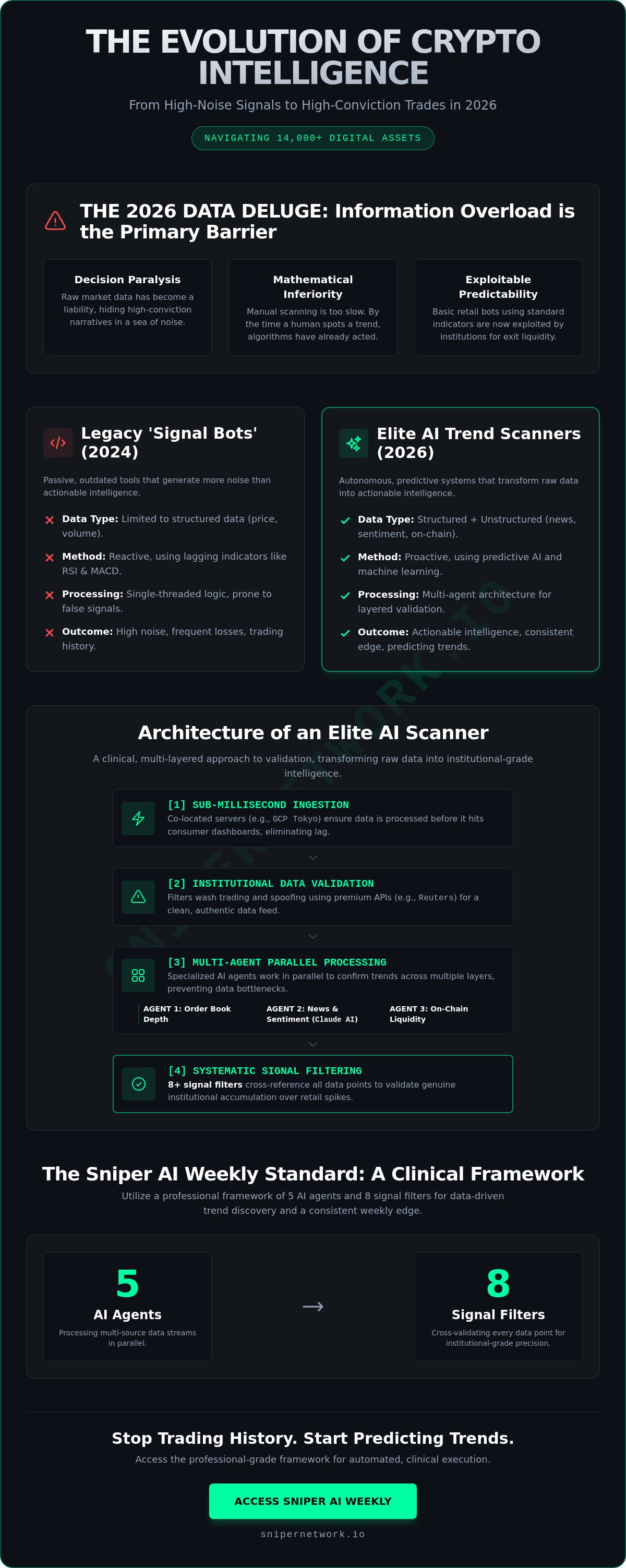
Legacy 2024 screeners relied almost exclusively on structured data like price and volume. They were passive tools that waited for specific parameters to be met. 2026 agents are proactive. These systems process unstructured data, including social sentiment, global news feeds, and complex on-chain movements. They integrate high-tier LLMs to understand the "why" behind a price move, not just the "what." These agents apply systematic crypto trading principles to ensure every signal is backed by a data-driven framework. They don't just find setups; they validate them against historical backtests in real-time.
Why Retail 'Signal Bots' Are Failing in 2026
Basic automated scripts have become liabilities. The saturation of retail bots using standard RSI, MACD, or Bollinger Band triggers has created a predictable environment for market makers. These institutional players now exploit common retail bot triggers to generate exit liquidity. Without multi-timeframe confirmation and deep volume profiling, a signal is just noise. This is where algorithmic trading must evolve. Elite scanners use 8 or more signal filters to confirm that a move is supported by genuine institutional accumulation rather than a temporary retail spike. Precision requires more than a script; it requires a multi-agent architecture that cross-references data points before a single alert is triggered.
The Technical Architecture of Elite Scanners
Institutional market intelligence requires more than a standard connection to an exchange API. It demands a sophisticated infrastructure designed for sub-millisecond data ingestion. While retail applications struggle with latency, an institutional-grade ai crypto trend scanner utilizes co-located server clusters in strategic hubs like GCP Tokyo. This physical proximity to exchange matching engines ensures that data processing occurs before price movements are reflected on standard consumer dashboards. Speed is the first filter. Without it, you are simply reacting to history.
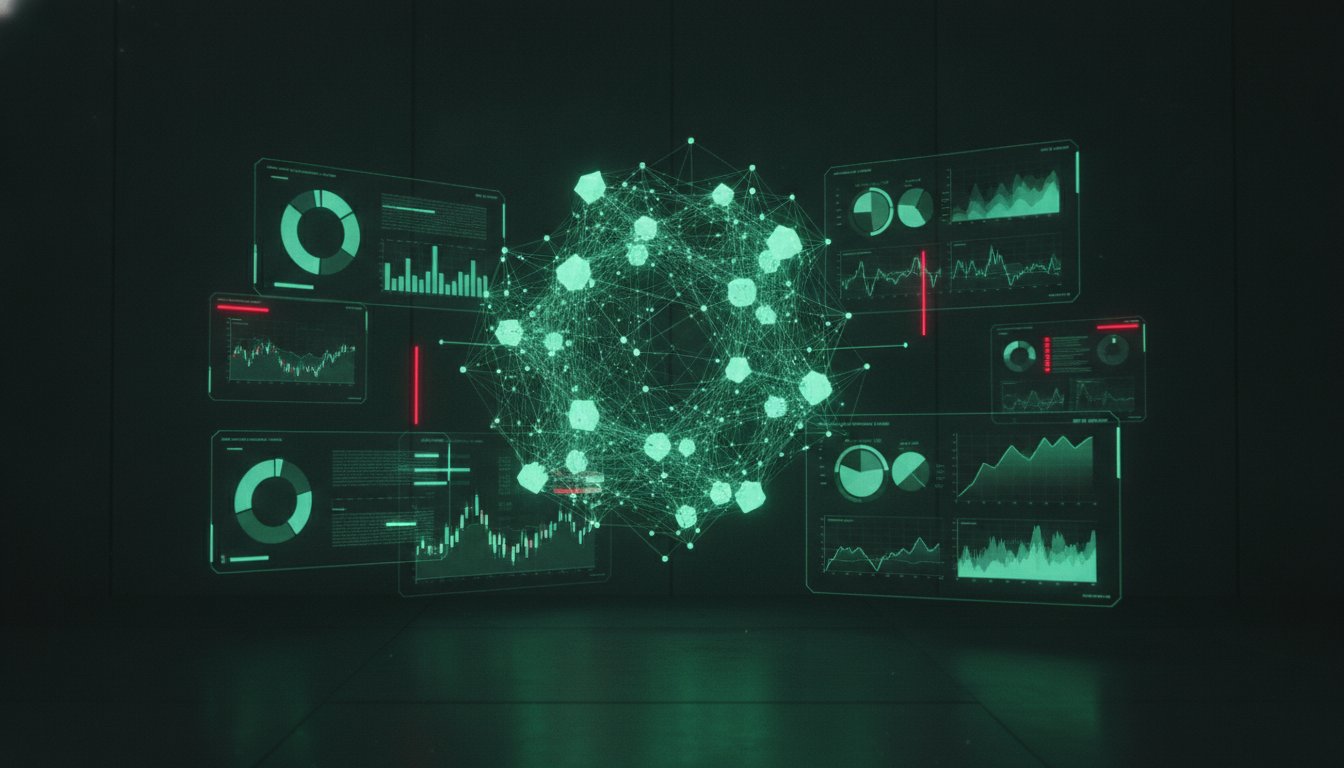
The system operates through a multi-agent architecture where specialized AI agents function in parallel. One agent monitors order book depth. Another parses global news feeds and social sentiment using high-tier LLMs like Claude AI. A third validates on-chain liquidity shifts. This parallel processing prevents data bottlenecks and ensures that a trend is confirmed across multiple layers before any intelligence is delivered. It's a clinical approach to validation. This technical sophistication aligns with recent academic analysis of AI's impact on digital asset markets, which highlights the necessity of multi-layered validation in volatile environments.
Data Source Validation and Infrastructure
Clean data is the foundation of technical precision. Elite scanners must filter out wash trading and spoofing, which frequently distort volume figures on unregulated exchanges. By integrating institutional-grade APIs from sources like Reuters or Bloomberg, the system ensures the analyzed feed is authentic. Server location is critical here. Co-location reduces the "hop" count between the scanner and the exchange, allowing for sub-millisecond execution of data parsing. This infrastructure removes the "lag" that often leads to retail slippage. For those seeking this level of technical rigor, the Sniper AI Weekly service provides a direct bridge to institutional-grade scanning.
Neural Networks vs. Heuristic Algorithms
Heuristic algorithms follow rigid "if-then" rules. They are easily gapped during periods of extreme volatility. Neural networks identify non-linear market patterns that are invisible to the human eye. These networks are trained on datasets spanning at least 10 years to ensure they recognize cycles across various macro environments. A common issue in AI is the "Black Box" problem, where the logic behind a decision is hidden. Elite scanners solve this by maintaining transparent logic maps. This ensures the user understands the specific data points—whether liquidity spikes or sentiment shifts—that triggered a trend identification. 5 AI agents. 8 signal filters. This is the standard for 2026.
Evaluating Scanner Performance: Signals vs. Intelligence
Raw signals are high-frequency liabilities. They offer volume but lack validation. Market intelligence is different. It's filtered data aligned with narrative shifts and risk-adjusted entries. A professional ai crypto trend scanner doesn't just identify price changes; it applies an 8-Layer Validation Framework to strip away market noise. Win rate is a deceptive metric. It's a vanity stat that ignores the reality of capital preservation. A 90% win rate is worthless if a single unmanaged drawdown wipes out your cumulative gains. Institutional performance is measured by the Sharpe ratio and maximum drawdown, not just gross profit. You need a system that prioritizes the quality of the entry over the frequency of the alert.
The difference lies in the processing depth. While retail bots bark at every RSI crossover, elite scanners look for confluence across fragmented data sets. This involves cross-referencing order book depth with on-chain liquidity shifts and social sentiment. 5 AI agents. 8 signal filters. This architecture ensures that by the time you receive intelligence, the noise has already been mathematically eliminated. It's a clinical approach to trend discovery that treats every data point as a potential risk until it's validated by the system's core logic.
Filtering Market Noise with Multi-Timeframe Confirmation
Fakeouts are the primary cause of retail liquidation. An advanced ai crypto trend scanner identifies these by correlating trends across the 15m, 1h, and 4h timeframes. If a 15m price spike isn't supported by the 4h narrative, the signal is discarded as noise. Volume-weighted analysis confirms price action with real liquidity. It ensures that a move isn't just a low-volume spike on a single exchange. Order book depth validation determines trend sustainability. If the bid-ask spread doesn't support the move, the scanner ignores it. This multi-layered confirmation prevents you from chasing ghost trends that lack institutional backing.
Risk Management and Drawdown Protection
Risk isn't an afterthought. It's the core of the engine. Automated stop-loss calculation uses ATR (Average True Range) to account for asset-specific volatility. A high-beta asset requires a wider berth than a stable large-cap. Position sizing is dynamic. The AI adapts based on changing market conditions and your predefined risk tolerance. This is the 'Institutional Edge.' You aren't just finding trends; you're managing risk like a professional hedge fund. The system executes based on mathematical certainty, not emotional bias. It monitors the market 24/5, ensuring that your capital is protected even when you aren't at the terminal. Precision over persuasion. Data over hope.
Implementing Scanners into a Systematic Workflow
Integrating an ai crypto trend scanner into a professional operation requires a clinical, five-step deployment strategy. It's not about chasing every alert. It's about systematic alignment between automated discovery and human risk management. Professional traders don't use these tools to replace their strategy; they use them to accelerate it. The workflow must be logical, frictionless, and data-driven.
- Step 1: Define your trading persona. Risk tolerance isn't a feeling; it's a mathematical constraint. Establish your drawdown limits and profit targets before the first scan.
- Step 2: Connect via non-custodial API. This ensures you maintain full control of your assets. Your API key, your funds.
- Step 3: Set automated filters. Narrow the scanner's focus to high-conviction asset classes such as DeFi, Layer 1s, or AI narratives. With over 14,000 cryptocurrencies active in 2026, sector-specific filtering is mandatory.
- Step 4: Review weekly intelligence reports. This provides the necessary narrative alignment to confirm the machine's findings against macro trends.
- Step 5: Execute with precision. Use automated engines to remove human latency and emotional hesitation during high-volatility events.
The Non-Custodial Security Mandate
Security is the primary concern for institutional-grade operations. You should never provide withdrawal permissions to any scanner or automated tool. The system only needs "Trade" and "View" access to function. Elite platforms utilize AES-256 encryption for API key storage, ensuring that your credentials remain secure. This "Silent Engine" approach allows the software to monitor the market 24/5 without ever touching your principal capital. It's a professional standard that separates high-tier tools from retail signal groups that often ignore custodial risks. If a platform asks for withdrawal access, it's a critical security failure.
Weekly Review and Narrative Alignment
The "set and forget" approach is a trap for retail traders. Professional edge requires a human-in-the-loop requirement to adjust strategy based on macro-economic data shifts. Using Sniper AI Weekly allows you to confirm long-term trends identified by the agents. While the AI handles the data parsing, the trader provides the context. This alignment ensures that your automated filters aren't trading against a major narrative shift, such as a regulatory change or a liquidity pivot. Consistency comes from combining machine speed with human oversight. To begin building your own data-driven framework, you can start your 3-day free trial and access our institutional-grade scanning engine today.
Sniper AI Weekly: The Professional Standard for Trend Discovery
Sniper AI Weekly represents the terminal evolution of market intelligence. It's the operational standard for traders who prioritize data over persuasion. This service provides clinical precision in an environment saturated by speculative noise. It isn't a manual signal group. It's an ai crypto trend scanner engineered for technical rigor. The engine utilizes a feature-first architecture. 5 AI agents. 8 signal filters. This framework ensures that every identified narrative is validated against liquidity flows and order book depth before delivery. We don't sell hope; we provide validated intelligence.
The system is built for the Elite Technician who demands reliability. It ignores the exuberant hype of retail markets to focus on backtested performance. By utilizing a strictly non-custodial architecture, Sniper AI Weekly maintains a clear operational boundary. We provide the intelligence; you retain the assets. This adheres to the "Your API key, your funds" protocol. It's a silent, automated engine working in the background to monitor over 14,000 assets across global exchanges with sub-millisecond data ingestion. Precision is the only metric that matters.
- ◈ Clinical precision: No hype, just data-driven weekly intelligence.
- ◈ 5 AI Agents. 8 Signal Filters. Institutional-grade validation.
- ◈ Non-custodial architecture: We provide the data; you keep the assets.
- ◈ Designed for the 'Elite Technician': High-speed, secure, and reliable.
Institutional-Grade Data for Retail Traders
We bridge the gap between high-frequency trading floors and individual participants. Our infrastructure provides 24/5 monitoring. This schedule aligns with global financial markets to ensure your strategy remains relevant during institutional hours. You gain direct access to performance metrics and backtested results previously inaccessible to retail. The system validates every trend against multi-timeframe confirmation layers. This prevents the fakeouts that commonly liquidate standard retail bots. Every data point is a trust marker of our technical sophistication. It's a bridge to a more professional trading framework.
The Sniper Network Signature
Transparency is our standard. We don't utilize high-pressure sales tactics. Our 3-day free trial requires no credit card. This allows the technical specifications to stand on their own. The Sniper Network signature is defined by technical precision and uncompromising security. We employ AES-256 encryption for API key storage and utilize co-located servers to minimize latency. ◈ Start your free trial of Sniper AI Weekly today. Secure your weekly edge with institutional-grade validation. Data-driven discovery is no longer optional in 2026. It's the only way to maintain a professional advantage in a saturated market.
Securing Your Quantitative Edge in 2026
Professional trading in 2026 is a contest of infrastructure and validation. You've identified why raw signals are liabilities. You've seen how an institutional ai crypto trend scanner transforms fragmented data into market intelligence. Clinical execution requires more than basic scripts. It requires sub-millisecond ingestion and an 8-Layer Validation Framework. Security is the non-negotiable foundation. Your API key, your funds. AES-256 encryption ensures your credentials remain secure while the engine monitors 14,000 assets 24/5.
Deploy 5 AI agents to manage your discovery process. Separate noise from actionable trends with mathematical certainty. ◈ Activate Your Sniper AI Weekly Intelligence Trial. No credit card is required to access our institutional-grade framework. Experience the speed of a high-end financial tool. Start your data-driven journey today and secure your position among the elite technicians of the digital asset market.
Frequently Asked Questions
What is the difference between a crypto scanner and a signal group?
A scanner is an autonomous software layer that parses live market data, while a signal group relies on manual human analysis. Signal groups are often driven by emotional bias and speculative hype. An ai crypto trend scanner removes the human element by utilizing machine learning to validate trends across thousands of assets simultaneously. It provides data-driven intelligence based on liquidity and volume rather than subjective opinions found in chat rooms.
Is an AI crypto trend scanner safe to use with my exchange account?
Safety depends on the custodial model of the software. Sniper Network utilizes a non-custodial architecture, meaning we never have access to your principal capital. You connect via an API key with restricted permissions that only allow for "View" or "Trade" functions. By ensuring "Withdrawal" permissions are disabled and using AES-256 encrypted storage, your funds remain entirely under your control on the exchange.
How much technical knowledge is required to use Sniper AI Weekly?
The system is designed for the Elite Technician but delivers simplified, actionable intelligence. While the underlying architecture involves 5 AI agents and complex neural networks, the output is a streamlined weekly report. You don't need to write code or understand sub-millisecond execution to benefit from the narrative alignment and trend discovery. We bridge the gap between high-frequency trading infrastructure and individual strategic decision-making.
Can an AI scanner predict price movements with 100% accuracy?
No system can predict market movements with absolute certainty. Markets are probabilistic, not deterministic. An ai crypto trend scanner is designed to identify high-conviction setups by filtering out noise and confirming trends across multiple timeframes. The goal is to provide a consistent statistical edge and manage risk through automated drawdown protection. Precision is about increasing the probability of success, not guaranteeing a specific outcome.
What are the best indicators for an AI scanner to monitor in 2026?
Effective scanners move beyond basic RSI and MACD. In 2026, the most critical data points include order book depth, liquidity flows, and social sentiment parsing via LLMs like Claude AI. Cross-referencing on-chain movements with exchange volume helps identify genuine institutional accumulation. Multi-timeframe confirmation is also essential. If a trend isn't visible on the 1h and 4h charts, it's often discarded as a retail fakeout.
Does Sniper Network have access to my trading funds?
Sniper Network never holds user funds. We operate as a data and intelligence provider, not a custodian. Our "Your API key, your funds" protocol is a verbal seal of security that ensures you maintain 100% ownership of your assets at all times. We provide the validated signals and trend discovery, while the execution and custody remain within your private exchange accounts.
How does AI filter out 'fake' volume and wash trading?
AI agents identify wash trading by analyzing the micro-structure of the order book and detecting repetitive, non-economic patterns. By cross-referencing data from Tier-1 institutional APIs like Reuters or Bloomberg, the system validates whether volume is supported by genuine liquidity. This process filters out the artificial spikes common on unregulated exchanges. It ensures that the trends you follow are backed by authentic market participation.
What makes a scanner 'institutional-grade' versus 'retail'?
Institutional-grade systems are defined by their infrastructure and validation depth. This includes co-located servers in hubs like GCP Tokyo to minimize latency and the use of multi-agent AI architectures. Retail tools often rely on single-bot scripts and basic technical indicators. An institutional system uses an 8-Layer Validation Framework to confirm every signal, prioritizing data integrity and risk-adjusted entries over high-frequency noise.