
Most traders lose an entire month of gains in a single 15-minute liquidation wick. It isn't a lack of alpha. It's a failure of math. In a 2026 market where futures represent 77% of total volume, guessing your entry size is a terminal error. Professional position sizing strategies for crypto are required for survival. 5 AI agents. 8 signal filters. One clinical framework. ◈
You've likely felt the paralysis of high volatility or the sting of an inconsistent trade size that erased weeks of disciplined progress. This emotional friction is a byproduct of unquantified risk. We'll provide a repeatable, clinical framework for every trade you execute. You'll learn to master the precision of institutional-grade sizing to protect capital and optimize returns. This guide previews the 1-2% risk rule, volatility-adjusted allocation, and the alignment of trade size with validated market intelligence. Use data to replace anxiety. ◈
Key Takeaways
- Eliminate emotional bias by quantifying the 'Risk of Ruin' and understanding the mathematical asymmetry of market drawdowns.
- Implement advanced position sizing strategies for crypto like Fixed Fractional models to ensure your risk remains constant as your capital scales.
- Utilize Average True Range (ATR) to dynamically adjust stops and size, preventing liquidation during high-volatility market cycles.
- Identify hidden portfolio risks by neutralizing the 'Correlation Trap' and treating highly correlated assets as a single exposure point.
- Optimize your workflow with Sniper AI Weekly to integrate institutional-grade technical and on-chain validation into your sizing decisions.
The Clinical Necessity of Position Sizing in Crypto
Position sizing is the quantitative determination of capital allocation per trade. It's the most critical variable in your risk management architecture. While retail participants obsess over entry signals, the Elite Technician focuses on the total position in finance they're assuming. Effective position sizing strategies for crypto decouple execution from emotion. They replace FOMO with mathematical certainty. If you don't know exactly how much capital is at risk before the order triggers, you aren't trading; you're gambling. ◈
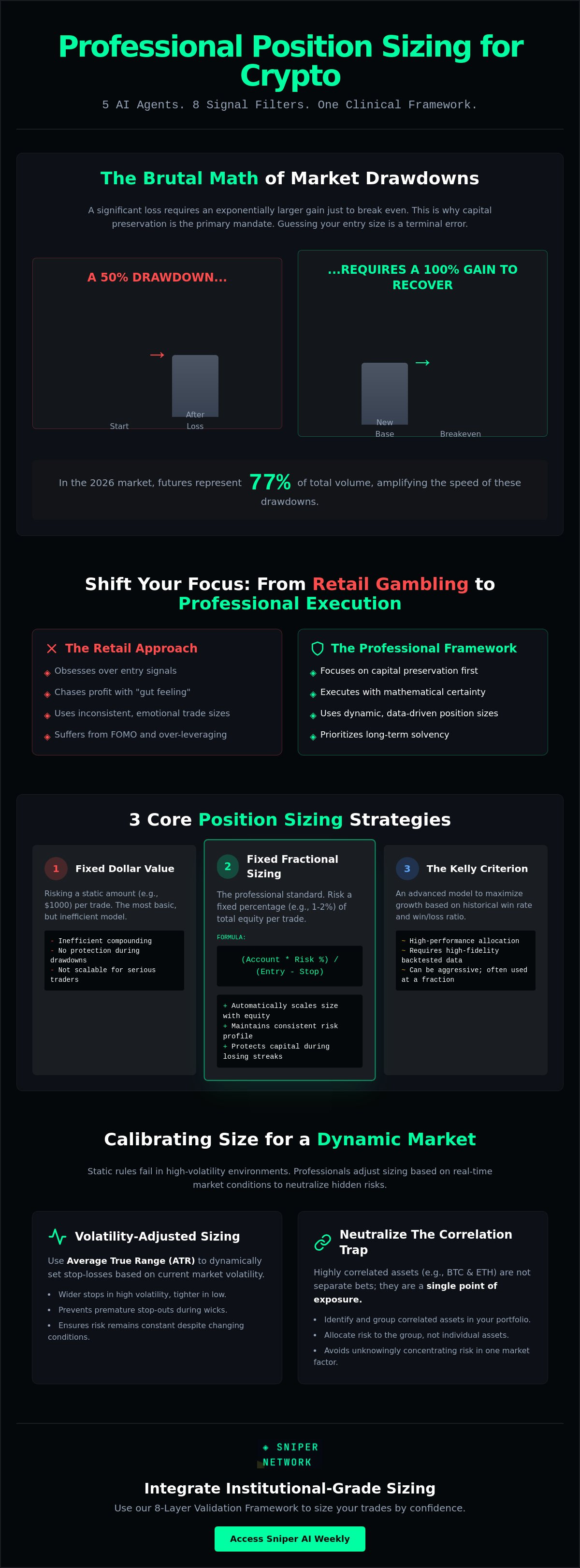
The math of recovery is brutally asymmetric. A 10% loss requires an 11.1% gain to return to baseline. A 50% drawdown requires a 100% gain just to break even. In the high-velocity crypto environment, where 2026 futures volume now accounts for 77% of total market activity, these numbers escalate with lethal speed. Position sizing is the only shield against the 'Risk of Ruin.' It ensures that no single market event, regardless of severity, can terminate your ability to operate in the markets. ◈
Institutional-grade trading requires a shift from profit-chasing to capital preservation. By calculating size based on hard data rather than "gut feeling," you remove the psychological friction that leads to over-leveraging. You aren't hoping for a win; you're executing a statistical edge. This clinical approach allows for a transparent partnership between the trader and the system, prioritizing long-term solvency over short-term dopamine. ◈
Capital Preservation vs. Profit Maximization
Profit is a secondary metric. For the professional, capital preservation is the primary mandate. Without a base of capital, your technical edge is irrelevant. Asymmetric returns are built on the foundation of staying in the game long enough for the math to work in your favor. A drawdown is the peak-to-trough percentage decline of your portfolio value during a specific market cycle. By limiting drawdown through precise sizing, you maximize the power of compounding. ◈
The 2026 Market Regime: Why Static Rules Fail
The 2026 landscape is dominated by high-frequency institutional flows and sub-millisecond execution. Static rules, like the 'standard 2%' risk model, are often insufficient because they ignore liquidity depth and rapid volatility expansion. Modern position sizing strategies for crypto must be dynamic. If your trade size exceeds the available liquidity at your stop-loss level, your actual risk is unquantified. We utilize a Signal-to-Noise ratio to determine if the current market environment warrants a full or reduced allocation. This ensures that your size always aligns with validated market intelligence. ◈
3 Core Position Sizing Strategies for Modern Traders
Execution without a defined allocation model is merely high-speed guessing. In the 2026 market regime, your choice of model determines your survival rate during volatility spikes. Professionals move beyond arbitrary numbers to implement position sizing strategies for crypto that are grounded in probability. There are three primary frameworks used by institutional desks and elite technicians to manage risk across varying account sizes. ◈
The Fixed Dollar Value method is the most basic approach. It involves allocating a static amount, such as $2,000, to every trade. While simple to execute, it's mathematically inefficient. It doesn't allow for effective compounding during growth phases, nor does it protect the bankroll during drawdowns. If you're serious about scaling, you must transition to models that respond to your account's real-time equity. ◈
Fixed Fractional Sizing: The Professional Baseline
Fixed Fractional sizing is the industry standard for maintaining a consistent risk profile. It ensures that you risk a specific percentage of your total equity on every trade, regardless of the entry price. The calculation is precise: (Account Balance * Risk %) / (Entry Price - Stop Loss). By utilizing this model, your trade size automatically shrinks during losing streaks and expands during winning streaks. ◈
Risk per trade is the only variable you truly control in an unpredictable market. When analyzing crypto position sizing strategies, the percentage should fluctuate based on market cycles. An Elite Technician might risk 1.5% during a confirmed bull trend but reduce that to 0.5% when the Signal-to-Noise ratio indicates a choppy, high-risk environment. ◈
The Kelly Criterion: High-Performance Allocation
For traders with high-fidelity data, the Kelly Criterion offers a mathematical path to maximize bankroll growth. The formula is: (Win Probability * Win/Loss Ratio - Loss Probability) / Win/Loss Ratio. This model determines the optimal size based on your historical performance. It's an aggressive strategy that requires a significant sample size of trades to be accurate. ◈
Most institutional players avoid "Full Kelly" to prevent excessive drawdowns. Instead, they utilize "Fractional Kelly," often risking only half or a quarter of the suggested amount. This provides a safety buffer while still outperforming fixed models over long timeframes. To execute this effectively, you need a reliable intelligence layer to provide the win-probability data required for the formula. ◈
Choosing between these position sizing strategies for crypto depends on your account maturity. Fixed Fractional is the safest baseline for 90% of traders. The Kelly Criterion is reserved for those who have moved past the learning phase and possess a validated technical edge. ◈
Calibrating Size for Volatility and Correlation
Static risk models are a vulnerability in the 2026 market regime. A 1% risk on a stable asset is fundamentally different from a 1% risk on a high-volatility altcoin. To maintain institutional-grade precision, you've got to calibrate your allocation based on current market behavior. Referencing a standard Position Size Definition is the baseline, but the Elite Technician goes further. Advanced position sizing strategies for crypto require adjusting for the statistical "noise" of the asset to prevent premature liquidation. ◈
ATR-Based Position Sizing
Average True Range (ATR) measures the degree of price movement over a specific period. It's the primary tool for distinguishing between market noise and actual trend changes. When ATR is high, price swings are wider. If you keep your stop-loss tight during these periods, you'll be stopped out by noise rather than a trend reversal. The solution is to widen the stop-loss and simultaneously reduce the position size. This keeps your total dollar risk identical while giving the trade room to breathe. ◈
The formula is straightforward. Calculate your stop-loss as a multiple of ATR, typically 1.5x or 2x. Then, plug that distance into your sizing equation. This dynamic adjustment is a core component of advanced crypto risk management tools used in the 2026 market. It ensures that your strategy remains robust across both low-volatility accumulation phases and high-volatility blow-off tops. ◈
Managing Sector Correlation
Diversification in crypto is often an illusion. The 'BTC Beta' effect means that when Bitcoin experiences a systemic flush, nearly all altcoins follow with higher magnitude. Holding five different DeFi protocols doesn't mean you have five separate risks; it often means you have one massive, correlated position. This is the 'Correlation Trap.' ◈
To mitigate this, implement a 'Sector Cap.' This limits your total exposure to a specific narrative, such as AI agents or Layer 2 solutions, regardless of how many individual signals trigger. If your sector cap is 5% and you have three signals in the same niche, your position sizing strategies for crypto must split that 5% across the three trades. Sniper AI agents filter these correlations in real-time, preventing the system from over-allocating to a single failure point. ◈
Systemic risk factors like the 'Fear and Greed' index also dictate size. When sentiment hits extreme greed, the probability of a sharp reversal increases. In these regimes, reducing size by 25% to 50% protects capital from the inevitable liquidity crunch. For low-cap assets, liquidity constraints are even more vital. Scaling down prevents slippage, ensuring your exit price matches your model's expectations. ◈
The 8-Layer Validation Framework: Sizing by Confidence
Treating every signal as an equal opportunity is a fundamental miscalculation. Professional position sizing strategies for crypto prioritize confluence over frequency. By implementing an 8-Layer Validation Framework, you transition from binary execution to a tiered allocation model. This framework ensures that your size is mathematically aligned with the probability of success. It removes the urge to over-leverage on weak signals while providing the conviction to scale on high-fidelity setups. ◈
The framework is divided into three distinct validation zones. Layers 1-3 focus on technical confirmation. This includes multi-timeframe alignment, volume profile validation, and RSI divergence. These layers provide the baseline setup. Layers 4-6 integrate sentiment and on-chain data. You monitor whale movements, exchange inflows, and social sentiment shifts to identify structural support for the technical move. Layers 7-8 provide the final macro and AI intelligence validation. This involves cross-referencing global liquidity trends and the latest Sniper AI Weekly reports to ensure the trade isn't fighting a systemic headwind. ◈
The Confidence Multiplier dictates your final risk. A setup hitting only the technical layers warrants a 0.5% testing size. When on-chain data and sentiment align, the size scales to a 1% standard risk. Only when all eight layers trigger do you move to a 2% high-conviction allocation. This systematic scaling protects your bankroll during low-probability regimes while maximizing returns on high-fidelity signals. It's the difference between retail gambling and institutional-grade risk management. ◈
Filtering Market Noise with AI Agents
Manual traders often fall victim to false breakouts because they lack the sub-millisecond processing power to filter liquidity traps. AI agents identify these anomalies by cross-referencing order book depth across multiple co-located exchanges. You stop guessing and start validating through data-driven insights. Utilizing ai for crypto market analysis tools allows you to see the predatory liquidity shifts that precede a price move. This intelligence layer is the foundation of the 2026 systematic framework. ◈
Implementing the Confidence Score
Assign a rigid score of 1 to 10 for every trade setup based on layer hits. This score creates an unemotional buffer between the signal and the execution. Tiers are defined by data, not intuition. Scores 1-4 are discarded immediately. Scores 5-6 receive 0.5% risk. Scores 7-8 receive 1%. Scores 9-10 receive 2%. A Layer 8 validation signifies full confluence across technical, on-chain, and AI intelligence layers, justifying a maximum institutional-grade allocation of 2%. To begin automating this validation layer, you can access institutional-grade signals through the Sniper Network dashboard. ◈
Strategic Allocation with Sniper AI Weekly
Automation is the final evolution of the systematic risk framework. Manually mining data across hundreds of assets is inefficient and prone to cognitive bias. By integrating Sniper AI Weekly, you refine your position sizing strategies for crypto through a persistent intelligence layer. This allows you to focus entirely on risk execution while the system handles the multi-timeframe validation. 5 AI agents. 8 signal filters. One clinical output. ◈
The weekly intelligence reports provide the 'Macro Bias' required for the confidence-weighted sizing discussed in previous sections. Without a clear understanding of global liquidity trends and institutional flow, your sizing remains a guess. Sniper AI Weekly delivers backtested filters that determine if the current regime warrants a 0.5% test size or a 2% high-conviction allocation. This reduces trading anxiety by replacing gut feelings with mathematical certainty. ◈
Institutional Data for Retail Execution
Professional trading floors utilize co-located servers and sub-millisecond data feeds to maintain their edge. We bridge this gap by providing retail traders access to the same infrastructure, including GCP Tokyo and Reuters-level data streams. This is non-custodial intelligence. We never hold your assets. The "Your API key, your funds" mantra is our ultimate security seal. ◈
The system operates with a 24/5 monitoring advantage, aligning crypto volatility with global institutional hours. While manual traders sleep, AI agents monitor exchange inflows and whale movements in real-time. This constant surveillance validates the 'Layer 4-6' sentiment data needed for precise sizing. You receive the technical proof before the order triggers, ensuring your capital is only exposed to high-probability environments. ◈
Next Steps: Professionalizing Your Workflow
The era of manual signal groups and emotional 'revenge trading' is over. To survive the 2026 market, you must move toward an institutional-grade workflow. This requires a shift from chasing green candles to protecting your base capital through advanced position sizing strategies for crypto. Professional traders don't gamble on size; they execute based on validated confluence. ◈
Integrating Sniper AI Weekly into your routine provides the structural support needed to scale your portfolio without increasing your risk of ruin. It’s a silent engine working in the background to filter out the noise. Don't leave your allocation to chance. Get institutional-grade intelligence with Sniper AI Weekly and start trading with clinical precision today. ◈
Mastering the 2026 Risk Architecture
The transition from retail gambling to institutional precision is no longer optional. You've seen how the mathematical recovery requirements for significant drawdowns make capital preservation the only viable long-term strategy. By implementing advanced position sizing strategies for crypto, you replace reactive emotional decisions with a clinical, data-driven framework. ◈
Success in this market regime requires the 8-Layer Validation Framework to quantify confidence and ATR-based calibration to survive systemic volatility. This is non-custodial intelligence. Your API key, your funds. You maintain full asset control while utilizing institutional-grade AI filtering to remove predatory market noise and false breakouts. ◈
Professional trading is a game of probability. It's time to stop guessing on your allocation and start executing with the speed and reliability of a high-frequency engine. You can secure your edge with Sniper AI Weekly market intelligence today. Precision is the ultimate shield against market volatility. ◈
Frequently Asked Questions
What is the most common mistake in crypto position sizing?
Subjective conviction over-riding mathematical models is the most frequent failure point. Traders often increase their size after a winning streak, failing to account for the statistical mean reversion of volatility. This emotional scaling leads to the "one big loss" that erases weeks of disciplined gains. ◈
How much should I risk per trade if I have a small account?
Capital preservation is your primary mandate regardless of account size. Risking more than 1-2% per trade on a small account significantly accelerates the risk of ruin. Effective position sizing strategies for crypto must prioritize staying in the game long enough for compounding to take effect. ◈
Is the Kelly Criterion too risky for highly volatile altcoins?
Full Kelly is mathematically sound but practically dangerous for high-volatility assets. Altcoins often experience liquidity gaps that cause slippage far beyond your intended stop-loss. Institutional desks use Fractional Kelly, such as a 0.25x multiplier, to maintain a safety buffer while still optimizing for long-term growth. ◈
How does leverage affect my position size calculation?
Leverage should never change your total dollar risk. If your model dictates a $500 risk, that remains constant whether you use 1x or 20x leverage. Leverage is simply a tool for capital efficiency that reduces the margin required to control a position, allowing you to run multiple co-located trades simultaneously. ◈
Should I change my position size during a crypto bull market?
Dynamic adjustment is necessary when the Signal-to-Noise ratio improves. In a confirmed bull regime, you may scale from a 0.5% testing size to a 2% conviction size. Always base these shifts on the 8-Layer Validation Framework rather than market euphoria or social sentiment. ◈
How do I factor in exchange fees when calculating position size?
Fees must be integrated into your entry and exit calculations to protect net returns. In 2026, exchanges like Kraken use tiered volume structures based on spot volume or assets held on the platform. Failing to account for these sub-millisecond costs can turn a break-even trade into a net loss. ◈
Can AI help me determine the right stop-loss level for my size?
AI agents process multi-timeframe confirmation to identify structural support levels. By calculating ATR and real-time order book depth, AI determines a stop-loss statistically positioned outside of normal market noise. This allows for more precise position sizing strategies for crypto by defining the exact price point where the trade setup is invalidated. ◈
Why is correlation more dangerous in crypto than in stocks?
Crypto assets exhibit extreme 'BTC Beta' during liquidity crunches. Unlike traditional equities where sectors often decouple, crypto assets move in lockstep during systemic flushes. This makes the Correlation Trap lethal, as a portfolio of five different coins may actually function as one giant, correlated position. ◈