
Stop-losses are no longer sufficient for a $4 trillion market defined by sub-millisecond volatility. In 2026, survival depends on the systematic filtration of market noise through multi-agent validation. You've likely experienced the anxiety of non-custodial security or the data latency inherent in manual research. It's a common friction point where FOMO replaces logic. This guide bridges that gap. You will master the technical architecture of advanced crypto risk management tools to build a clinical, emotionless trading environment. We provide the blueprint to transform raw data into institutional-grade intelligence while maintaining full non-custodial control.
This systematic guide analyzes the 2026 regulatory landscape, including the July 1 MiCAR transitional deadline and the Basel Committee's disclosure framework. We'll detail how to deploy a tech stack that operates with the precision of a high-end financial engine. This transition moves your strategy from reactive manual trades to automated, data-validated execution. You'll discover how to filter signal from noise, ensuring your portfolio remains protected by the same standards used on professional trading floors. We'll also examine how tools like Sniper AI Weekly provide the high-frequency insights necessary to navigate this accelerated market without emotional bias.
Key Takeaways
- Shift from reactive manual monitoring to technical frameworks built for sub-millisecond market execution.
- Optimize your defensive architecture using advanced crypto risk management tools to automate contract security and real-time P&L tracking.
- Eliminate information asymmetry by accessing institutional-grade data feeds and co-located infrastructure once reserved for professional floors.
- Secure assets through a 4-tier framework that maintains non-custodial control while automating the compliance and tax layer.
- Utilize Sniper AI Weekly for systematic trend validation via five AI agents, ensuring a clinical and emotionless trading environment.
The 2026 Crypto Risk Landscape: Beyond Basic Stop-Losses
The global cryptocurrency market reached a $4 trillion valuation in 2025. This scale introduced a level of volatility that renders legacy defensive strategies obsolete. In the 2026 market environment, risk is no longer managed via simple price triggers. It's managed through a technical framework designed to isolate institutional-grade signal from decentralized noise. Legacy stop-losses are reactive; they respond after capital is already at risk. Modern crypto risk management tools prioritize proactive intelligence, moving the defense line from the exchange order book to the pre-execution phase.
Manual monitoring fails in sub-millisecond execution markets. Human reaction times cannot compete with algorithmic liquidity sweeps or flash crashes triggered by automated sell-side pressure. Relying on manual research creates data latency. By the time a trader identifies a trend, the institutional move is often complete. Clinical execution requires a transition to emotionless systems. These systems validate data across multiple timeframes before a single satoshi is committed. While the foundational principles of financial risk management remain relevant, the execution layer in crypto requires a specialized, automated architecture.
The Three Pillars of Modern Risk Management
- Asset Security: This is the foundation of the stack. It focuses on protecting the physical integrity of funds through non-custodial intelligence. Your API key stays with you; your funds never leave your control.
- Market Intelligence: High-fidelity data filtration is mandatory. Tools like Sniper AI Weekly provide this by using five AI agents to validate trends. This ensures you're acting on backtested signals rather than social media hype.
- Execution Logic: Removing the human element is the final step. Automated triggers execute entries and exits based on cold data. This eliminates the "FOMO" response that often leads to capital erosion during high-volatility events.
Why Traditional Finance (TradFi) Tools Fail in Crypto
TradFi infrastructure is built for markets that pause. Crypto is a 24/7 cycle with no weekend breaks. A tool designed for the NYSE cannot account for a Sunday liquidity drain in a DeFi pool. On-chain transparency also offers a unique data point that TradFi lacks. Crypto risk management tools must monitor wallet health and smart contract security in real time. Finally, the impact of social sentiment on slippage is far more pronounced in digital assets. A single viral post can drain a liquidity pair in seconds. If your risk stack isn't monitoring social velocity alongside price action, it's incomplete. The July 1, 2026, MiCAR transitional deadline further emphasizes the need for systems that integrate compliance with technical precision.
Categorising the Crypto Risk Management Stack
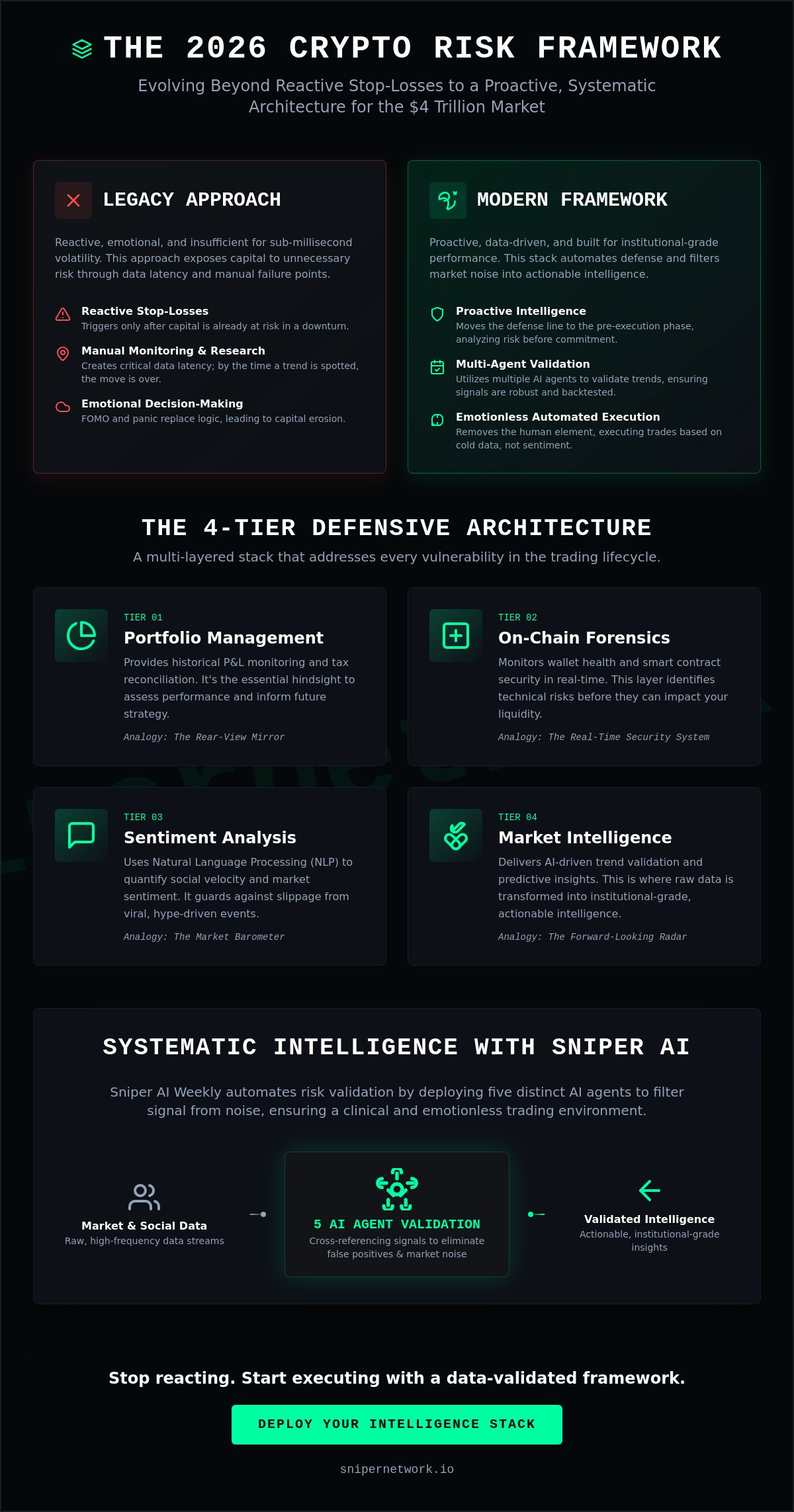
Effective risk mitigation requires a multi-layered approach. You can't manage what you don't measure. Modern crypto risk management tools are segmented into four technical categories. Each layer addresses a specific vulnerability in the trading lifecycle. Portfolio trackers provide real-time P&L monitoring and tax reconciliation. They offer the necessary hindsight to assess historical performance. On-chain forensics monitor wallet health and smart contract security. This technical layer is essential for identifying crypto risks and harms before they impact your liquidity. Sentiment analyzers use Natural Language Processing (NLP) to quantify social velocity. Finally, market intelligence platforms deliver AI-driven trend validation, transforming raw data into institutional-grade reports.
Portfolio Management vs. Market Intelligence
Portfolio tools are historical. They tell you what happened to your capital. Intelligence tools are predictive. They tell you what is happening in the order books and on-chain. Professional traders utilize both for a 360-degree risk view. Integrating systematic crypto trading into your daily stack allows you to bridge the gap between these two layers. It's the difference between seeing a loss and preventing one. Deploying the right crypto risk management tools ensures your architecture is resilient against sudden liquidity shifts. You need a stack that monitors both your internal balance and the external market environment simultaneously.
The Intelligence Layer: AI Signal Filtration
The intelligence layer is where the human element is replaced by technical precision. AI agents scan 1,000+ pairs across multiple exchanges. They don't sleep. They don't suffer from fatigue. These agents use multi-timeframe confirmation to filter out "fake-out" signals that often trap retail liquidity. This level of automation reduces manual research time from 40 hours to 10 minutes weekly. It's about efficiency and accuracy. By automating the filtration process, you ensure that every trade is backed by backtested logic. You can review these automated reports to see how AI agents isolate high-probability setups from market noise. This is the standard for 2026; manual scanning is no longer a viable strategy for capital preservation.
Institutional vs. Retail: Bridging the Intelligence Gap
Information asymmetry is the primary driver of retail capital erosion. Institutions don't trade based on social media hype or gut feelings. They trade based on sub-millisecond data feeds and co-located servers. This infrastructure allows institutional desks to identify and execute on liquidity shifts before the average retail trader even sees the price move on a chart. Advanced crypto risk management tools are now closing this gap. By utilizing automated AI agents, prosumer traders can access high-frequency market analysis once reserved for Tier-1 financial institutions. This shift moves the advantage from those with the most capital to those with the most precise data filtration.
The 24/7 nature of digital assets creates a "monitoring fatigue" that leads to human error. Institutions solve this with automated 24/5 and 24/7 surveillance systems. They monitor order book imbalances and whale movements while the market sleeps. To compete in 2026, your defensive stack must operate autonomously. It's not just about having access to data; it's about the speed at which that data is processed and validated. Deploying crypto risk management tools that mirror institutional latency requirements is the only way to maintain a clinical, emotionless trading environment.
Infrastructure Trust Markers
Institutional-grade isn't a marketing buzzword. It's a latency requirement. Elite risk systems utilize GCP (Google Cloud Platform) for high-availability data processing. For example, co-locating servers in regions like GCP Tokyo minimizes the physical distance to exchange matching engines, reducing execution lag. Processing the constant noise of global news requires advanced LLMs like Claude AI to quantify sentiment in seconds. This technical architecture ensures your system operates at market speed. If your tools aren't built on high-tier infrastructure, you're trading with a built-in disadvantage.
Validating the Validator
A clinical risk strategy requires backtested proof. Every market signal should pass through an 8-layer validation framework before capital commitment. This framework includes volume delta analysis, multi-timeframe confirmation, and order book depth checks. Avoid "black box" tools that hide their methodology behind vague claims of "secret algorithms." Transparency in logic is a mandatory trust marker. If a tool cannot explain its triggers or provide backtested results, it's a liability. Your strategy should rely on a "Your API key, your funds" mantra, ensuring that even as you automate intelligence via Sniper AI Weekly, you never relinquish asset custody to a third party.
Building Your Defensive Architecture: A 4-Tier Framework
A fragmented approach to security is a technical vulnerability. Clinical trading requires a systematic hierarchy. This 4-tier framework organizes crypto risk management tools into a logical stack. It moves from physical asset preservation to the generation of actionable alpha. Each layer must be validated before the next is deployed. Without a structured architecture, you're simply reacting to market volatility rather than managing it.
Tier 1: Cold Storage & Hardware (The Foundation). Security begins at the hardware level. Air-gapped wallets ensure the physical integrity of your assets. This layer protects against exchange insolvency and remote exploits. It's the baseline for any professional portfolio.
Tier 2: Portfolio & Tax Tracking (The Compliance Layer). Regulatory scrutiny is at an all-time high in 2026. With the MiCAR transitional deadline of July 1, 2026, automated tracking is no longer optional. This layer handles real-time P&L monitoring and tax reconciliation across multiple chains, ensuring your data is ready for institutional-grade disclosure.
Tier 3: Sentiment & News Scanners (The Awareness Layer). Market moves often originate in the social layer. NLP scanners process global news feeds and social velocity in real time. This provides the necessary context for price action, identifying shifts in liquidity before they manifest on the chart.
Tier 4: AI Market Intelligence (The Alpha Layer). This is the execution trigger. AI agents validate trends across multiple timeframes. It's the layer that converts raw data into clinical execution, removing the emotional bias that leads to capital erosion.
Tier 4: The Strategic Intelligence Layer
Intelligence is the ultimate risk management tool. It's not enough to track your losses; you must identify market reversals before they hit retail news feeds. AI agents scan order books and volume deltas to spot exhaustion points. This allows for proactive capital reallocation. You can master this by navigating crypto market volatility with AI analysis using data-driven frameworks. High-tier intelligence removes the human element from entry and exit logic, allowing the system to execute based on backtested probabilities.
The Non-Custodial Mandatory
Security protocols must be uncompromising. Your crypto risk management tools should never require asset custody. We operate on the "Your API key, your funds" principle. This ensures you maintain full control over your liquidity at all times. Tools must utilize AES-256 encryption for all API communications. This is the industry standard for financial-grade security. Never trust a platform that holds your keys or manages your withdrawals. Clinical trading requires both technical precision and absolute asset sovereignty. To secure your stack, deploy institutional-grade intelligence that respects your custody and operates with sub-millisecond precision.
Systematic Intelligence: How Sniper AI Weekly Automates Risk
Risk mitigation reaches its technical peak at the intelligence layer. While tiers one through three establish your perimeter, Tier 4 dictates your survival. Sniper AI Weekly provides this strategic edge through a systematic, automated framework. Our system utilizes five AI agents to execute multi-timeframe trend validation across 1,000+ asset pairs. This isn't a manual signal group; it's a high-frequency filtration engine. It converts raw market volatility into institutional-grade intelligence. By deploying these crypto risk management tools, you remove the psychological friction that leads to capital erosion during flash crashes. The system doesn't guess; it validates.
Our architecture is strictly non-custodial. We provide the intelligence while you maintain the assets. The "Your API key, your funds" mantra is our technical seal of security. Research is automated to eliminate the 40-hour manual work week, but asset sovereignty remains entirely with the user. In a $4 trillion market, speed is the only metric that matters. Our engine operates with sub-millisecond precision, ensuring every data point is backtested against historical liquidity shifts. This clinical approach replaces the exuberant hype of speculative trading with the cold reliability of data-driven execution. It's a professional bridge between decentralized markets and institutional standards.
The Sniper AI Weekly Framework
The framework relies on a proprietary 8-layer validation process. Each AI agent specializes in a distinct data vertical, from volume delta analysis to NLP sentiment quantification via Claude AI. This multi-agent coordination filters out the noise that often traps retail liquidity. You receive a comprehensive report every week, designed specifically for professional traders who value technical precision over social media speculation. Our reports provide a clear view of market health without linguistic clutter. You can review the technical specifications in the Sniper AI Weekly guide to understand how our agents maintain a 24/5 watch on global markets.
Getting Started with Zero Friction
Transitioning from speculative gambling to systematic intelligence shouldn't be complex. Our onboarding process is designed for speed. We offer a "No Card Required" trial to provide clinical transparency from day one. You can integrate our crypto risk management tools into your defensive architecture in under 60 seconds. There's no need for manual setup or long-term institutional contracts. The system is co-located on high-tier infrastructure like GCP Tokyo to ensure you're trading at the same speed as the desks we monitor. This setup provides the reliability of a high-end financial tool without the typical barriers to entry. ◈ Start your Sniper AI Weekly trial now and secure your capital with the precision of an elite technician.
Mastering Clinical Execution in the 2026 Market
The 2026 market environment demands a departure from reactive retail habits. Manual monitoring creates fatal data latency in a $4 trillion landscape. Survival now requires a 4-tier defensive architecture that prioritizes sub-millisecond validation. By integrating institutional-grade crypto risk management tools, you replace emotional bias with backtested logic. This systematic transition ensures your strategy remains resilient against flash crashes and liquidity drains while maintaining full non-custodial sovereignty.
Sniper Network provides the technical stack to bridge the intelligence gap. Our framework utilizes 5 AI agents and 8 signal filters to isolate high-probability alpha from decentralized noise. Powered by institutional-grade infrastructure in GCP Tokyo, the system delivers clinical reports with zero speculative hype. Your API key remains yours; your funds never leave your control. It's time to move from speculative gambling to a data-driven framework built for the next era of digital finance. You're ready to secure your edge.
◈ Access Institutional-Grade AI Intelligence with Sniper AI Weekly
Frequently Asked Questions
What are the best crypto risk management tools for professional traders in 2026?
Professional traders in 2026 utilize a 4-tier stack including air-gapped hardware, automated tax trackers, and AI intelligence engines. Crypto risk management tools must prioritize technical precision and sub-millisecond execution to remain effective. Sniper AI Weekly serves as the strategic intelligence layer, providing multi-agent validation that replaces manual scanning. This systematic approach ensures every trade is backed by backtested data rather than speculative hype.
How does AI help in managing cryptocurrency market volatility?
AI manages volatility by processing high-frequency data feeds faster than humanly possible. Our agents scan 1,000+ pairs simultaneously to identify exhaustion points and liquidity shifts. This removes the emotional bias that leads to capital erosion during high-volatility events. By utilizing multi-timeframe confirmation, AI filters out market noise, allowing traders to execute based on clinical logic rather than FOMO.
What is the difference between custodial and non-custodial risk management tools?
Custodial tools require you to relinquish control of your assets to a third party, creating significant counterparty risk. Non-custodial tools provide intelligence while you maintain full asset sovereignty. This model uses encrypted API keys to monitor or execute without ever holding your private keys. It's the only acceptable standard for professional traders who prioritize security and institutional-grade performance.
Can AI risk management tools prevent losses during a flash crash?
Automated execution logic can mitigate losses during a flash crash by triggering defensive protocols in sub-milliseconds. While no tool guarantees zero loss, systems co-located on GCP Tokyo infrastructure minimize the data latency that causes manual traders to fail. These protocols execute based on cold data, ensuring your portfolio responds to market shifts before retail news feeds even report the event.
Do I need to give an AI tool access to my private keys?
No, you should never provide an AI tool with your private keys or seed phrases. Legitimate crypto risk management tools operate via API keys with restricted permissions. These keys allow the software to read data or execute trades without the ability to withdraw funds. This keeps your capital secure within your chosen exchange or hardware wallet while the AI provides the necessary intelligence.
How much time can automated market intelligence save me per week?
Automated market intelligence reduces the manual research workload from approximately 40 hours to 10 minutes per week. This efficiency allows you to focus on strategy rather than raw data collection. Sniper AI Weekly delivers these insights through weekly reports, summarizing 1,000+ asset scans into actionable intelligence. It's a high-performance solution for busy traders who require institutional-grade data without the time sink.
Is sentiment analysis a reliable risk management tool?
Sentiment analysis is a reliable risk metric when quantified through Natural Language Processing (NLP) like Claude AI. It identifies social velocity and news noise that often precede price moves. By monitoring these triggers alongside technical indicators, traders can spot market reversals before they manifest on the chart. This awareness layer is critical for navigating the 24/7 crypto cycle.
What is the "Your API Key, Your Funds" security model?
The "Your API Key, Your Funds" model is a technical seal of security ensuring the user maintains absolute asset sovereignty. The risk tool provides automated research and execution triggers, but never holds custody of the underlying liquidity. All communications are AES-256 encrypted to prevent unauthorized access. This transparent partnership ensures that even as you automate your intelligence, you never compromise your security.