Bitcoin currently trades within the $80,000 to $82,000 range while the CME CF Bitcoin Volatility Index (BVXS) holds steady at 39.38. For most, these figures signal uncertainty. For the elite technician, they represent a high-frequency data stream ready for exploitation. Navigating crypto market volatility with AI analysis is no longer a luxury; it's a requirement for sub-millisecond precision. 5 AI agents. 8 signal filters. This framework converts market noise into actionable intelligence before the retail crowd even sees the candle move.
You've likely felt the emotional exhaustion of 24/7 monitoring. Constant "fakeout" volatility leads to unnecessary losses and fragmented news sources create total information overload. It's time to stop reacting. We'll show you how to master a technical framework that uses AI-driven intelligence to filter noise and trade with institutional precision. You'll learn to automate trade validation, reduce screen time, and apply institutional-grade data to your personal portfolio. This guide breaks down the systematic transition from manual fatigue to automated, data-driven execution.
Key Takeaways
- Isolate tradeable signals from the 90% of irrelevant intraday noise using institutional-grade data filters.
- Master the technical framework for navigating crypto market volatility with AI analysis by deploying multi-agent systems for real-time validation.
- Replace human cognitive delay with sub-millisecond execution to eliminate emotional bias and revenge trading impulses.
- Implement a non-custodial architecture to maintain 100% control over your API keys and assets at all times.
- Detect cross-exchange anomalies across Binance, Bybit, and OKX simultaneously for institutional-grade market precision.
Understanding Crypto Volatility as a Data Problem
Volatility is not a threat to be managed. It is a high-frequency data stream to be processed. Digital assets move at a velocity that traditional equities cannot match. This speed is driven by 24/7 market access, fragmented liquidity, and the absence of institutional circuit breakers. For the retail trader, this environment is chaotic. For a sophisticated system, it is a goldmine of information. Navigating crypto market volatility with AI analysis starts with reclassifying price swings as raw data points rather than market sentiment.
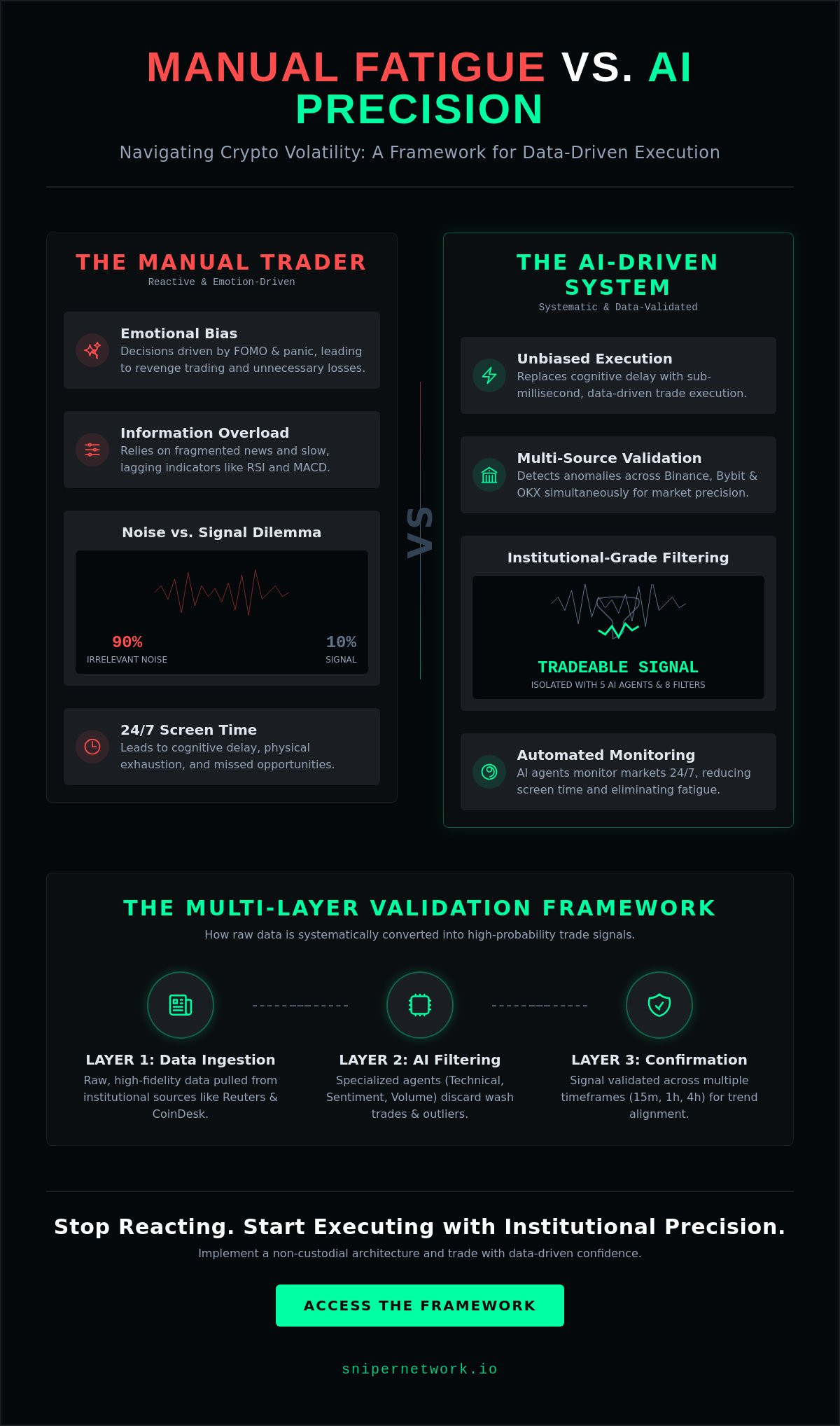
The primary challenge is the "Noise vs. Signal" dilemma. Roughly 90% of intraday price movements are irrelevant. They are statistical outliers or non-organic fluctuations. Manual observation fails here. Human eyes cannot distinguish between a legitimate trend reversal and a liquidity grab in real-time. AI thrives on this complexity. It uses every price tick to refine its predictive model; it turns "dangerous" swings into validated entries. Volatility generates the data points AI needs. Volume spikes, order book imbalances, and sentiment shifts are all captured and filtered in milliseconds.
The Mechanics of Market Noise
Market noise is often manufactured. Low liquidity and wash trading create "fake" volatility. These moves target retail stop-losses to build liquidity for larger players. Structural cascades occur when major positions hit liquidation prices, triggering automated sell-offs. Human psychology amplifies these events. FOMO and panic turn a minor correction into a vertical drop. AI ignores the emotional narrative. It monitors order book depth and liquidation clusters. It identifies the structural failure before the panic reaches the charts.
Why Traditional Technical Analysis Fails
Standard indicators like RSI and MACD are relics of slower markets. They rely on historical averages. They are reactive. In a sub-millisecond environment, a lagging indicator is a liability. "Whale" movements invalidate static support levels in seconds, rendering traditional charting useless. Modern markets require systematic crypto trading frameworks that adapt to real-time flow. The dominance of algorithmic trading systems means you are competing against machines that execute thousands of trades per minute. You cannot win with a manual RSI crossover. You need a system that validates volume, sentiment, and cross-exchange data simultaneously. AI provides that edge. It filters the noise and focuses on the signal.
How AI Analysis Filters Volatility in Real-Time
Institutional precision requires more than a single algorithm. It demands an architecture of specialized agents. Our framework utilizes three distinct AI layers to process market flux. Technical agents monitor price action. Sentiment agents parse linguistic data. Volume agents track order book depth. This multi-agent approach ensures no single data point triggers a false positive. Navigating crypto market volatility with AI analysis means moving beyond simple price alerts into a world of multi-dimensional validation.
Cross-exchange validation provides the second filter. A price move on Binance without corresponding volume on Bybit or OKX is often a localized anomaly or a liquidity trap. Our system monitors these venues simultaneously; it flags divergences that manual traders miss. This level of oversight is critical for detecting wash trading and artificial price inflation. Machine learning models further refine this by identifying reversal signatures before the candle closes. By analyzing the rate of change in order book delta, the system predicts exhaustion points with high probability. It's about seeing the shift before the retail crowd reacts.
The Multi-Layer Validation Framework
Data integrity is the foundation of our execution. We don't rely on delayed public feeds. Our stack is designed for high-fidelity ingestion and processing. This is how technology is reshaping finance with AI, moving from speculative guessing to probabilistic certainty.
- Layer 1: Raw data ingestion. We pull directly from institutional sources like Reuters and CoinDesk to ground the system in verified global events.
- Layer 2: Algorithmic filtering. The system automatically discards outlier trades and wash volume that don't meet liquidity thresholds.
- Layer 3: Multi-timeframe confirmation. No trade is validated unless the trend aligns across the 15-minute, 1-hour, and 4-hour charts.
Sentiment Analysis and Narrative Tracking
Volatility is often a linguistic phenomenon. Natural Language Processing (NLP) allows us to quantify "fear" and "greed" by scanning thousands of social media posts and news headlines per second. The AI identifies Narrative Shifts; these occur when volatility is driven by breaking news rather than technical exhaustion. If a price drop lacks a corresponding sentiment shift, the AI classifies it as a technical correction rather than a fundamental crash.
We use an 8-layer validation process to filter this noise effectively. This ensures that every signal is backed by a confluence of technical, volume, and sentiment data. The result is a clinical trading environment where decisions are based on math, not emotion. To see this architecture in action, you can explore our institutional-grade tools designed for the 2026 market landscape.
Manual vs. AI-Driven Volatility Management
Human biology is the ultimate bottleneck in modern finance. A professional trader requires 200 to 300 milliseconds to perceive a market shift and several seconds to execute a response. In the 2026 landscape, that delay is terminal. AI systems operate with sub-millisecond execution speeds. They process over 10,000 data points per second across multiple venues simultaneously. Navigating crypto market volatility with AI analysis eliminates this cognitive lag. It replaces slow human intuition with high-velocity mathematical certainty.
Emotional bias is the second failure point. Market crashes trigger a "fight or flight" response in the human brain. This leads to revenge trading or premature exits that ignore the underlying data. AI is unemotional. It doesn't feel the sting of a stop-loss or the euphoria of a breakout. It executes based on pre-defined parameters and real-time validation. It maintains a clinical focus while retail participants succumb to panic. Machines don't sleep. Humans do. 24/7 autonomous monitoring ensures that opportunities at 3:00 AM are captured with the same precision as those during the London open.
The Cost of Human Error
Manual entry during high volatility carries a hidden tax: slippage. Executing a trade seconds late can cost 1% to 3% in price impact. Over a year, this erodes the entire portfolio's performance. Fatigue further compounds the issue. Crypto markets never close. Human traders eventually lose focus, leading to missed exits and skewed risk-to-reward ratios. The psychological toll is equally high. 24/7 market anxiety isn't a sustainable strategy. It's a recipe for burnout and catastrophic error.
Institutional Grade vs. Retail Tools
Most retail "trading bots" are simplistic. They follow basic grid or DCA strategies. They often fail in high-volatility regimes because they lack the intelligence to distinguish between a trend and a trap. Validated intelligence is different. It's not just a signal; it's a multi-layered report backed by technical, sentiment, and volume data. Transitioning from speculative gambling to Sniper AI Weekly intelligence represents a shift in methodology. Navigating crypto market volatility with AI analysis moves the trader from a reactive state to a proactive, institutional-grade posture. You aren't just watching charts. You're deploying a silent, automated engine that monitors the market with clinical precision.
5 Steps to Navigating Volatility with AI Analysis
Transitioning from manual observation to institutional precision requires a structured deployment. Navigating crypto market volatility with AI analysis is not about chasing every price spike. It is about building a filter that only permits high-probability entries. This process replaces human intuition with a backtested framework. Follow these five steps to implement a clinical, data-driven strategy for the 2026 market environment.
Step 1: Setting Up the Intelligence Stack
Security is the foundation of any professional operation. Your API key, your funds. Establishing a non-custodial setup ensures that your assets never leave your exchange account. When configuring your intelligence stack, prioritize "Read-Only" or "Trade-Only" permissions. This limits the software to specific actions while preventing unauthorized withdrawals. Select an intelligence provider that utilizes institutional-grade infrastructure, such as co-located servers in GCP Tokyo. This reduces latency and ensures your system maintains a sub-millisecond edge over the retail crowd. A professional stack uses AES-256 encryption for all data transmissions, mirroring the security protocols of high-end financial institutions.
Step 2: Implementing the Validation Filter
Raw data is useless without a filter. You must define your volatility parameters by distinguishing between "tradeable" and "dangerous" swings. Volatility validation is the cross-referencing of volume, sentiment, and price action to confirm a high-probability entry. Set "Minimum Validation" thresholds for every trade. For example, a price move must be confirmed by at least three independent AI agents before an alert is triggered. Use AI to identify "Volatility Squeezes" where price remains tight while volume builds. These periods of compression often precede massive breakouts. By monitoring order book imbalances during these squeezes, the system identifies the likely direction of the move before it occurs.
The final steps involve total automation of the research and execution phases:
- Integrate Multi-Source Intelligence: Combine technical AI agents with sentiment analysis from sources like Reuters and social data. This confluence ensures the "why" of the move matches the "how."
- Automate the Research Process: Let AI agents handle the 24/7 data-crunching. Human fatigue leads to errors; automated systems maintain peak performance regardless of the hour.
- Execute Based on Validation: Trust the backtested framework. Intuition is an emotional liability in a high-volatility market. If the data doesn't meet the validation threshold, the trade does not execute.
Success in 2026 requires a silent, automated engine working in the background. Secure your edge by deploying our institutional-grade trading engine today. 5 AI agents. 8 signal filters. Zero emotional interference.
The Sniper Approach: Clinical Intelligence for 2026
Navigating crypto market volatility with AI analysis requires a fundamental shift in methodology. You must move from being a market victim to becoming a systematic technician. The Sniper Network provides the technical infrastructure for this transition. We deploy a silent, automated engine that monitors the market with clinical precision. Our framework is built on 5 specialized AI agents and 8 signal filters. This is not a manual signal group. It is an institutional-grade intelligence stack designed for sub-millisecond execution. You maintain 100% control of your portfolio at all times. Your API key, your funds. We never hold your assets; we simply provide the data required to protect and grow them.
Manual research groups are obsolete in the 2026 landscape. They cannot compete with the speed of data ingestion provided by our multi-agent system. While a human group discusses a single chart, our agents validate technical patterns, sentiment shifts, and volume anomalies across multiple exchanges simultaneously. This ensures that every piece of intelligence is backed by a confluence of data points. By the time a manual group identifies a trend, our system has already validated the entry and calculated the risk-to-reward ratio. This is the difference between speculative guessing and probabilistic certainty.
Automated Research, Manual Control
Sniper AI Weekly automates the high-intensity grunt work of crypto research. It scans the 24/7 market to deliver a clinical intelligence report directly to your dashboard. We align our monitoring with 24/5 institutional hours to provide a structured framework for an otherwise chaotic market. This approach filters out the low-probability noise that occurs during illiquid weekend trading. You receive the weekly intelligence report, review the validated data, and maintain final manual control over your execution. It is the perfect synergy of machine speed and human oversight. Our infrastructure, including co-located servers in GCP Tokyo, ensures that the data you receive is the most accurate available in the industry.
Joining the Elite Technician Class
Transparency is our primary security protocol. We offer a "No Card Required" trial to ensure you can verify our data-driven results before committing. This onboarding process is designed to be frictionless and transparent, mirroring the clinical nature of our software. By joining the elite technician class, you are moving beyond the emotional exhaustion of 24/7 monitoring. You are building a long-term, data-driven strategy that treats volatility as an asset rather than a risk. Stop reacting to the market and start exploiting it with institutional precision. Start your AI-driven market intelligence trial at snipernetwork.io today and deploy the ultimate tool for 2026.
Secure Your Competitive Edge in the 2026 Market
The transition from manual observation to systematic execution is no longer optional. You've seen how volatility is a data stream rather than a risk. By deploying a multi-agent framework, you eliminate the cognitive lag and emotional bias that drain retail portfolios. Navigating crypto market volatility with AI analysis allows you to focus on high-probability signals validated by institutional-grade infrastructure. You stop guessing and start executing based on mathematical certainty.
Our stack operates with 5 AI agents and 8 signal filters to ensure every entry is backed by technical, volume, and sentiment confluence. We maintain a strict non-custodial mandate. Your API key, your funds. With our sub-millisecond execution infrastructure, you're equipped to handle the fastest market shifts with clinical confidence. This is the era of the elite technician. You don't need to monitor charts 24/7 when you have a silent, automated engine working in the background.
Access Institutional-Grade AI Market Intelligence 24/5 and transform your trading from a reactive struggle into a precise, automated operation. The system is live. The data is validated. It's time to execute with precision.
Frequently Asked Questions
How does AI analysis help during a crypto market crash?
AI eliminates emotional bias by executing based on structural data rather than panic. It monitors liquidation clusters and order book imbalances in real-time to identify exhaustion points. This allows for clinical exits or entries while retail participants succumb to fight or flight responses. Automated systems maintain sub-millisecond execution speeds that human traders can't match during high-velocity events.
Is AI crypto analysis more accurate than manual technical analysis?
AI analysis is more accurate because it integrates multi-dimensional data points that manual charting ignores. While human traders rely on lagging indicators like RSI, AI processes technical, sentiment, and volume data simultaneously. This multi-agent approach filters out roughly 90% of irrelevant intraday noise. It replaces subjective interpretation with backtested mathematical certainty and institutional-grade precision.
Can AI predict crypto market volatility before it happens?
AI identifies Volatility Squeezes and structural imbalances that often precede major breakouts. By analyzing the rate-of-change in order book delta and cross-exchange anomalies, the system flags compression before the expansion occurs. Navigating crypto market volatility with AI analysis involves identifying these probabilistic setups before the retail crowd reacts. It doesn't guess; it calculates the mathematical probability of expansion.
What is the difference between a crypto trading bot and AI market intelligence?
Standard trading bots follow simplistic grid or DCA logic without market context. AI market intelligence uses specialized agents to validate the "why" behind a move. It integrates institutional-grade sources like Reuters and sentiment analysis to distinguish between a legitimate trend and a liquidity trap. Intelligence frameworks like Sniper AI Weekly focus on validated data rather than just repetitive automated execution.
Is it safe to use AI tools with my crypto exchange API keys?
Safety depends on a non-custodial architecture and restricted API permissions. You should only grant Read-Only or Trade-Only access to ensure your funds never leave your exchange account. Professional tools use AES-256 encryption and institutional infrastructure like GCP Tokyo for security. Your API key, your funds. This mantra ensures total asset security while maintaining automated precision.
Do I need technical coding skills to use AI for crypto analysis?
No, institutional-grade platforms provide a streamlined interface for the modern technician. The system handles the complex backend data ingestion and multi-agent validation automatically. You receive actionable intelligence reports without writing a single line of code. This allows you to focus on strategy and portfolio management rather than infrastructure maintenance or software development.
How much does institutional-grade AI crypto intelligence typically cost?
Cost varies depending on the depth of the data stack and the number of signal filters provided. Professional services offer transparent onboarding and often include a trial period to verify results. The value of these systems lies in reducing slippage and eliminating the human error tax. Navigating crypto market volatility with AI analysis provides a return on intelligence that manual research cannot replicate.
What is the "noise" in crypto markets and how does AI filter it?
Market noise consists of low-liquidity fluctuations, wash trading, and artificial price inflation. AI filters this by using cross-exchange validation to flag anomalies across Binance, Bybit, and OKX simultaneously. If a price move lacks multi-venue confirmation or organic volume, the agents discard it as noise. This ensures you only trade signals that have structural significance and institutional backing.