Over 30% of institutional portfolios have integrated AI-assisted strategies as of June 2026. This data confirms a fundamental shift in capital management. You've seen the pattern before: a market crash occurs, and every asset in your "diversified" portfolio drops in perfect correlation. It's a failure of manual strategy. Information overload and emotional noise during volatility lead to delayed execution. You need a system that operates at the speed of the market, not the speed of human thought.
This guide enables you to master institutional-grade diversification using AI for crypto trend identification to navigate 2026 market correlations. We'll outline a systematic framework designed to optimize your Sharpe ratio through automated intelligence. You'll learn how to deploy high-tier infrastructure to filter market noise and isolate actionable signals. We're moving past speculative gambling toward a clinical, data-driven approach to risk management. This is the blueprint for building a correlation-resistant portfolio using the same tools driving today's elite trading floors.
Key Takeaways
- Transition from static rebalancing to a dynamic, correlation-resistant framework designed for the 2026 market environment.
- Structure your portfolio using a two-tier institutional model that balances store-of-value anchors with productive smart contract assets.
- Leverage professional-grade AI for crypto trend identification to execute multi-timeframe confirmations and eliminate emotional bias during high volatility.
- Apply a rigorous 5-step systematic protocol to audit asset overlap and maintain an optimized Sharpe ratio through automated intelligence.
- Streamline your diversification research by integrating Sniper AI Weekly for clinical, autonomous market monitoring and precise data delivery.
Beyond Static Rebalancing: Why Diversification Requires Intelligence in 2026
The traditional 60/40 portfolio model is obsolete in the digital asset sector. It relies on a predictable inverse relationship between equities and bonds that does not exist here. In crypto markets, asset correlations often spike above 0.9 during liquidity events. This means your "diversified" basket of tokens will likely collapse in unison. True diversification in 2026 is not a matter of asset count. It's a matter of mathematical independence. To achieve this, you must apply Modern Portfolio Theory through a high-frequency, algorithmic lens. Manual research is too slow to detect these shifts. It cannot process 24/5 global data streams effectively. Recency bias often clouds human judgment during a crash. Using AI for crypto trend identification removes this interference. It replaces emotional "gut feelings" with cold, backtested logic.
The Correlation Trap in Modern Crypto Markets
Bitcoin remains the primary dictator of market liquidity. When volatility peaks, capital flows back to the core, causing altcoins to bleed out regardless of their individual utility. This creates a trap for investors who believe holding twenty different tokens equals safety. If those tokens all share a high correlation coefficient with BTC, you aren't diversified; you're leveraged. The 2026 bank stress tests projected aggregate losses of nearly $708 billion across 32 large institutions, highlighting the reality of systemic risk. Within crypto, this risk is amplified. Holding multiple assets within the same sector, such as five different Layer 1 platforms, offers no protection during a sector-wide correction. You need a system that identifies when correlations are breaking down in real-time.
From Speculation to Systematic Intelligence
Retail traders often rely on social media sentiment or lagging news cycles. These are noise, not signals. Professional-grade allocation requires systematic crypto trading to isolate actionable data from market hysteria. This transition marks the move from narrative-driven selection to clinical asset validation. AI for crypto trend identification monitors multi-timeframe confirmations across thousands of trading pairs simultaneously. It identifies emerging trends before they reach the mainstream consciousness. This allows for a proactive rather than reactive strategy. By utilizing objective data, you can build a portfolio designed for longevity rather than short-term gambling. The system validates. It monitors. It triggers. It does not panic. This is the baseline for institutional-grade risk management in 2026.
The 2026 Institutional Allocation Model: Integrating AI for Crypto Trend Identification
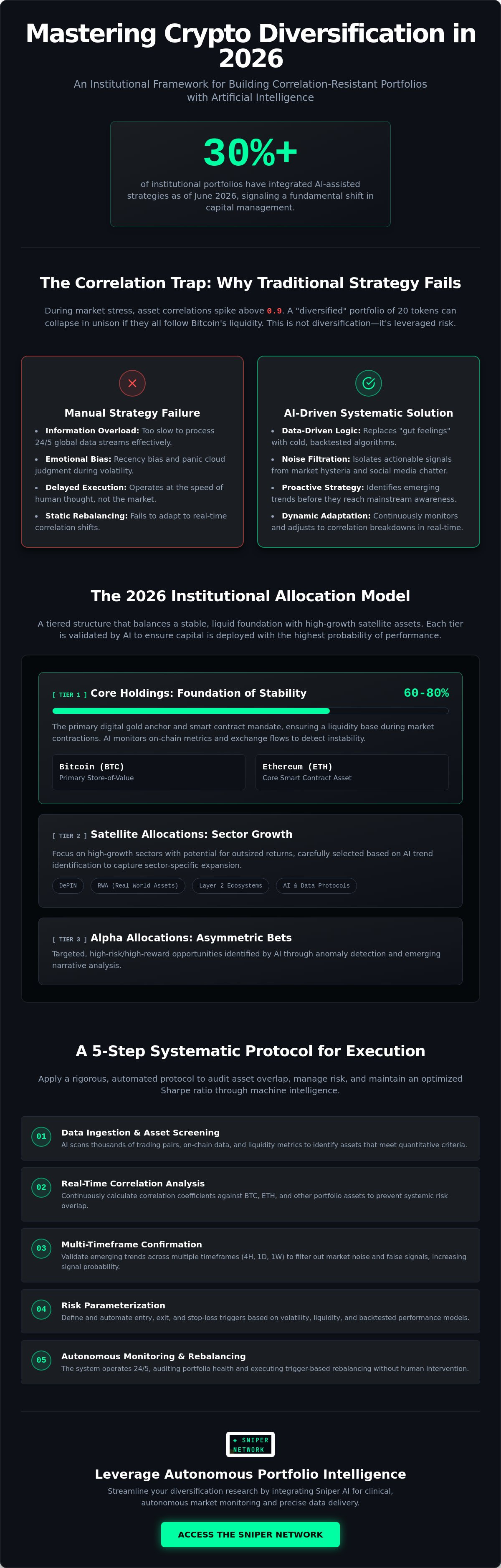
Institutional models in 2026 prioritize liquidity and correlation-resistance. It's no longer sufficient to maintain a static percentage of top-tier assets. Portfolios have evolved. More than 30% of institutional portfolios now integrate AI-assisted strategies. This framework utilizes a three-tier structure to balance stability with growth. Tier 1 provides the foundation. Tier 2 captures sector-specific expansion. Tier 3 targets high-alpha opportunities. Each tier requires AI for crypto trend identification to validate entries and exits based on objective data rather than market hype. This systematic approach ensures your capital is deployed where it has the highest probability of performance.
Core Holdings: The Foundation of Stability
Bitcoin serves as the primary digital gold anchor. In most institutional models, it occupies 60-80% of the total allocation. This high concentration ensures a liquidity base during market contractions. Ethereum remains the secondary core asset. It captures the smart contract mandate. AI monitors these blue-chip assets by analyzing on-chain metrics and exchange inflows. It identifies when stability is compromised. This automated monitoring allows for rapid rebalancing before retail markets react. Maintaining this core is essential for long-term portfolio longevity. It acts as the "safe haven" within the digital asset ecosystem.
Satellite and Alpha Allocations
Tier 2 holdings focus on high-growth sectors. These include DePIN, RWA, and Layer 2 ecosystems. These assets offer higher potential returns but carry increased correlation risk. You must weight these positions using ai for crypto market analysis tools to ensure they don't over-leverage the portfolio. Tier 3 is the Alpha layer. It consists of emerging narratives and AI-validated agentic tokens. A strict 5% rule applies here. This speculative cap protects the core from total loss during sector-specific crashes. It allows for upside exposure without compromising the entire capital base.
Market conditions in 2026 move at sub-millisecond speeds. Manual oversight is no longer viable for multi-sector management. AI for crypto trend identification processes these complex data points instantly. It filters out the noise from social media. It focuses on price action and volume profiles. For those managing complex portfolios, a clinical data engine is the only way to maintain institutional-grade precision. This structured approach ensures your portfolio remains resilient across different market cycles. It replaces guesswork with validated execution. You gain the speed of an automated system with the security of a proven framework.
Mitigating Systemic Risk: Leveraging AI for Crypto Trend Identification
Systemic risk in 2026 is not a theoretical concern. It's a mathematical certainty for the unprepared. In the 2026 stress test of 32 large banks, aggregate projected losses reached nearly $708 billion. This fragility extends to digital assets. You cannot rely on manual oversight to protect your capital. 5 AI agents. 8 signal filters. This is the specific architecture required for risk reduction. While traditional models focus on historical volatility, AI for crypto trend identification monitors real-time liquidity depth and correlation shifts. It detects the onset of a liquidity trap before it impacts your core holdings. This level of precision is only possible through the deployment of crypto risk management tools designed for sub-millisecond execution.
Filtering the Signal from the Noise
Manual news consumption is a strategic liability. By the time a headline appears on your feed, the institutional move is already complete. Automated sentiment analysis processes data from global sources, including Reuters and X threads via Grok, to identify shifts in market psychology instantly. AI for crypto trend identification goes further by validating volume quality. It filters out artificial volume and wash trading that often characterize fake breakouts. This system utilizes multi-timeframe confirmation to ensure a trend is statistically significant before triggering an alert. It removes the FOMO effect. It replaces emotional urgency with clinical scoring. You don't trade on hope; you trade on validated data points.
The Non-Custodial Advantage
Security is the ultimate risk metric. The 2026 regulatory landscape, including the GENIUS Act for stablecoins and the SEC's March 17 interpretation of federal securities laws, demands higher transparency. Sniper Network operates on a strict non-custodial basis. Your API key, your funds. We never hold user capital. This eliminates counterparty risk, which is a critical requirement for high-net-worth individuals and institutional-grade traders. Our infrastructure is co-located in GCP Tokyo to ensure sub-millisecond validation speeds without compromising asset control. ◈
Effective risk management requires a system in constant, autonomous motion. It monitors 24/5, aligning crypto markets with traditional institutional hours. It validates every signal through a rigorous filter stack. This approach ensures that your diversification strategy remains intact even during extreme market stress. You gain a sophisticated, silent engine working in the background. It's reliable, fast, and uncompromisingly secure. This is how you navigate 2026 market correlations with calm confidence.
Executing Your Diversification Strategy: A 5-Step Systematic Protocol
Execution is the point of failure for most traders. You've identified your tiers. You've assessed the risks. Now you must deploy. This protocol replaces discretionary bias with a repeatable, high-frequency workflow. It ensures your portfolio remains aligned with the institutional standards established in 2026. This isn't a suggestion. It's a technical requirement for capital preservation. Each step validates the previous one. We move from the broad audit to specific, automated execution. ◈
Step 1 & 2: Auditing and Defining Risk
Start with a clinical audit. Evaluate your current asset correlation coefficients in real-time. If your Layer 2 holdings move in perfect lockstep with your Layer 1 core, you aren't diversified. You're over-exposed. Use professional-grade tools to visualize these overlaps across all sub-sectors. Establish hard stops for every sector. For example, cap DePIN or RWA exposure at 10% to prevent systemic contagion from a single-sector crash. Align these boundaries with the 2026 macro-liquidity environment, where the algorithmic trading market is projected to exceed $54 billion. This definition phase creates the necessary guardrails for your automated system.
Step 3 to 5: Validation and Clinical Execution
Validation is the primary filter. Use AI for crypto trend identification to vet every new entry against an 8-layer validation framework. This framework analyzes sub-millisecond price action, exchange depth, and social sentiment threads via Grok. This process integrates data-driven crypto trading to ensure no asset enters your portfolio without a verified statistical edge. Once validated, you must automate the monitoring process. Set weekly intelligence triggers. These triggers alert you when an asset's risk-reward profile shifts or when sector correlation spikes above 0.85.
Finally, execute a clinical rebalance. Do this based on the "Weekly Pulse" data, not your emotional response to a red candle. This method focuses on systematic rebalancing without the friction of over-trading. You review the data. You validate the signal. You rebalance the position. This loop eliminates the cognitive bias traps that lead to manual trading errors. It ensures your Sharpe ratio remains optimized regardless of market volatility. For traders seeking institutional-grade precision, access our systematic trading engine to automate your diversification intelligence today.
Leveraging Sniper AI Weekly for Autonomous Portfolio Intelligence
Executing a 5-step systematic protocol is only effective if the underlying data is accurate. Manual research is a strategic liability in 2026. It is slow, biased, and prone to critical errors during high-correlation events. Sniper AI Weekly automates the intelligence phase of your diversification strategy. It delivers clinical precision through a weekly automated framework. This system monitors the market 24/5, aligning your crypto operations with traditional institutional trading hours. It ensures you never miss a liquidity shift or a breakdown in asset correlation. This is a sophisticated, silent engine designed to produce institutional-grade data without the lag of human analysis. You gain the speed of an automated system with the security of a proven framework.
Infrastructure That Drives Performance
The tech stack defines the result. We utilize Claude AI for deep sentiment analysis and GCP Tokyo for co-located execution speed. Sub-millisecond execution engines are critical for AI for crypto trend identification in 2026. This infrastructure processes thousands of data points from Reuters and on-chain monitors simultaneously. It validates every signal through a multi-timeframe confirmation process. This is the same level of sophistication used by private bot operators and high-end financial tools. It removes linguistic clutter. It provides a feature-first approach to market intelligence. By bridging the gap between retail traders and institutional floors, we provide the technical precision required for portfolio longevity.
Getting Started with Sniper Network
Onboarding is frictionless. The process takes 30 seconds. It is entirely non-custodial. Your API key, your funds. We provide the intelligence; you maintain the control. This reflects our "Transparent Partner" trait and our commitment to asset security. Your first Sniper AI Weekly report will contain validated trend scores, correlation heatmaps, and tier-specific entry signals. It's the clinical data you need to execute the "Weekly Pulse" rebalancing method described in our protocol. We don't hold your assets. We provide the tools to protect them through AI for crypto trend identification and automated risk filters.
- Clinical precision. Institutional-grade data. Weekly delivery.
- 30-second onboarding for non-custodial intelligence.
- 24/5 monitoring to align with global market hours.
- No card required trial for immediate data access.
◈ Start your free trial of Sniper AI Weekly
This is the frictionless path to data-backed trading. You receive the intelligence. You validate the signal. You execute the trade. There is no lingering on philosophy or market hype. The flow is entirely dedicated to how the system works and what it produces. It creates a sense of momentum, leading you from curiosity to clinical execution in seconds. This reflects the automated, high-frequency nature of the Sniper Network product itself. Reliable. Fast. Uncompromisingly secure.
Mastering Correlation-Resistance with Systematic Execution
The 2026 market environment doesn't reward manual research or emotional rebalancing. You've seen how institutional tiers and the 5-step protocol provide a clinical roadmap for capital preservation. Relying on AI for crypto trend identification is no longer optional for those seeking an optimized Sharpe ratio. It's the technical baseline for navigating high-correlation events and systemic volatility. Manual oversight is a strategic liability that our framework deliberately eliminates. We replace guesswork with validated, data-driven outcomes.
Sniper Network provides the necessary infrastructure to execute this strategy with sub-millisecond precision. Our system utilizes 5 AI agents and 8 signal filters to validate every market trend. By leveraging GCP Tokyo co-located infrastructure, you gain the speed and reliability of a professional trading floor. We maintain a strict focus on your security. Your API keys, your funds. We never hold your capital. It's a transparent, data-driven partnership designed for the elite technician who values technical precision over market hype.
◈ Access Institutional AI Intelligence: Start Your Sniper AI Weekly Trial
Transition your portfolio from speculative gambling to a systematic engine today. The data is ready. The execution is automated. You have the tools to navigate 2026 market correlations with calm, data-backed confidence.
Frequently Asked Questions
What is the best crypto portfolio diversification ratio for 2026?
Institutional models in 2026 favor a 70/25/5 tiered ratio. This allocates 70% to store-of-value anchors like Bitcoin, 25% to productive Layer 2 or DePIN ecosystems, and a strict 5% cap on high-alpha speculative assets. This structure ensures a liquidity base while capturing sector-specific growth. It prevents over-exposure to volatile emerging narratives that often collapse during market stress. ◈
How often should I rebalance my crypto portfolio in 2026?
You should execute a clinical rebalance weekly or when specific data triggers are met. The "Weekly Pulse" method avoids the friction of over-trading while maintaining your target risk-tier boundaries. Automated triggers should monitor for correlation spikes above 0.85 between your core and satellite holdings. This systematic approach replaces emotional reactions with data-driven execution. It maintains your Sharpe ratio without constant manual intervention.
Can AI really help with crypto portfolio diversification?
AI is the primary tool for maintaining mathematical independence between assets. Utilizing AI for crypto trend identification allows you to monitor multi-timeframe confirmations across thousands of pairs simultaneously. It identifies when previously uncorrelated assets begin to move in lockstep. This automated oversight is the only way to process 24/5 global data streams with institutional-grade precision and speed. 5 AI agents. 8 signal filters.
What are the risks of over-diversifying in cryptocurrency?
Over-diversification often leads to the "Correlation Trap" where you hold multiple assets that move in perfect unison. Holding twenty tokens within the same sector, such as five different Layer 1 platforms, does not reduce risk. It increases management complexity and potential liquidity traps. True diversification requires assets with low correlation coefficients, not just a high asset count. It requires clinical asset validation.
How do I measure correlation between different crypto assets?
Measure correlation using the Pearson correlation coefficient calculated over rolling 30, 60, and 90-day timeframes. High-tier tools visualize these relationships through heatmaps. You must identify assets with coefficients below 0.5 to achieve genuine risk reduction. AI-driven metrics automate this calculation, alerting you when sector-wide correlations begin to spike. This data allows for proactive rebalancing before a liquidity event impacts the broader portfolio.
Is Sniper AI Weekly a custodial service?
Sniper AI Weekly is strictly non-custodial. We never hold user funds or have direct access to your assets. Your API key, your funds. Our system provides the clinical intelligence and signal filters required for decision support. You maintain total control over execution and custody at all times. This eliminates counterparty risk, which is a critical requirement for high-net-worth individuals and institutional-grade traders.
What is the 8-layer validation framework in crypto trading?
The 8-layer validation framework is a technical protocol used to vet market entries. It analyzes price action, exchange depth, volume quality, and sentiment threads via Grok. It also monitors multi-timeframe confirmations and social signals from sources like Reuters. This filter stack ensures that only statistically significant trends trigger an alert. It removes the FOMO effect and replaces emotional urgency with clinical scoring.
How does market sentiment affect diversification strategy?
Market sentiment acts as a primary driver of short-term asset correlation. During periods of extreme fear or greed, technical fundamentals often break down as assets move in unison. Automated sentiment analysis identifies these shifts instantly. It allows the system to adjust diversification weightings to protect the core holdings from narrative-driven volatility. AI for crypto trend identification filters this noise to isolate actionable data from market hysteria.