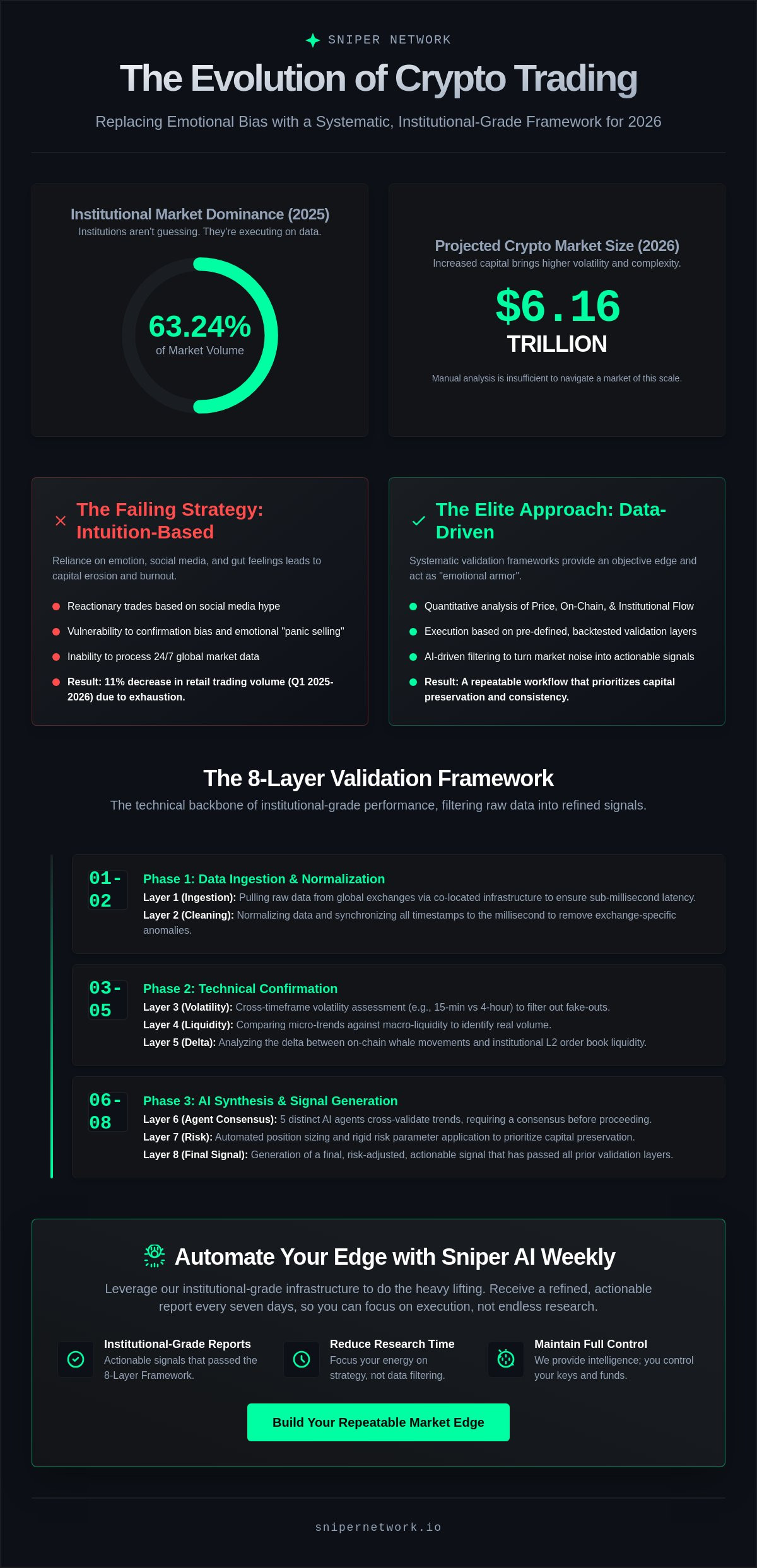
Institutional participants now command 63.24% of the cryptocurrency market. These entities do not trade based on social media sentiment or intuition. They operate via cold, technical precision. For the individual trader, the shift toward data-driven crypto trading is no longer optional; it is a requirement for survival. You likely feel the weight of information overload from conflicting sources. High volatility leads to emotional exhaustion. You want a professional edge without the custodial risks associated with many automated tools.
We agree that manual research is a failing strategy in a market projected to hit $6.16 trillion this year. This guide provides the blueprint to replace emotional bias with a systematic, institutional-grade validation framework. You will learn to leverage AI-driven market intelligence to filter noise into actionable signals. We will preview the specific steps to reduce your research time while maintaining absolute control over your API keys and funds. The era of speculative gambling is over. The era of the elite technician has arrived. This is how you build a repeatable market edge for 2026.
Key Takeaways
- Replace qualitative intuition with quantitative precision to navigate the high-frequency volatility of the 2026 market.
- Implement an 8-layer validation framework to filter raw exchange data through multi-timeframe confirmation and volatility assessments.
- Master data-driven crypto trading by analyzing the delta between on-chain whale movements and institutional L2 order book liquidity.
- Construct a repeatable workflow that prioritizes capital preservation through rigid risk parameters and automated position sizing.
- Leverage Sniper AI Weekly to automate the multi-layer filtering process and receive institutional-grade reports every seven days.
Beyond Intuition: The Shift to Data-Driven Crypto Trading
Success in the 2026 digital asset market requires a hard transition from qualitative "gut feelings" to the clinical application of quantitative metrics. The era of the "Crypto Cowboy," characterized by reactionary trades based on social media hype, has reached its conclusion. Manual signal groups and discretionary trading models simply cannot keep pace with high-frequency execution environments. Professional participants now rely on data-driven crypto trading to maintain an objective edge. This systematic approach utilizes three core pillars: Price Action, On-Chain Activity, and Institutional Flow. By stripping away the psychological weight of market cycles, these frameworks act as emotional armor. They provide a structural barrier between your capital and your impulses.
The Failure of Manual Market Analysis
Human cognitive limits cannot process 24/7 global liquidity across hundreds of fragmented exchanges. Manual analysis is inherently flawed due to confirmation bias. Traders often seek data that supports their existing positions while ignoring contradictory signals. This psychological trap leads to catastrophic financial outcomes. Data from Q1 2026 shows that retail trading volume decreased by 11% compared to Q1 2025. Much of this decline stems from retail exhaustion and the high cost of emotional "panic selling." Systematic models eliminate this vulnerability. They don't sleep. They don't feel fear. They execute based on pre-defined validation layers rather than impulse. 5 AI agents. 8 signal filters. This is the standard required to filter the noise of a $6.16 trillion market.
Why 2026 Demands Institutional-Grade Data
The current landscape is dominated by sophisticated AI-driven market manipulation. Retail noise is no longer just a distraction; it's a weaponized tool used by large-scale actors to create false liquidity. Spotting these patterns requires more than a basic chart. It requires high-fidelity intelligence. Transitioning to professional-grade algorithmic trading strategies is now a competitive necessity for anyone seeking to preserve capital. Institutional participants accounted for 63.24% of the market in 2025. You aren't just trading against other people; you're trading against sub-millisecond execution engines and co-located servers. data-driven crypto trading provides the only viable path to compete on this level. It involves moving from a reactive state to a predictive, validated stance. This shift ensures that every trade is backed by backtested logic rather than a speculative gamble.
The 8-Layer Validation Framework: Filtering Market Noise
The 8-layer validation framework is the technical backbone of institutional-grade performance. Raw market data is volatile and often deceptive. Layers 1 and 2 focus on ingestion and cleaning. We pull data from global exchanges and normalize it. This removes exchange-specific anomalies. Layer 2 ensures all timestamps are synchronized to the millisecond. We utilize co-located infrastructure to reduce data latency to sub-millisecond levels. This is the foundation of data-driven crypto trading. Speed isn't just an advantage; it's a requirement for accurate ingestion.
Layers 3 through 5 move into technical confirmation. This involves cross-timeframe volatility assessment. The system compares micro-trends against macro-liquidity. It identifies where real volume exists versus where bots are simply painting the tape. Layers 6, 7, and 8 involve AI synthesis. This is where the machine logic provides final risk-adjusted signal generation. Each signal must pass through these filters before being considered actionable. The result is a refined data set that prioritizes capital preservation over speculative noise.
Multi-Agent AI Synthesis
A single algorithm is a single point of failure. We deploy 5 distinct AI agents to cross-validate every market trend. These agents operate as a committee of experts. Our 8-layer validation process ensures that AI agents filter noise by requiring a clinical consensus of technical, on-chain, and institutional flow metrics. Multi-timeframe confirmation is the ultimate defense against fake-outs. If the 15-minute data contradicts the 4-hour trend, the signal is discarded. This approach preserves capital during periods of high-frequency manipulation.
Backtesting vs. Forward Testing
Overfitting historical data is a common retail error. A strategy that looks perfect on past charts often fails in live markets. We solve this by implementing sub-millisecond execution simulations. These simulations account for slippage and order book depth. It's not enough to know where the price was; you must know if you could have actually filled the order. Utilizing advanced crypto risk management tools allows for the creation of rigid safety boundaries. Regulatory bodies like FINRA highlight the need for effective supervision and control practices to mitigate systemic risks. ◈ Our system monitors these parameters 24/5. For those who prefer a ready-made implementation of this framework, Sniper AI Weekly delivers these validated signals directly to your dashboard.
Evaluating Data Sources: On-Chain vs. Institutional Feeds
Raw data is the fuel for data-driven crypto trading, but the quality of that fuel determines the reliability of the output. We categorize data into two primary streams: on-chain metrics and institutional feeds. On-chain data allows us to track "Whale" movements and exchange net-flows in real time. By monitoring the movement of assets from cold storage to exchanges, we can anticipate supply-side pressure before it hits the order book. This transparency is a unique characteristic of digital assets that traditional markets lack.
Institutional data provides a different tactical lens. We analyze Level 1 and Level 2 order book depth to determine liquidity clusters across major exchanges. This allows for a granular analysis of where large buy or sell walls are actually positioned. Many retail platforms provide only surface-level price data. We dig deeper into the "Clean" data layer. This involves identifying and removing wash-trading artifacts, ensuring that our models don't react to artificial volume generated by exchanges to inflate their rankings. Data integrity is the first step in clinical execution.
Sentiment data is often a trap for the uninitiated. Most competitors treat social media sentiment as a primary signal; however, it is almost always a lagging indicator. By the time a trend is "trending," the move is often exhausted. We use sentiment as a contrarian filter. Extreme exuberance triggers a caution flag. Extreme fear, when validated by on-chain accumulation, suggests a high-probability entry point. Data-driven crypto trading requires the discipline to ignore the noise and follow the math.
The Hierarchy of Market Signals
Not all data types are created equal. In our framework, price and volume always lead the narrative. We rank signals based on their proximity to actual capital commitment. Integrating institutional grade crypto data into your strategy allows you to spot "Liquidity Gaps." These gaps, visible on order book heatmaps, represent zones where price can move rapidly due to a lack of resting orders. Identifying these zones is critical for setting realistic take-profit targets.
Identifying Market Reversals with AI
AI agents are specifically programmed to detect "Exhaustion" patterns before they appear on standard retail charts. They monitor the delta between price movement and aggressive buying or selling. Funding rates and open interest play a vital role here. If price reaches a new high while funding rates are spiking and open interest is dropping, a liquidation event is likely. Using data to time entries during "Extreme Fear" regimes ensures you are providing liquidity when the market is most desperate for it. This is how you transition from a reactive trader to a systematic technician.
How to Build Your Systematic Trading Workflow
Constructing a professional-grade execution environment requires a modular approach. Step 1: Define your risk parameters. You must establish a maximum drawdown limit and a rigid position sizing model before a single dollar is deployed. This is non-negotiable. Step 2 requires selecting your "Intelligence Layer." This involves choosing between clinical reports, raw data feeds, or automated signals based on your technical capacity. Step 3 focuses on the weekly review cycle. This cadence allows you to monitor model performance against real-world benchmarks without reacting to daily volatility. Finally, Step 4 automates the research phase. Automation eliminates the "Analysis Paralysis" that often leads to missed opportunities. Data-driven crypto trading is about efficiency. It's about removing the human element from the validation process to ensure objective results.
The Weekly Intelligence Routine
A weekly cadence beats high-frequency noise for most participants. Daily charts are often saturated with bot-driven manipulation designed to trigger retail stops. Setting up a systematic crypto trading dashboard provides a high-level view of market health. We utilize a "Checklist" approach to trade validation. Every potential entry must meet specific criteria across on-chain and institutional data layers. No checklist. No trade. This clinical discipline ensures consistency across diverse market regimes. It mirrors the sub-millisecond execution logic of institutional engines. By reviewing performance every seven days, you maintain a strategic perspective while the system handles the tactical heavy lifting.
Risk Management Protocols
Security is the foundation of any systematic framework. We mandate the use of AES-256 encrypted API connections for all automated interactions. This ensures data integrity and prevents unauthorized access. Our "Non-Custodial" mandate is absolute: never give a tool withdrawal permissions. Your API key, your funds. ◈ This remains our recurring verbal seal of security. Hard stops are calculated based on ATR data rather than arbitrary percentages. This aligns your risk with current market volatility. If the ATR indicates high volatility, the system automatically widens stops and reduces position size. This is math, not guesswork. If you are ready to deploy these protocols without the manual overhead, get started with Sniper AI Weekly today to access our institutional-grade validation engine.
Automating the Edge: The Sniper AI Weekly Solution
The transition from a manual researcher to a strategic portfolio manager requires a reliable automation engine. Sniper AI Weekly executes the 8-Layer Validation Framework discussed in previous sections with clinical precision. It removes the burden of raw data ingestion and cross-exchange cleaning. Every seven days, you receive institutional-grade reports that synthesize the output of five distinct AI agents. This cadence provides a clear tactical advantage. It filters out the high-frequency noise that often leads to retail exhaustion. You maintain 100% asset control at all times. Your API key, your funds. ◈ This non-custodial model ensures that while the intelligence is centralized, the security of your capital remains entirely in your hands. High-tier data-driven crypto trading is no longer restricted to institutional front-offices.
Institutional Intelligence for the Individual
We bridge the gap between elite infrastructure and the individual technician. Our system utilizes co-located servers in GCP Tokyo to ensure sub-millisecond data synchronization. These AI agents monitor the markets 24/5, aligning your strategy with traditional institutional hours. They track structural shifts in liquidity and on-chain whale activity that manual analysis would miss. This is a silent engine working in the background. It validates every signal through a committee of technical and fundamental filters. For a practical example of this logic in action, see our case study on identifying trend reversals using Sniper AI Weekly insights. The results are based on backtested data and real-world execution simulations.
Get Started with Data-Driven Precision
Clinical data is the only sustainable edge in the 2026 crypto market. As institutional dominance grows to 63.24%, retail participants must adopt sophisticated tools or face capital erosion. We have removed the friction from accessing professional-grade intelligence. Our "No Card Required" trial allows you to experience the 8-Layer Validation Framework without financial commitment. This transparency is a core pillar of our partnership. You get the data. You see the results. You decide on the allocation. There is no hype or speculative persuasion. There is only the math. Data-driven crypto trading requires a commitment to objective metrics over emotional impulses. The tools are ready. The infrastructure is co-located. Start your data-driven journey with Sniper AI Weekly today.
Standardizing the Institutional Edge
The transition to data-driven crypto trading marks the end of speculative retail gambling. You have learned that success in 2026 requires a clinical application of quantitative metrics. We have established that price action, on-chain movements, and institutional flow are the only reliable pillars of market truth. By implementing an 8-layer validation framework, you replace emotional bias with technical certainty. This systematic approach isn't just about finding trades. It's about capital preservation through rigid risk management and multi-agent synthesis. You are now positioned to move from a manual researcher to a strategic portfolio manager.
Sniper AI Weekly provides the infrastructure to execute this framework autonomously. You maintain absolute control over your assets. Your API key, your funds. ◈ Our 24/5 automated market monitoring ensures you remain aligned with institutional liquidity cycles without the manual research burden. The market is projected to reach a $6.16 trillion valuation this year. Don't trade against the machine. Trade with it. Access Institutional-Grade AI Intelligence with Sniper AI Weekly and secure your competitive edge in the evolving digital asset landscape. The era of the elite technician has arrived.
Frequently Asked Questions
What is the difference between data-driven trading and a simple trading bot?
Data-driven trading is a multi-layer framework that synthesizes on-chain, technical, and institutional data to create a validated signal. A simple trading bot usually executes basic "if-then" logic based on a single indicator like RSI or MACD. data-driven crypto trading involves 5 AI agents and 8 signal filters to ensure clinical validation. This reduces the frequency of false signals that plague basic automated scripts.
Is data-driven crypto trading suitable for beginners with small portfolios?
Systematic frameworks are suitable for any portfolio size because they standardize the execution process. Beginners benefit from the removal of the manual research burden and the elimination of emotional bias. It's about establishing professional habits early, such as taking the time to explore AI-Powered Investing Education before diving into live markets. While the infrastructure is institutional-grade, the application is accessible to anyone prioritizing technical precision over speculative intuition.
How does AI help in reducing the emotional stress of crypto trading?
AI reduces stress by providing an objective validation layer that operates outside of human psychology. It doesn't react to social media hype or temporary price spikes. The system executes based on backtested models and real-time liquidity analysis. This allows you to maintain a calm, grounded perspective during periods of high-frequency market volatility. You trust the math, not the noise.
Do I need to know how to code to use a data-driven strategy?
You don't need coding skills to utilize our systematic framework. Sniper AI Weekly manages the complex infrastructure, including GCP Tokyo co-location and sub-millisecond data ingestion. You act as the strategic manager rather than the technician. The focus remains on interpreting the 7-day reports and adjusting your risk parameters. We handle the 8-layer validation so you can focus on results.
What are the risks of using automated AI market intelligence?
The primary risks include model decay and unprecedented market anomalies. No AI can account for every variable in a $6.16 trillion market. We mitigate these risks through multi-agent synthesis and rigid safety protocols. This is why we insist on a non-custodial model where you retain 100% control over your API keys and funds. ◈ Security is our primary technical priority.
How often should I update my data-driven trading model?
Performance monitoring should be constant, but strategic adjustments are best handled on a weekly cycle. Our system validates signals 24/5 to ensure alignment with global liquidity. High-frequency updates often lead to over-optimization and "overfitting." A weekly review cadence provides the necessary perspective to distinguish structural shifts from temporary market noise. Consistency is more valuable than constant tinkering.
Can data-driven strategies predict "Black Swan" events in crypto?
Data-driven strategies cannot predict true "Black Swan" events with absolute certainty. However, they excel at identifying the liquidity exhaustion and aggressive order book shifts that occur before a crash. By monitoring funding rates and whale net-flows, the framework provides early warnings. It's about risk mitigation rather than perfect prophecy. The goal is to exit before the structural collapse occurs.
Why is a non-custodial approach better for data-driven tools?
A non-custodial approach is superior because it eliminates the risk of platform insolvency or custodial theft. We never hold user funds. Your API key, your funds. This mantra ensures that you benefit from institutional-grade AI intelligence without surrendering custody of your assets. It's the absolute standard for security in the 2026 decentralized landscape.