
Traditional technical indicators are failing. Most retail traders are drowning in social noise while institutional desks execute on sub-millisecond data logic. If you're still relying on manual sentiment analysis, you're operating with a high-latency handicap. Deploying machine learning for crypto market intelligence is no longer optional for those seeking to identify high-probability trends in the 2026 regulatory environment.
You've felt the paralysis of information overload. It's time to replace emotional bias with a repeatable validation framework. This guide teaches you how to deploy institutional-grade machine learning models to filter market noise and automate your decision-making process. We'll use the latest stable releases, including scikit-learn 1.9.0 and PyTorch 2.12.0, to ensure technical precision and reliability.
We'll move from raw data ingestion to automated signal filtration. One framework. Three layers of validation. You'll learn the exact steps to build a systematic engine that mirrors professional trading floors. The goal is clear. Reduced latency. Higher signal clarity. Absolute technical authority over every trade in the 2026 market.
Key Takeaways
- Differentiate between simple trading bots and autonomous intelligence engines focused on structural pattern recognition.
- Prioritize institutional-grade data inputs, including order book depth and liquidation levels, to filter out misleading exchange noise.
- Deploy machine learning for crypto market intelligence using ensemble methods like XGBoost to isolate high-probability trend signals.
- Implement a systematic 8-layer validation framework to remove emotional bias and ensure every signal meets rigorous technical standards.
- Leverage Sniper AI Weekly to automate the intelligence lifecycle and receive institutional-grade analysis without manual decision-making latency.
Defining Machine Learning for Crypto Market Intelligence
In 2026, the definition of Machine learning in the digital asset space has shifted. It is no longer about simple automation. It is about autonomous pattern recognition. Most retail participants use basic 'Trading Bots' that follow rigid, script-based logic. These scripts fail when market structures shift. Professional desks utilize 'Market Intelligence Engines' instead. These engines don't just execute orders. They process order book depth, liquidation levels, and cross-exchange arbitrage data to find a structural edge.
Security is the foundation of this technical shift. High-end tools now utilize non-custodial architecture as a standard protocol. Your API key; your funds. This approach eliminates the counterparty risk found in manual signal groups. Manual groups are high-latency and prone to human bias. ◈ Systematic validation removes the emotional component. It replaces "gut feelings" with backtested data models. This is the core of machine learning for crypto market intelligence. It provides a cold, data-driven filter for an otherwise chaotic market.
Intelligence vs. Prediction
Price prediction is a common trap. Hyper-volatile environments break simple linear regressors. Intelligence is different. It acts as a filter. It identifies the signal within terabytes of raw exchange noise. Many models fail because they attempt to guess the future. Effective machine learning for crypto market intelligence focuses on the present state. It validates whether a trend has institutional backing or is merely a retail-driven spike. Transparency is maintained through clear logic outputs. We avoid 'Black Box' systems. You see the data points that triggered the signal. No mystery; just math.
The 2026 Crypto AI Landscape
The market has evolved toward multi-agent AI systems. These systems use specialized agents to monitor specific data streams. One agent monitors GCP Tokyo latency. Another validates Reuters news feeds. A third analyzes on-chain whale movements. This requires sub-millisecond data processing to remain effective. The shift from simple regressors to these complex, parallel systems defines the current era. For a technical breakdown of the infrastructure required, see our guide on AI for crypto market analysis tools. This landscape rewards speed and technical precision. It penalizes manual decision-making and high-latency execution.
The Data Layer: Sourcing Institutional-Grade Inputs
◈ Data quality over quantity. This is the primary directive for institutional data ingestion. Raw exchange data is often misleading. It's saturated with phantom liquidity and wash trading noise. Effective machine learning for crypto market intelligence requires a sanitized, high-fidelity data layer. We source OHLCV, real-time order book depth, and liquidation events. These are the fuel for our model training. To minimize the handicap of distance, we prioritize co-location. Running infrastructure on GCP Tokyo provides the sub-millisecond edge required to process APAC-based exchange feeds before the retail market reacts.
Information without speed is a liability. By co-locating near exchange matching engines, we reduce the time between a market event and its inclusion in our intelligence engine. This ensures that every signal is based on the most recent state of the order book. High-frequency inputs require high-frequency processing. It's a technical necessity for anyone serious about machine learning for crypto market intelligence in 2026. You can access these high-performance feeds through Sniper Network's technical infrastructure.
Cleaning and Normalizing Crypto Data
Raw feeds are inherently messy. Wash trading remains a persistent issue in both DEX and CEX environments. We apply aggressive volume-weighted filters to isolate authentic liquidity. Feature engineering transforms raw price into actionable ML inputs. We don't just look at price; we look at volatility clusters, liquidity gaps, and funding rate anomalies. Maintaining time-series consistency is critical. In a 24/7 market, even a one-second timestamp misalignment can invalidate a model. We enforce strict synchronization across all global data nodes to prevent look-ahead bias.
Alternative Data Streams
Price and volume are lagging indicators. We utilize on-chain forensics to monitor 'Whale' movements. Large-scale wallet transfers to exchanges often signal impending sell-side pressure. We also deploy Natural Language Processing (NLP) for automated news analysis. Our agents ingest Reuters feeds and social sentiment in real-time. Integrating sentiment analysis in cryptocurrency provides a secondary confirmation layer. This data synthesis creates a comprehensive framework for cryptocurrency price forecasting. It ensures that our intelligence engine isn't just reacting to price; it's understanding the narrative driving it.
Selecting the Right ML Models for Crypto Patterns
Choosing a model is a high-stakes technical decision. Effective machine learning for crypto market intelligence requires a hybrid approach rather than a single algorithm. We don't rely on basic linear projections. We deploy ensemble methods. Random Forest and XGBoost dominate this space for a reason. They aggregate the outputs of multiple decision trees to reduce variance. They handle the non-linear relationships and extreme outliers common in crypto liquidations better than any standalone regressor.
For long-term dependencies, we utilize LSTMs (Long Short-Term Memory) networks. These deep learning models are designed to remember historical market cycles. They identify recurring structural phases that simpler models miss. However; these networks are data-hungry. Without the institutional-grade cleaning protocols discussed in the previous section, deep learning models often hallucinate patterns in the noise. Precision is the priority. We prioritize models that offer high interpretability over "black box" complexity.
Traditional backtesting is a retail trap. It often suffers from temporal data leakage. We use walk-forward validation instead. This process simulates real-time execution by strictly separating training data from subsequent testing windows. It ensures the model hasn't "seen" the future during its learning phase. If a model can't survive a walk-forward stress test; it doesn't reach production. This is how we maintain institutional-grade reliability in 2026.
Classifiers for Trend Detection
Classifiers identify the market's structural state. We use binary classification to determine if a regime is 'Bullish' or 'Bearish'. This isn't a guess. It's a calculation based on hundreds of technical features. By integrating AI for crypto market patterns, we detect reversals before they appear on standard charts. We reduce false positives through multi-timeframe confirmation. A signal is only valid if the 5-minute micro-trend aligns with the 4-hour macro-structure.
Regressors for Volatility Mapping
Regressors don't predict the exact price; they predict the range. They map market 'Heat' and exhaustion points. This helps us understand the expected move size rather than just the direction. These outputs drive our systematic crypto trading frameworks. When the regressor indicates high exhaustion, the system automatically tightens risk parameters. It's a proactive defense mechanism. It ensures capital preservation during periods of erratic volatility.
Building a Systematic Market Validation Framework
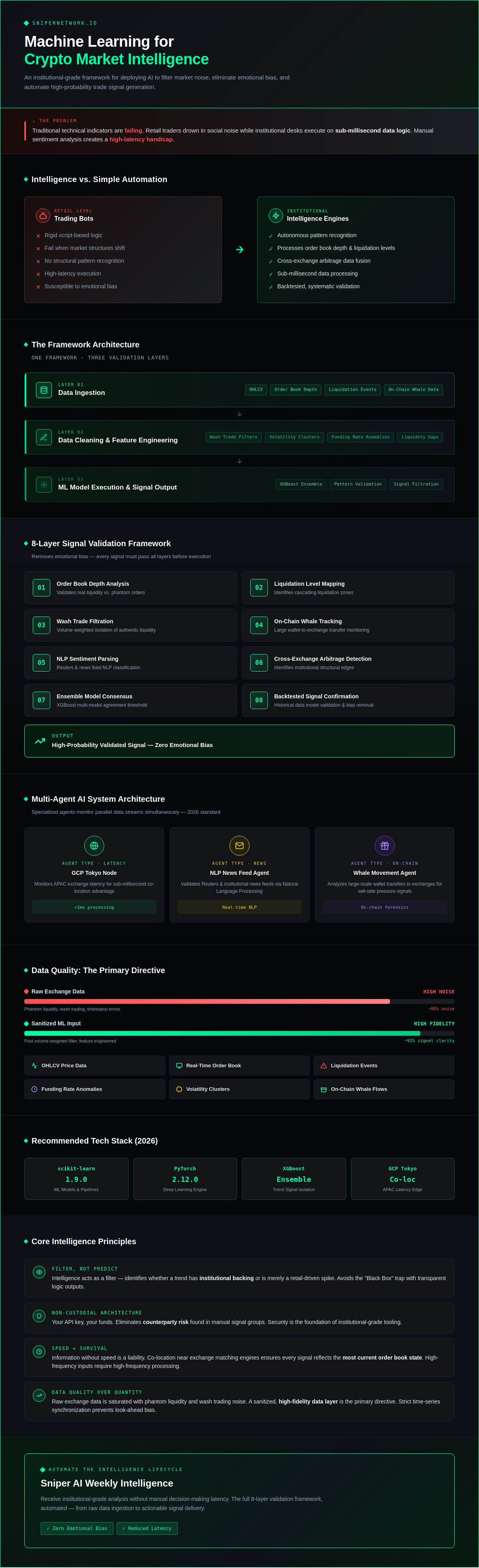
A framework is only as strong as its weakest filter. We deploy a ◈ 8-Layer Validation Framework to ensure signal integrity. This systematic approach transforms fragmented data into institutional-grade reports. It starts with multi-source data ingestion. We clean raw exchange feeds from GCP Tokyo before they reach the orchestration layer. This is where machine learning for crypto market intelligence transitions from theory to execution. We don't guess. We validate.
The orchestration layer is critical for high-probability trend identification. We integrate Claude, GPT-4, and Llama 3 to analyze different market dimensions simultaneously. Claude handles narrative shifts and news flows. GPT-4 validates technical correlations across multiple timeframes. Llama 3 identifies micro-patterns in order book depth. This multi-agent approach ensures no single model bias dictates the output. It's a redundant, high-precision system designed for the 2026 market. Our validation process follows four primary stages:
- Step 1: Multi-source data ingestion. We pull from CEX, DEX, and on-chain nodes while cleaning noise with scikit-learn 1.9.0.
- Step 2: AI agent orchestration. Parallel processing across Claude, GPT-4, and Llama 3 models ensures multi-dimensional analysis.
- Step 3: Cross-referencing. Technical signals must align with real-time sentiment data and liquidation levels.
- Step 4: Final risk-score assignment. Every potential trend receives a numerical confidence rating before the system generates an actionable report.
Avoiding the Overfitting Trap
Overfitting is the silent killer of crypto models. A model that looks perfect in historical backtesting often collapses in live markets. It hasn't learned structural logic; it has merely memorized the past. We use walk-forward optimization to solve this. This involves continuous re-training on rolling windows of data using PyTorch 2.12.0. We also maintain a human-in-the-loop protocol. Expert technicians validate the final intelligence output to account for black swan events that data models might overlook. This is essential for navigating the MiCA regulatory environment, which demands increased transparency for all CASPs by July 1, 2026.
Infrastructure for Real-Time Execution
Local hardware is insufficient for 2026 market speeds. We deploy AI agents on cloud-based clusters to ensure zero-latency processing. Security is non-negotiable. All communications utilize AES-256 encryption. We adhere to a strict non-custodial posture. Your API key; your funds. This ensures you maintain absolute control over your assets while benefiting from high-tier machine learning for crypto market intelligence. You can deploy these institutional frameworks here.
Scaling with Sniper AI Weekly Intelligence
Sniper AI Weekly automates the technical heavy lifting described in previous sections. It manages the entire lifecycle of machine learning for crypto market intelligence. From GCP Tokyo data ingestion to final signal filtration; the process is autonomous. Retail traders no longer need to manage complex PyTorch 2.12.0 environments or clean raw exchange noise manually. Institutional-grade analysis is delivered directly to your dashboard every week. This removes the technical barrier to entry while maintaining professional standards.
◈ 5 AI agents. 8 signal filters. Zero manual bias. This infrastructure operates 24/5 to align with institutional hours. It provides a bridge between professional trading desks and the individual trader. We offer a 'No-Card' trial to ensure transparency. You evaluate the data before committing. No friction; just raw technical performance. The system validates every trend against multiple data streams to ensure that only the highest probability signals reach the final report.
Why Weekly Intelligence Beats Daily Noise
Daily markets are saturated with high-frequency emotional noise. Retail participants often overtrade during periods of artificial volatility. Weekly reports shift the focus to 'Macro' trends and structural narratives. By analyzing the market over a longer timeframe; the intelligence engine isolates high-probability movements that daily fluctuations obscure. This approach reduces the risk of reacting to "wash trading" anomalies or social sentiment spikes. It provides a steady, data-driven perspective on market direction. For a deeper dive into our operational methodology; visit the Sniper AI Weekly Pillar.
Getting Started with Sniper Network
Onboarding is rapid and logical. We move you from curiosity to data-backed insights in seconds. Our validation framework is transparent. Every signal includes backtested results and risk-score assignments. We prioritize a non-custodial posture. Your API key; your funds. This ensures security while utilizing the most advanced machine learning for crypto market intelligence available in 2026. We don't hold assets. We provide the tools to monitor them with clinical precision. ◈ Clinical precision for the modern trader.
Executing with Data-Driven Authority
The shift from speculative guessing to technical precision is complete. Success in the 2026 crypto market requires more than just access to data. It demands a rigorous 8-layer validation framework and sub-millisecond execution logic. You've seen how high-fidelity data and ensemble models form the backbone of a professional engine. Deploying machine learning for crypto market intelligence is the only way to effectively filter the noise of thousands of regulated firms and identify high-probability trends before they materialize in retail news feeds.
You can now deploy these institutional frameworks without the overhead of manual decision-making. Sniper AI Weekly automates the intelligence lifecycle through systematic AI orchestration. This reduces emotional bias and ensures every signal meets strict technical criteria. We maintain a non-custodial posture at all times. Your API key, your funds. The infrastructure is ready. The data is validated. Start your Sniper AI Weekly trial. No credit card required. Take command of the market with the speed and precision of an elite technician.
Frequently Asked Questions
Is machine learning for crypto market intelligence better than technical analysis?
Machine learning is superior because it processes non-linear relationships and alternative data streams that traditional technical analysis ignores. While technical analysis relies on historical price patterns; machine learning integrates order book depth and sentiment to provide structural context. It's a shift from reactive charting to proactive, data-driven intelligence.
Do I need to know how to code to use ML for crypto?
You don't need coding expertise if you utilize an automated framework like Sniper AI Weekly. We manage the Python scripts, PyTorch 2.12.0 environments, and scikit-learn 1.9.0 integrations. You receive the final, validated intelligence reports without managing the underlying infrastructure or cloud-based AI agents.
Can machine learning predict the exact price of Bitcoin?
No; machine learning cannot predict exact prices with absolute certainty due to market volatility and black swan events. It identifies high-probability ranges and structural trends instead. Effective machine learning for crypto market intelligence focuses on risk-adjusted probability rather than pinpoint price forecasting to ensure long-term capital preservation.
What is the difference between a trading bot and an intelligence service?
Trading bots follow rigid, script-based logic to execute orders, whereas an intelligence service provides the data-driven "why" behind a market move. Sniper AI Weekly uses 5 AI agents to validate market structures. This ensures you only execute on signals that have passed a rigorous 8-layer institutional validation process.
How does Sniper AI Weekly protect my funds?
Sniper Network never holds your assets; we operate on a strictly non-custodial basis. Your API key remains under your control at all times. We provide the intelligence; you maintain the funds. This "Your API key, your funds" protocol is our recurring seal of security for every user.
What kind of data does machine learning need for crypto analysis?
Models require high-fidelity OHLCV data, real-time order book depth, and liquidation levels. They also ingest alternative streams like Reuters news feeds and on-chain whale movements. This multi-source ingestion is essential for training ensemble models to filter out wash trading noise and phantom liquidity.
Is real-time crypto AI analysis actually possible in 2026?
Yes; real-time analysis is standard in 2026 through cloud-based co-location. By deploying AI agents in GCP Tokyo, we achieve sub-millisecond processing speeds. This infrastructure allows for the validation of multi-timeframe patterns before they impact broader retail sentiment or trigger manual decision-making processes.
Why is sentiment analysis important for machine learning models?
Sentiment analysis provides a critical confirmation layer for technical signals. It helps models determine if a price move is driven by authentic institutional interest or retail-led hype. Integrating machine learning for crypto market intelligence with Natural Language Processing allows the system to process narrative shifts alongside raw exchange data.