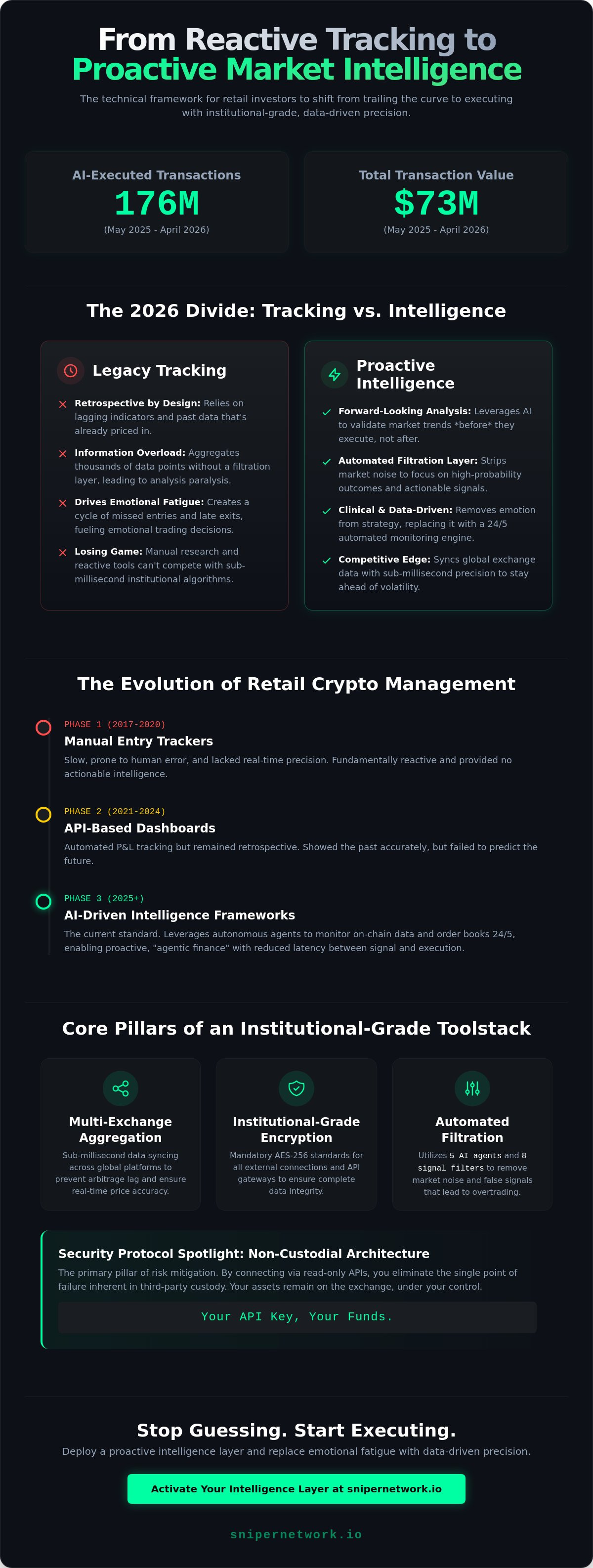
AI agents executed 176 million transactions worth $73 million between May 2025 and April 2026. This isn't a speculative projection; it's the current baseline of the digital asset landscape. You're likely feeling the weight of information overload and the persistent fatigue of trying to identify trends before they execute. Most AI crypto market analysis for retail investors relies on retrospective data that's already been priced in by institutional algorithms. It's a legacy approach that leaves you trailing behind the curve.
You know that manual research is a losing game against sub-millisecond execution and automated signal filters. This guide provides the technical framework required to shift from reactive tracking to proactive market intelligence. We'll detail how to leverage institutional-grade data access and automated research filtration while maintaining strict non-custodial security. You'll learn to strip the emotion from your strategy and replace it with a clinical, data-driven engine that monitors the market 24/5. It's time to stop guessing and start executing with precision.
Key Takeaways
- Shift from manual tracking to automated, API-driven intelligence to eliminate retrospective data lag.
- Implement the "Your API key, your funds" standard using non-custodial architecture for institutional-grade security.
- Leverage advanced AI crypto market analysis for retail investors to validate market trends before they execute.
- Sync global exchange data with sub-millisecond precision to ensure your intelligence layer remains ahead of volatility.
- Deploy an automated research layer to filter market noise and reduce the impact of emotional trading.
What are Crypto Portfolio Management Tools for Retail Investors?
Portfolio management tools are specialized software architectures designed to aggregate, analyze, and optimize digital asset holdings. They've moved beyond simple balance displays. Today, an institutional-grade tool provides a unified view of exchange accounts, cold storage, and DeFi protocols through secure API connections. This transition mirrors the broader evolution of algorithmic trading, where speed and data accuracy are the primary competitive advantages. By June 2026, the standard for retail investors has shifted. It's no longer enough to see what you own. You must validate the market's direction in real-time using integrated AI agents.
The Evolution of Retail Crypto Management
Retail crypto management has evolved through three distinct technical phases. Phase 1 (2017-2020) relied on manual entry trackers. These were slow, prone to human error, and lacked real-time precision. Phase 2 (2021-2024) introduced API-based dashboards. These tools automated P&L tracking across multiple platforms but remained fundamentally reactive. They showed you the past, not the future. The data was accurate, but it wasn't actionable.
We've now entered Phase 3: AI-driven intelligence frameworks. These systems leverage AI crypto market analysis for retail investors to move beyond simple aggregation. They use autonomous agents to monitor on-chain data and exchange order books 24/5. With the 2026 launch of tools like Coinbase for Agents, the focus has shifted to "agentic finance." Investors now use AI to execute trades within defined parameters, removing the need for constant manual oversight and reducing the latency between signal and execution.
Why Traditional Trackers Fail in Volatile Markets
Standard trackers are retrospective by design. They show you where you've been, not where the market is going. This reliance on lagging indicators often results in late exits during drawdowns and missed entries during breakouts. Retrospective data doesn't prevent future drawdowns; it merely documents them. For the retail trader, this creates a cycle of emotional fatigue and missed opportunities. You're always one step behind the institutional algorithms.
Information overload is the primary driver of analysis paralysis. Traditional tools aggregate thousands of data points without providing a filtration layer. When volatility spikes, the human brain cannot process the influx of conflicting signals at the speed required for effective capital protection. A tool that only aggregates data is a liability in a high-frequency environment. You don't need more data. You need validated intelligence that triggers action before the trend executes. AI crypto market analysis for retail investors provides this filtration, stripping away the noise to focus on high-probability outcomes.
Core Pillars of an Institutional-Grade Toolstack
Institutional-grade performance requires more than a sleek dashboard. It demands a technical foundation capable of processing high-velocity data without compromising asset safety. The primary pillar is non-custodial architecture. We follow a strict protocol: your API key, your funds. By maintaining assets on the exchange and only connecting through encrypted gateways, you eliminate the single point of failure inherent in third-party custody. All external connections must utilize AES-256 encryption standards to ensure data integrity across the entire pipeline. This focus on specialized infrastructure is mirrored in other high-stakes fields; for instance, elite plaintiff law firms can learn more about Nexus Legal Group.
A robust toolstack must integrate these core technical specifications:
- ◈ Multi-exchange aggregation: Sub-millisecond data syncing across global platforms to prevent arbitrage lag.
- ◈ Institutional-grade encryption: AES-256 standards for all external connections and API gateways.
- ◈ Automated filtration: 5 AI agents. 8 signal filters. This removes market noise and false signals that lead to overtrading.
Security Protocols and Asset Safety
Non-custodial tools aren't just a preference; they're mandatory for risk mitigation. When configuring your stack, verify that you're providing read-only API permissions. Execution rights should only be granted if the framework includes a hardware-level security layer. Data accuracy is further validated by the use of co-located servers in regions like GCP Tokyo. This minimizes latency and ensures the price action you see is the price action currently executing on global order books. You shouldn't settle for delayed data when milliseconds determine your entry price.
Advanced Analytics Beyond Simple P&L
Moving beyond simple P&L tracking is essential for survival. Effective AI crypto market analysis for retail investors must quantify market fear and greed through automated sentiment analysis. This isn't guesswork. It's the aggregation of social signals, news flow, and on-chain movement processed by high-tier infrastructure. According to a recent AI in retail investing report, these tools are becoming critical for identifying herding behavior and reducing the cost of decision-making.
Advanced frameworks also include portfolio-specific anomaly detection. This provides an early warning system for potential rug-pulls or liquidity drains before they impact your holdings. By monitoring multi-timeframe confirmations, the system validates trends across 1m, 5m, and 1h charts simultaneously. To see how these protocols function in a live environment, explore our proactive intelligence framework. It's designed to strip away the noise and deliver clinical, data-driven results.
Tracking vs. Intelligence: The 2026 Divide
The distinction between tracking and intelligence is the difference between a post-mortem and a forecast. Standard trackers are digital balance sheets. They aggregate historic price action and current holdings to show you where you are. Intelligence frameworks identify where the market is going. By June 2026, the retail sector has reached a tipping point where simple data aggregation is no longer a competitive advantage. It's a baseline. To outperform, you must move toward AI crypto market analysis for retail investors that prioritizes validation over volume.
Standard tools often boast about the number of data sources they aggregate. They dump 140 news feeds and thousands of social signals into a single dashboard. This creates a "noise cost." Without a filtration layer, this volume of information becomes a liability, leading to analysis paralysis and delayed execution. AI frameworks solve this by validating data against multi-timeframe confirmations before it ever reaches your screen. You don't need more data; you need higher signal density.
Automated Market Intelligence Explained
Automated intelligence relies on AI agents that scan global liquidity and narrative shifts in real-time. These agents don't just report that a price has moved. They analyze the "why" by correlating on-chain whale movements with sentiment shifts across high-tier infrastructure. There is a fundamental difference between a "signal" and a "validated market insight." A signal is a raw data point. A validated insight is the result of that data point passing through a rigorous backtesting engine.
Retail investors are increasingly adopting systematic crypto trading methods to remove guesswork. This approach uses clinical data to identify reversals and trend continuations with institutional precision. By automating the identification of these patterns, you eliminate the latency inherent in manual chart analysis. The system monitors the order books while you focus on high-level strategy.
The Role of AI Agents in Research
AI agents transform the research process by automating an 8-layer validation framework for every potential trade. This framework checks liquidity depth, volume profile, sentiment skew, and macro correlations simultaneously. It delivers a cold, clinical output that is entirely stripped of emotional bias. This is critical for retail investors who often fall victim to the "fear of missing out" or emotional fatigue during periods of high volatility.
Weekly intelligence reports are proving more effective than 24/7 manual monitoring. Constant chart watching leads to overtrading and cognitive drain. A proactive intelligence layer, like AI crypto market analysis for retail investors, processes the noise of the work week into actionable insights delivered directly to your inbox. It allows you to maintain an institutional-grade perspective without the time commitment of a professional trading floor. Precision beats presence every time.
How to Choose Your Crypto Management Framework
Selecting a framework is a technical decision, not an aesthetic one. You must first define your management style. Passive tracking is sufficient for retrospective tax reporting but fails in active market environments. Active intelligence requires a system that prioritizes AI crypto market analysis for retail investors to identify high-probability entries. If a tool doesn't reduce your screen time, it isn't an intelligence layer; it's just another source of noise. A professional framework should automate the heavy lifting of data filtration. 5 AI agents. 8 signal filters. This is the baseline for 2026.
Security remains the non-negotiable baseline. Always verify the non-custodial status of any tool. A legitimate framework never requests withdrawal permissions. It operates on the "Your API key, your funds" principle. Beyond security, evaluate the underlying infrastructure. Does the tool leverage tier-1 providers like GCP Tokyo for low-latency execution? Does it ingest data from verified sources like Reuters? Without institutional-grade data, the AI output is fundamentally flawed. You're looking for a clinical engine, not a speculative dashboard.
Step-by-Step Tool Evaluation
Begin by checking for comprehensive multi-chain and DeFi compatibility. Your intelligence layer must see across silos to provide a true market overview. Next, analyze report frequency. Real-time alerts often lead to emotional overtrading. Weekly intelligence reports, however, provide the necessary distance for strategic decision-making. Finally, verify the technical background of the development team. They should have documented expertise in ai for crypto market analysis tools and systematic framework construction.
Red Flags in Portfolio Management
Avoid any platform with custodial requirements or promises of "managed" funds. These are often masks for centralized risk. Be wary of exuberant marketing. Claims of "guaranteed" returns or 100% accuracy are immediate red flags in a volatile market. Professional tools focus on backtested results and probability, not certainty. If the data sources are opaque or the validation layers are not clearly defined, the tool is a liability. For those seeking a validated, non-custodial solution, you can access our institutional-grade framework to start filtering market noise today.
Sniper AI Weekly: The Proactive Intelligence Layer
Sniper AI Weekly delivers clinical, automated research directly to your inbox. It's built for the professional retail investor who values technical precision over market hype. This framework provides the most sophisticated AI crypto market analysis for retail investors by utilizing a proprietary stack of high-tier infrastructure. The goal is simple: replace emotional fatigue with data-driven confidence. We provide the intelligence; you maintain absolute control over your assets. It's a strictly non-custodial relationship built on the "Your API key, your funds" security standard.
Our system operates with a specific technical configuration to ensure maximum signal density:
- ◈ 5 AI agents: Specialized agents monitor sentiment, liquidity, on-chain movement, macro correlations, and technical structures.
- ◈ 8 signal filters: Every potential insight must pass through eight layers of validation, including volume profile analysis and multi-timeframe confirmation.
- ◈ Zero emotional noise: The output is entirely clinical, removing the "FOMO" and panic that lead to retail drawdowns.
The Power of Automated Weekly Reports
Institutional clarity requires distance from the sub-millisecond noise of daily volatility. A weekly interval provides the optimal balance of speed and clarity for the professional retail investor. Our proprietary AI algorithms filter global narratives from market noise, identifying high-probability trend continuations before they fully execute on the charts. By accessing Sniper AI Weekly, you're receiving data-backed entries validated by co-located servers in GCP Tokyo. You don't need to watch the charts 24/7 when you have a silent engine monitoring the order books for you.
Systematic Risk Management
Intelligence is a liability without a protection layer. We use AI to manage crypto risk management tools and portfolio allocations. This ensures your exposure remains within strictly defined parameters, even during sudden liquidity shifts or narrative reversals. We prioritize transparency as a core value, which is why we offer a "No Card Required" trial. We don't hold your funds, and we don't need your billing information to prove the system's efficacy. It's a frictionless entry into institutional-grade market intelligence.
The 2026 market doesn't reward manual effort; it rewards automated precision. It's time to stop trailing the institutional algorithms and start using them. ◈ Action: Start your automated intelligence trial at Sniper Network.
Secure Your Execution Edge
The shift from retrospective tracking to proactive intelligence is no longer optional. It's a requirement for survival in a market dominated by institutional speed. You've seen how non-custodial architecture and sub-millisecond data validation provide the necessary security layer for your capital. By deploying high-tier infrastructure, you eliminate the emotional fatigue of manual monitoring. Effective AI crypto market analysis for retail investors isn't about more data. It's about higher signal density through clinical filtration.
Our framework operates as a silent, autonomous engine in the background. 5 AI agents. 8 signal filters. 24/5 automated monitoring. We provide the intelligence while you maintain absolute control. Your API key, your funds. This is the technical standard for the professional retail investor in 2026. Stop reacting to past price action and start anticipating the next move with backtested precision.
◈ Access Sniper AI Weekly: Institutional-Grade Market Intelligence
You're now equipped to execute with the same technical rigor as a professional trading floor. Precision is your primary advantage.
Frequently Asked Questions
What is the best crypto portfolio tracker for retail investors in 2026?
The best tracker is one that shifts from retrospective data to proactive intelligence. Sniper AI Weekly is the technical standard for retail investors seeking institutional-grade data. It uses 5 AI agents and 8 signal filters to validate market movements rather than just recording them. You need a system that prioritizes data density over simple balance displays to maintain a competitive edge in high-velocity markets.
Are crypto portfolio management tools safe if I use API keys?
Safety depends on the tool's architecture and your specific permission settings. Institutional-grade tools use AES-256 encryption and follow the "Your API key, your funds" protocol. You must ensure you only provide "read-only" permissions during setup. This prevents the tool from executing withdrawals while allowing its engine to aggregate data from co-located servers in regions like GCP Tokyo.
Do I need to pay for a crypto portfolio tool or are free ones enough?
Free tools are generally retrospective and provide lagging data. Professional retail investors require institutional-grade infrastructure to compete with high-frequency algorithms. Paid frameworks offer sub-millisecond data syncing and automated filtration. Free versions often lack the computational power needed for real-time market validation. You're paying for the removal of market noise and the addition of validated intelligence layers.
How does AI improve crypto portfolio management for retail investors?
AI improves management by automating the research filtration process. It removes market noise and emotional bias from the decision-making pipeline. By using AI crypto market analysis for retail investors, frameworks can scan global liquidity and narrative shifts 24/5. This allows for proactive intelligence rather than simple balance tracking. It moves you from reactive counting to proactive execution based on clinical data.
Can these tools help with crypto tax reporting?
Most advanced portfolio tools provide API-driven data exports for tax compliance. These tools aggregate cost-basis information across multiple exchanges and DeFi protocols automatically. While the AI focus is on market intelligence, the underlying data layer is essential for generating accurate P&L reports. This reduces the manual labor required to meet the standards of global regulatory frameworks and the CLARITY Act.
What is the difference between a custodial and non-custodial management tool?
A custodial tool holds your private keys or assets, creating a significant single point of failure. A non-custodial management tool never holds user funds. It connects to your exchange via a secure API. Your assets remain in your control at all times. This is the mandatory standard for institutional-grade security. It ensures that your capital is never at risk from platform-level insolvency.
How often should I check my crypto portfolio intelligence reports?
Weekly intervals are optimal for strategic clarity. Checking portfolios 24/7 leads to cognitive drain and emotional overtrading. Professional frameworks provide weekly intelligence reports that filter five days of market noise into actionable insights. This allows you to maintain an institutional perspective without the time commitment of a professional trading floor. It prioritizes long-term precision over short-term reactionary movements.
Can AI agents predict market reversals for retail portfolios?
AI agents identify reversals by correlating on-chain whale movements with sentiment shifts across high-tier infrastructure. They use multi-timeframe confirmation to validate trend shifts before they fully execute on global order books. While no system provides 100% certainty, AI crypto market analysis for retail investors provides a probability-based edge. It identifies the technical signatures of a reversal that manual chart watching often misses.