
Sentiment is not a signal. It is raw, unrefined noise that functions as a liquidation trap for the retail majority. Following the herd into "Extreme Fear" without technical validation is a strategy for capital depletion. You have likely experienced the exhaustion of market volatility, where lagging indicators lead to late entries and social noise creates paralysis. The June 2026 market contraction, which erased over $800 billion in market capitalization, proved that raw sentiment data is insufficient for institutional-grade timing.
We agree that emotional bias is the primary predator of your trading performance. To survive, you need a clinical crypto fear and greed index strategy that operates with technical precision. This framework transforms volatile data into a systematic execution plan using AI-driven validation. It removes the guesswork. It prioritizes reliability over hype. It functions as a sophisticated, silent engine for your capital.
This guide provides a systematic 2026 execution framework. We detail how to filter sentiment through multi-timeframe confirmations, integrate the latest IRS 1099-DA reporting requirements into your logic, and leverage AI infrastructure to maintain a cold edge. You will learn to treat the index as a raw input, not a final trigger.
Key Takeaways
- Implement a clinical crypto fear and greed index strategy by treating sentiment as raw input rather than a standalone signal.
- Identify high-probability entry points by isolating historical sentiment outliers and applying the mean reversion principle.
- Eliminate emotional bias using an 8-layer validation framework that filters social noise through multi-timeframe confirmations.
- Scale execution efficiency by transitioning from manual DCA to automated, AI-driven validation.
- Access institutional intelligence through Sniper AI Weekly to monitor 8 signal filters with technical precision.
What is the Crypto Fear and Greed Index and Why Strategies Fail
The Crypto Fear and Greed Index operates as a composite metric. It quantifies market sentiment on a linear scale from 0 to 100. A score of 0 indicates "Extreme Fear." A score of 100 represents "Extreme Greed." The calculation engine ingests specific data streams: volatility, market momentum, social media volume, and Bitcoin dominance. It’s designed to provide a snapshot of the collective psychological state of the market. However, most retail participants use this as a direct signal. This is a tactical error. The index is a lagging indicator. It documents the aftermath of price action. By the time the index registers "Greed," the smart money has already distributed into retail liquidity. This "Lag Gap" is where portfolios collapse. A successful crypto fear and greed index strategy requires moving beyond observation. It demands systematic execution based on data validation, not just a score.
The Mechanics of Sentiment in 2026
The landscape has shifted. In 2026, social media volume is no longer a pure reflection of human interest. AI-driven social bots now saturate platforms. They artificially inflate sentiment scores to trigger retail entries. We also see institutional liquidity frequently moving in direct opposition to these retail-heavy signals. This creates a decoupling of price from sentiment. During the June 2026 market contraction, which erased over $800 billion in market capitalization, the index hit "Extreme Fear" while institutional accumulation was already underway in dark pools. Retail traders stayed sidelined. They misread the signal because they ignored the underlying liquidity flow and high-frequency environment.
Common Strategy Pitfalls
Precision requires more than a single data point. Most traders fall into the "Daily Trap." They monitor the index on a 24-hour basis without checking the weekly trend. This lack of multi-timeframe confirmation leads to premature exits or late entries. Greed can remain in the "Extreme" zone for weeks during an irrational exuberance phase. Selling too early is as damaging as buying too late. To build a robust crypto fear and greed index strategy, you must avoid these common failures:
- Over-reliance on the daily index score: Short-term fluctuations often mask long-term accumulation phases.
- Ignoring persistence: Greed can persist for extended periods, trapping those who try to time the exact top.
- Failure to verify: Using sentiment as a standalone signal without validating through on-chain data or technical filters.
- Lack of intelligence tools: Relying on manual observation instead of non-custodial intelligence to verify sentiment shifts in sub-millisecond environments.
A clinical framework filters out the noise of social bots. It identifies the true institutional pivot points. You don't need to guess how the market feels. You need to validate what the data executes.
The Anatomy of a High-Probability Sentiment Strategy
High-probability execution requires identifying statistical outliers. Most participants react to any reading above 70 or below 30. A clinical crypto fear and greed index strategy ignores these mid-range fluctuations. It focuses on the tails of the distribution. For Bitcoin, true historical outliers exist below 20 and above 80. These zones represent points where price action becomes unsustainable. In June 2026, the market contraction provided a clear example. As the index plummeted, institutional dark pools began absorbing retail sell pressure. This wasn't a guess. It was a data-validated pivot. Ethereum often exhibits higher volatility, requiring even tighter filters to avoid premature entries.
Sentiment is cyclical. It operates on the "Mean Reversion" principle. Regardless of the intensity of a trend, the score inevitably returns to the 50-point baseline. Research into Crypto Sentiment Dynamics confirms that the index acts as a leading indicator of trend exhaustion. However, sentiment alone is insufficient. You must validate shifts with on-chain exchange inflows. High inflows during "Extreme Fear" often signal the final capitulation. Conversely, stagnant volume during "Extreme Greed" indicates a lack of new buyers. This multi-timeframe approach prevents the common error of "catching a falling knife" during aggressive sell-offs.
Extreme Fear: The Institutional Accumulation Zone
Institutional players don't buy the first dip. They wait for capitulation wicks. These are high-volume price spikes that coincide with index readings below 20. By utilizing sentiment analysis in cryptocurrency, you can identify hidden divergence where sentiment hits new lows but price holds support. We implement a 48-hour rule. We don't trigger entries the moment the index drops. We wait for 48 hours of sentiment stabilization. This ensures the initial panic has exhausted itself before we deploy capital. It’s about precision, not speed.
Extreme Greed: The Distribution Framework
Exits must be as clinical as entries. Retail FOMO peaks when social media saturation metrics hit vertical levels. When the index crosses 80, the risk-to-reward ratio for new longs becomes mathematically unfavorable. We set systematic exit targets at these levels. Beware of "Greed Plateaus." In sustained bull markets, sentiment can stay above 70 for weeks. This is where most traders get liquidated by trying to short too early. Precision timing requires a systematic intelligence tool to monitor these plateaus in real-time. Don't let the noise of a trending market cloud your exit logic.
Manual DCA vs. Systematic AI-Driven Strategies
Manual Dollar Cost Averaging (DCA) is a legacy approach. It prioritizes simplicity over precision. While it resists emotional panic, it lacks the surgical accuracy required in the 2026 market landscape. A basic crypto fear and greed index strategy relying on manual DCA often executes entries during "dead-cat bounces." It cannot distinguish between true capitulation and a temporary pause. Systematic AI-driven strategies solve this. They prioritize data-validated, institutional-grade entry points. They don't just buy because the index is red. They buy because the liquidity validates the reversal. 2026 markets require sub-millisecond data processing to compete with institutional algorithmic sellers. Guessing is no longer a viable risk management plan.
The Limits of Manual Sentiment Trading
Human bias remains the primary bottleneck. Even with a documented plan, traders hesitate during "Extreme Fear." The psychological weight of a massive market contraction creates paralysis. Manual trading also suffers from the "Noise" problem. Distinguishing a temporary dip from a structural trend reversal requires processing massive datasets in real-time. You can't do this with a browser and a spreadsheet. Execution fatigue is a constant risk. Markets operate 24/5; humans don't. This gap creates missed opportunities and late entries. Transitioning to systematic crypto trading frameworks removes this biological limitation. It replaces hesitation with clinical execution.
Automating Intelligence with AI Agents
Modern execution requires speed. We utilize 5 AI agents to monitor 8 signal filters simultaneously. This isn't just automation. It's intelligence scaling. These agents validate sentiment against on-chain exchange inflows and multi-timeframe trends. They operate with the speed of co-located servers. Security is non-negotiable in this framework. Using non-custodial ai for crypto market analysis tools ensures you maintain control. Your API key, your funds. This approach replaces the noise of manual signal groups with automated logic. It allows you to monitor the "Extreme Fear" zone without the emotional exhaustion of manual watching. The system triggers based on data, not gut feeling.
This transition is about moving from a reactive stance to a proactive, institutional-grade posture. You aren't just following a chart. You're deploying a sophisticated, silent engine that works in the background. It's fast. It's reliable. It's uncompromisingly secure.
The 8-Layer Validation Framework for Sentiment Trading
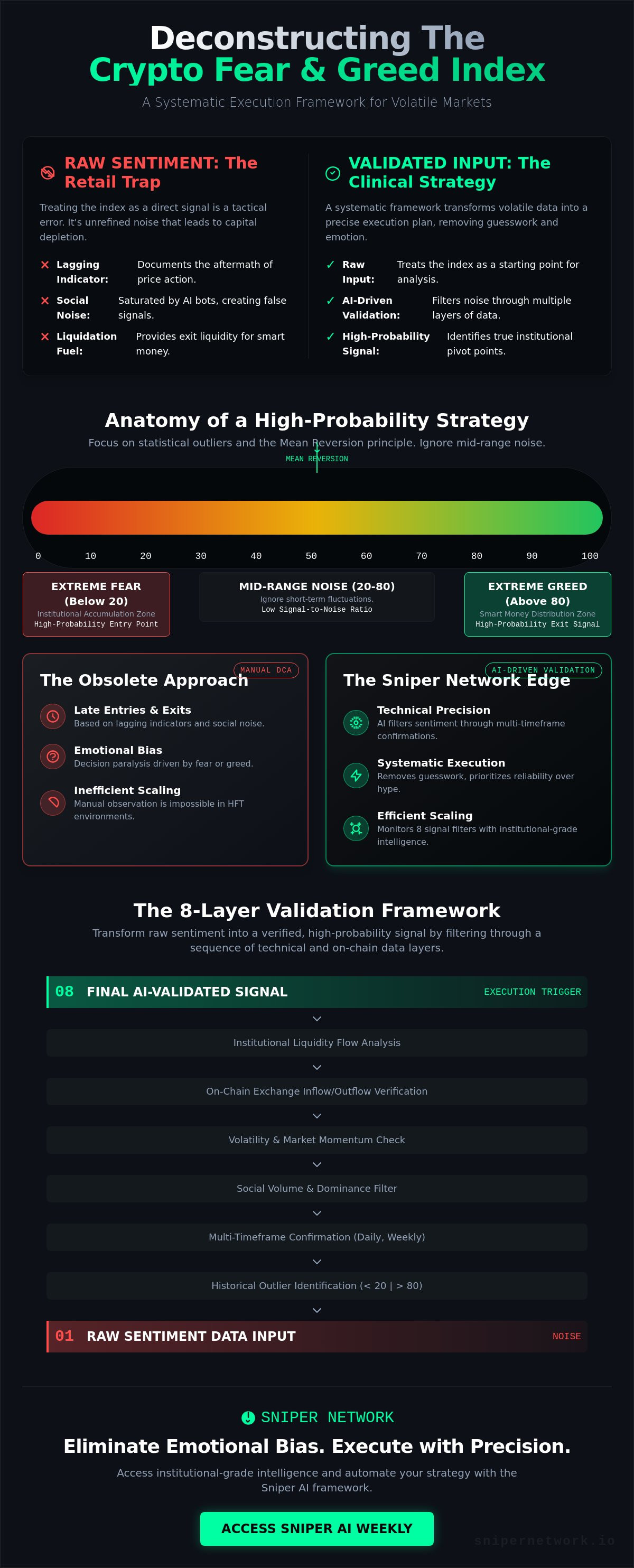
A standalone index reading is a liability. Treating a single number as a trade trigger ignores the structural complexity of 2026 markets. A clinical crypto fear and greed index strategy requires an 8-layer validation framework to filter out noise and isolate institutional-grade signals. This framework ensures that sentiment is merely the starting point; it's the raw material that must be refined through technical and on-chain filters before capital is deployed. We don't trade on feelings. We trade on validated data clusters.
- Layer 1: Raw Sentiment Input. The core Fear and Greed Index score. We ignore all readings between 26 and 74.
- Layer 2: Multi-Timeframe Confirmation. We cross-reference daily sentiment with weekly trends. This prevents the "Daily Trap" where short-term panic masks long-term accumulation.
- Layer 3: Social Media Noise Filter. AI-driven narrative analysis. This layer strips away bot-driven hype and identifies human-led sentiment shifts.
- Layer 4: On-Chain Liquidity Check. Monitoring exchange reserves. We look for decreasing reserves during "Extreme Fear" as a sign of cold-storage accumulation.
- Layer 5: Institutional Order Flow. Tracking large-scale "whale" movements through co-located data feeds. We only move when institutional signatures align with sentiment extremes.
Executing the Validation Scan
Precision execution follows a strict three-step protocol. We trigger the initial validation scan only when the index hits the outlier zones of below 25 or above 75. Once triggered, we cross-reference the signal with crypto risk management tools to define position sizing. This prevents over-exposure in volatile environments. Finally, we validate the trade through AI-driven weekly intelligence reports. This three-step process ensures that every entry is backed by a multi-layered consensus of data. It removes the guesswork. It prioritizes capital preservation.
Filtering Market Noise
Objective data is your only defense against market volatility. In 2026, influencer hype and social media noise are engineered to create retail exit liquidity. Our framework uses clinical, data-backed insights to ignore these distractions. Automated news analysis prevents reactive trading by processing headlines at sub-millisecond speeds. It identifies the "why" behind a price move before the retail crowd can react. By the time a narrative reaches social media, the institutional move is already complete. You need a system that monitors the source data, not the social echo. You can automate this intelligence gathering to maintain a technical edge without the emotional exhaustion of 24/5 monitoring.
This 8-layer approach transforms a simple sentiment score into a professional execution engine. It’s fast. It’s data-heavy. It’s designed for the high-frequency reality of modern digital asset markets.
Scaling with Sniper AI Weekly: Institutional Intelligence
Execution is the final barrier. You now understand the 8-layer validation framework. You recognize the "Lag Gap" and the necessity of mean reversion. However, manual application of a crypto fear and greed index strategy is unsustainable in 2026. The market moves too fast. Social noise is too dense. Sniper AI Weekly provides the automated intelligence required to scale these insights into a clinical execution engine. It removes the human bottleneck. It replaces hesitation with data-driven precision.
Our system utilizes 5 AI agents to monitor 8 signal filters simultaneously. These agents don't just track a score. They validate sentiment against institutional order flow and on-chain liquidity. This is not a signal group. It is a sophisticated, silent engine working in the background. It monitors the "Extreme Fear" and "Extreme Greed" zones with sub-millisecond accuracy. By the time a sentiment shift is visible to the retail crowd, our agents have already confirmed the trend through dark pool data and exchange reserve monitoring.
Security remains our primary protocol. Sniper AI Weekly is entirely non-custodial. We never hold your funds. We never ask for withdrawal permissions. Your API key, your funds. This "Transparent Partner" approach ensures you maintain full control of your assets while leveraging institutional-grade infrastructure. It's the bridge between professional trading floors and the individual trader.
The Sniper AI Weekly Advantage
Information is delivered with technical precision. Automated weekly reports arrive directly at your dashboard. They provide a clinical breakdown of the current market structure. Our infrastructure is built for speed, utilizing co-located servers and GCP Tokyo integration. This ensures that the data you receive is processed at the same speed as institutional algorithms. We provide unemotional analysis that prioritizes technical precision over market hype. There's no exuberant persuasion. There's only data.
Securing Your Strategy for 2026
The future of retail trading is non-custodial intelligence. As regulatory scrutiny intensifies, maintaining control of your own assets is a necessity, not an option. You can join the elite technicians today. Start your Sniper AI Weekly trial to automate your research process. Before deploying your next trade, ensure you've completed the final systematic checklist:
- Verify Multi-Timeframe Consensus: Does the weekly trend align with the daily sentiment?
- Filter Social Noise: Has the AI agent stripped away bot-driven exuberance?
- Confirm Institutional Flow: Are whales accumulating during the "Extreme Fear" phase?
- Define Position Size: Is your risk management tool active for this volatility level?
Stop guessing. Start executing with clinical precision. The market contraction of 2026 proved that only data-driven strategies survive. Secure your edge now.
Deploying Your Systematic Execution Engine
The transition from retail guessing to institutional-grade performance is now complete. You've established that a profitable crypto fear and greed index strategy is built on 8-layer validation, not social media noise. You understand the necessity of identifying historical outliers and applying the 48-hour rule to avoid premature entries. By moving beyond manual DCA and embracing sub-millisecond data processing, you eliminate the emotional exhaustion that erodes capital.
Precision is your only defense against market volatility. You now possess the framework to treat sentiment as a raw input for a sophisticated, silent engine. It's time to automate this intelligence scaling. Our system utilizes 5 AI agents and 8 signal filters to maintain constant market monitoring. This is an institutional-grade technical precision tool designed for the 2026 landscape. It's non-custodial; your API key, your funds.
Start your Sniper AI Weekly trial and automate your market intelligence. Transition to a clinical, data-driven posture today. You're ready to execute with technical precision and total confidence.
Frequently Asked Questions
Is the Fear and Greed Index a reliable crypto strategy in 2026?
The index is a reliable sentiment metric but functions poorly as a standalone signal. In the 2026 trading environment, high-frequency markets require filtering this raw data through technical and on-chain layers. A successful crypto fear and greed index strategy integrates this score as one variable in a multi-layered framework. It acts as a trigger for further validation rather than a direct execution command. Without this, it remains a lagging indicator.
How often should I check the index for my trading strategy?
Check the index daily for psychological snapshots, but prioritize weekly trends for structural execution. Rapid fluctuations create market noise that often leads to retail overtrading. For institutional-grade precision, cross-reference the daily score with a 7-day moving average to identify sustained sentiment shifts. Automated intelligence tools process these updates at sub-millisecond speeds. This ensures you don't miss critical pivot points while avoiding the exhaustion of constant manual monitoring.
What is the difference between Extreme Fear and a Bear Market?
Extreme Fear is a temporary psychological snapshot; a bear market is a sustained structural price trend. Extreme Fear often occurs during sharp corrections within a larger bull cycle. It represents a state where investors are irrational and panicked. A bear market requires a prolonged period of declining prices and lower highs. Distinguishing between them requires analyzing institutional order flow and exchange reserves rather than just social media volume.
Can I use the Fear and Greed Index for altcoins or just Bitcoin?
The index primarily weights Bitcoin data, but it serves as a proxy for the entire digital asset market. Altcoins typically exhibit higher beta and overreact to Bitcoin's sentiment shifts. When the index hits "Extreme Fear," altcoins often experience deeper liquidations. A clinical crypto fear and greed index strategy uses the Bitcoin-centric score to define the overall market regime before selecting specific altcoin entries. It dictates the risk-on or risk-off posture.
Why does the index stay in Extreme Greed while prices are falling?
This occurs due to the "Lag Gap" where social excitement persists after the price has peaked. The index incorporates social media volume and Google Trends, which often hit vertical levels while smart money is distributing assets. This divergence signals that retail FOMO is high despite institutional selling. Relying on the index during these plateaus without technical confirmation results in holding through a trend reversal. Objective data must override social sentiment.
How do AI agents improve sentiment-based trading strategies?
AI agents eliminate human hesitation and process datasets at speeds unattainable by manual traders. They monitor 8 signal filters simultaneously, including dark pool liquidity and exchange inflows. These agents validate raw sentiment against objective market structure in real-time. By removing execution fatigue and emotional bias, they transform a volatile index into a clinical execution plan. They operate 24/5, ensuring sub-millisecond responses to institutional-grade pivot points while you remain offline.
What are the best non-custodial tools for sentiment analysis?
Non-custodial tools are the standard for secure, professional asset management. These systems interface with your exchange via API keys without requesting withdrawal permissions. They provide institutional-grade intelligence while ensuring you maintain full control of your capital. Sniper AI Weekly is a prime example of this "Your API key, your funds" model. It prioritizes security protocols and technical precision without requiring direct asset custody or holding user funds.
Is a Fear and Greed Index strategy suitable for beginners?
Simple versions are accessible, but a professional execution framework requires technical discipline. Beginners often fall into the "Daily Trap" by reacting to every score change. To move beyond amateur guessing, you must integrate risk management and multi-timeframe analysis. While the core concept is simple, the systematic application requires high-tier infrastructure to filter out noise. It's better suited for traders using automated tools to maintain a cold, data-driven edge.