
What if you could execute institutional-grade strategies without ever surrendering your private keys to a third party? Exchange insolvency is no longer a tail risk; it's a predictable failure of centralized architecture. You're likely frustrated by the information overload of manual signal groups and the technical friction of self-custody. To maintain absolute sovereignty, you must deploy non-custodial crypto tools that prioritize sub-millisecond execution and data integrity over speculative hype.
This article provides a clinical framework for evaluating the 2026 security landscape. You'll learn how to audit your infrastructure against the latest standards, including Ledger 4.6.0 security updates and the regulatory protections of the Digital Asset Market Clarity Act. We'll show you how to automate market research and eliminate emotional bias while maintaining 100% asset control. We'll preview how high-performance systems like Sniper AI Weekly provide the technical edge needed to monitor global markets with institutional precision. This is about moving from speculative gambling to a data-driven, non-custodial advantage.
Key Takeaways
- Audit your infrastructure using the 8-layer security validation checklist to ensure private keys never leave your local environment.
- Transition from passive storage to active market participation by deploying high-performance non-custodial crypto tools that maintain absolute asset sovereignty.
- Replace low-accuracy manual signal groups with data-driven intelligence frameworks that provide institutional-grade insights without third-party interference.
- Secure your technical edge by implementing multi-device authentication and offline physical backups to protect your self-custody infrastructure.
- Utilize the Sniper AI Weekly system to validate market triggers through 5 AI agents and 8 signal filters while keeping your API keys and funds entirely private.
Defining the 2026 Non-Custodial Ecosystem
In 2026, asset sovereignty is a binary state. You either hold your private keys or you are a functional creditor to a centralized entity. The 2026 market environment has rendered passive cold storage insufficient for professional participants. High volatility and rapid narrative shifts demand a transition from "static vaulting" to active participation. This evolution requires a sophisticated stack of non-custodial crypto tools that provide institutional performance without compromising security protocols. True sovereignty now means maintaining 100% control while executing data-driven strategies in real time.
The 2025 CLARITY Act provided a regulatory floor for software developers, yet technical risks remain. Centralized exchanges continue to represent a single point of failure. Modern retail sovereign users now utilize the same infrastructure as high-frequency trading floors. This includes co-located execution engines and AI-driven intelligence layers. The goal is simple. Eliminate the middleman. Reduce latency. Maintain absolute custody.
The 'Your Keys, Your Funds' Standard
Third-party custody is a structural vulnerability. In 2026, verifying the non-custodial nature of a Cryptocurrency wallet or intelligence tool requires auditing its source code. Open-source architecture allows for the validation of transaction signing logic. Technical precision is mandatory here. If the software requires you to upload a seed phrase to a remote server, it is custodial. Professional tools interact with the blockchain directly from your local environment. They use your local hardware or encrypted API keys to sign transactions. Your funds never leave your control until the moment of execution. ◈ Your API key, your funds.
The Three Pillars of Non-Custodial Architecture
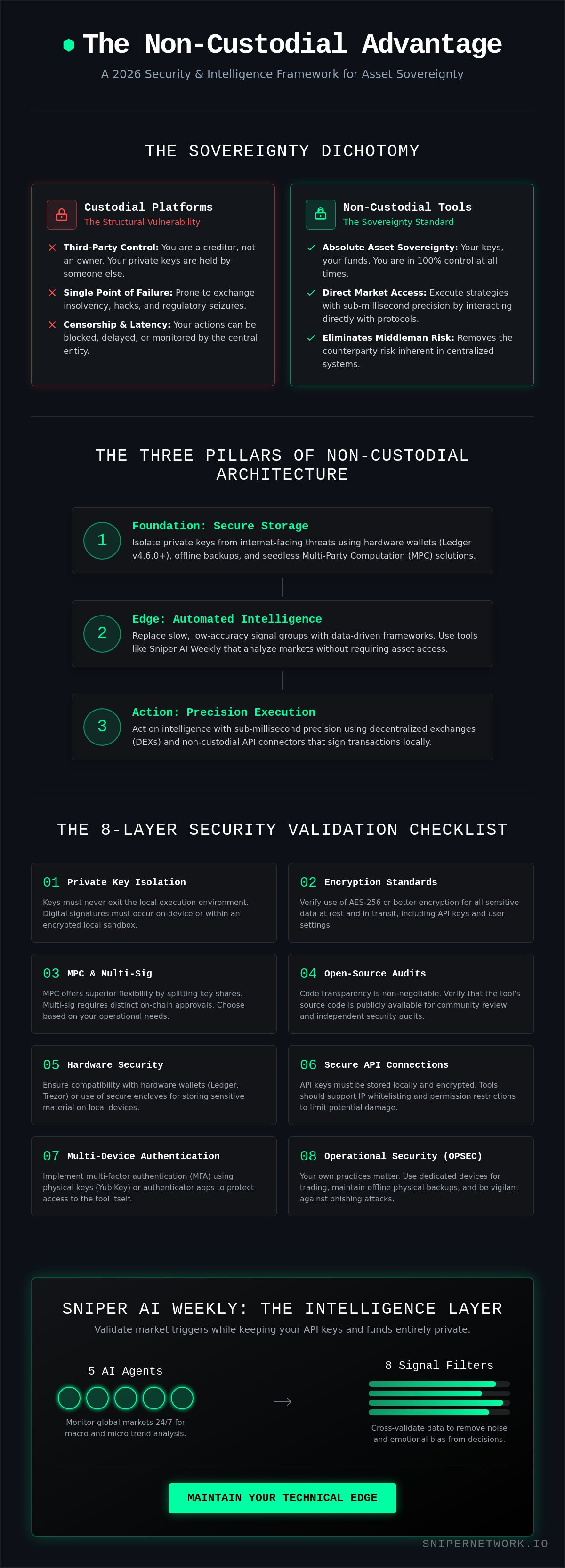
A professional non-custodial stack is built on three distinct layers. Most market participants fail because they only focus on the first.
- Storage: This is the foundation. It includes hardware wallets like Ledger (v4.6.0) or seedless Multi-Party Computation (MPC) solutions. These isolate private keys from internet-facing threats.
- Intelligence: Raw data is noise. You need automated analysis that identifies trends without requiring asset access. Systems like Sniper AI Weekly provide this institutional-grade data. They validate signals through multiple AI agents while remaining entirely decoupled from your wallet.
- Execution: This layer includes decentralized exchanges (DEXs) and non-custodial API connectors. These tools allow you to act on intelligence with sub-millisecond precision.
Relying on alternatives to crypto signal groups is now the standard for reducing emotional bias. Manual groups are slow and prone to manipulation. Automated, non-custodial crypto tools remove the human element. They monitor the chain 24/5. They trigger based on data, not hype. This is the institutional-grade framework required to maintain a market edge in 2026.
The 8-Layer Security Validation Checklist
Deploying non-custodial crypto tools requires more than a cursory glance at a feature list. It demands a systematic audit of the underlying architecture. A robust security stack is built on verifiable technical layers, ensuring that the user remains the sole arbiter of their assets. This framework moves beyond non-custodial wallets explained by regulatory bodies; it focuses on the engineering reality of 2026. Every component must be validated against a zero-trust model.
- Layer 1: Private Key Isolation. Keys must never exit the local execution environment. Digital signatures should occur on-device or within an encrypted local sandbox.
- Layer 2: Encryption Standards. AES-256 is the global standard for non-custodial data protection.
- Layer 3: Multi-Party Computation (MPC) vs. Multi-sig. MPC splits a single key into shares, eliminating single points of failure without requiring multiple on-chain signatures. Multi-sig requires distinct approvals from different devices. MPC offers superior flexibility for high-frequency environments.
- Layer 4: Open Source Audits. Check GitHub for daily commits and active pull requests. Verify public security reports from reputable firms like Trail of Bits or OpenZeppelin.
- Layer 5: Zero-Knowledge Proofs (ZKP). These allow for transaction validation and identity verification without exposing sensitive metadata or wallet balances to the tool provider.
Verifying Infrastructure and Encryption
Professional tools utilize Hardware Security Modules (HSM) to manage digital keys. You can verify HSM usage by reviewing the technical whitepaper for FIPS 140-2 Level 3 compliance. Speed is essential. Co-located servers in regions like GCP Tokyo minimize latency for execution tools without requiring custody. This architecture ensures sub-millisecond response times while maintaining a strict "no-asset-access" policy. Validates. Executes. Monitors. The system stays in constant motion without touching your capital.
Audit and Transparency Requirements
Proprietary "black box" software is a critical red flag. If a firm cannot provide a verifiable smart contract audit, the tool is a security risk. Look for audits conducted within the last six months to ensure compatibility with current network upgrades like Ethereum's post-Dencun environment. Verify the development firm's founding date and track record. Institutional-grade intelligence, such as that found in Sniper AI Weekly, relies on transparent data pipelines that do not require your private keys. You can begin optimizing your workflow by exploring the technical specifications of our infrastructure to ensure your stack meets these 2026 standards.
Intelligence vs. Execution: Evaluating Non-Custodial Tools
The 2026 market environment has rendered manual signal groups obsolete. These groups are high-risk, low-accuracy, and structurally prone to emotional volatility. Human latency is a structural risk that professional participants cannot afford. You need alternatives to crypto signal groups that operate on raw data and backtested logic. Successful participation requires a clinical separation between the intelligence layer and the execution layer. This ensures that your non-custodial crypto tools provide a market edge without exposing your assets to external management risks.
Automated Market Intelligence Framework
Intelligence tools filter the noise of 24/5 global markets without requiring access to your funds. They utilize institutional-grade AI agents to process multi-timeframe confirmations. 5 AI agents. 8 signal filters. Multi-timeframe confirmation. These ai for crypto market analysis tools monitor on-chain metrics and macroeconomic triggers simultaneously. Relying on weekly crypto market reports allows you to scale research without the fatigue of manual charting. Automated research is the only way to identify trend shifts before they are priced in. It removes the human bottleneck from the analysis phase.
The Non-Custodial Execution Stack
Execution is the final step in the sovereign stack. It involves connecting automated crypto trading insights to your local environment via secure APIs. When managing noncustodial wallets, you must implement "Trade-Only" API permissions. This technical restriction prevents the tool from initiating withdrawals. It ensures that even if an execution engine is compromised, your capital remains locked in your custody. ◈ Your API key, your funds.
Sub-millisecond execution is mandatory for 2026 volatility. This is achieved through co-located infrastructure that triggers orders based on pre-validated signals. The system monitors the chain for liquidity and slippage. Validates. Executes. Monitors. The capital remains in your custody while the engine works in the background. By maintaining this separation, you gain the speed of a professional trading floor while retaining the security of a cold vault. This architecture is the definitive standard for retail sovereign users who refuse to compromise on either performance or safety.
Operational Checklist for Self-Custody Traders
Transitioning from a passive holder to an active sovereign trader requires a rigorous operational protocol. Theory is useless without execution. You must manage your infrastructure with the same discipline as a regulated financial institution. This operational checklist ensures that your technical edge remains secure while maximizing market performance. Maintaining non-custodial crypto tools is a continuous process of validation and refinement.
- Step 1: Secure your seed phrase using a physical, offline backup method. Digital storage is a structural vulnerability. Use steel plates or titanium backups to prevent physical degradation.
- Step 2: Implement a multi-device authentication strategy. Hardware-based FIDO2 keys are the standard for all tool access. Never rely on SMS-based 2FA.
- Step 3: Establish a systematic crypto trading routine. Consistency reduces emotional noise. Data governs every entry and exit.
- Step 4: Audit permissions. Review your non-custodial crypto tools every 30 days. Revoke unused API access or smart contract permissions immediately to minimize your attack surface.
- Step 5: Use a dedicated, air-gapped machine for high-value transaction signing. Isolate your private keys from any environment that interacts with the public web.
Daily and Weekly Maintenance Routines
Daily operations focus on data validation. Monitor market reversals using ai for crypto market patterns to identify liquidity shifts before they manifest in price. Review automated weekly reports to recalibrate risk parameters based on current volatility. Check for firmware updates on hardware-based tools. For instance, the Ledger 4.6.0 update released on May 29, 2026, included critical security patches. Outdated software is a vector for known exploits. Validates. Updates. Secures.
Risk Management Integration
Set non-custodial stop-losses. These triggers must execute on-chain or via smart contracts without requiring manual approval or custodial intervention. Use crypto risk management tools to enforce pre-defined drawdown limits. This prevents the emotional bias that often leads to catastrophic losses during sharp drawdowns. Every tool in your stack must support a permissionless exit strategy. You must retain the ability to move assets at any time, independent of the tool's operational status. ◈ Your API key, your funds.
You can deploy these institutional protocols today by integrating our automated intelligence framework into your sovereign stack.
Sniper AI Weekly: The Ultimate Non-Custodial Intelligence Tool
Most non-custodial crypto tools focus exclusively on the storage layer. They provide a secure vault but ignore the intelligence required to navigate 2026 market structures. Sniper AI Weekly bridges this critical gap. It delivers institutional-grade data without ever requesting asset access or private keys. This architecture ensures you maintain absolute sovereignty while gaining a technical edge over manual participants. You don't have to choose between security and performance.
The core of this framework is a 5-agent AI system. Each agent operates with clinical autonomy. Agent 1 monitors whale wallet movements. Agent 2 analyzes order book depth. Agent 3 tracks social sentiment shifts. Agent 4 validates technical indicators. Agent 5 monitors macroeconomic news cycles. These signals are then processed through 8 distinct filters to eliminate false positives and market noise. This rigorous validation process removes the human bottleneck. It eliminates the structural risk of manual signal groups, which are often compromised by emotional bias or front-running. You receive objective, backtested intelligence that you execute within your own sovereign environment.
Clinical Precision in Market Analysis
Sniper Network operates with cold, institutional professionalism. We deliberately avoid the exuberant hype of speculative communities. Instead, we leverage high-tier infrastructure like GCP Tokyo and Claude AI for sub-millisecond data processing. This ensures every signal is validated against live global feeds with surgical accuracy. Sniper AI Weekly delivers automated research directly to your dashboard while you maintain 100% custody of your funds. ◈ Your API key, your funds. This mantra is a technical reality. Our system never asks for your seed phrase. It never holds your assets. You use trade-only API permissions to connect the intelligence layer to your execution engine. This separation of concerns is the only way to scale a professional trading operation in 2026.
Getting Started with Non-Custodial AI
Onboarding is frictionless and transparent. We offer a 'No Card Required' trial to allow for immediate technical validation of our data pipelines. You can integrate Sniper insights into your existing non-custodial wallet setup in minutes. This is not a speculative gamble; it's a high-end financial tool for the modern elite technician. Our system provides 24/5 monitoring, aligning crypto with traditional institutional hours to ensure you never miss a validated market shift. By automating the research phase, you reduce emotional latency and focus entirely on execution. You see the data. You verify the results. You retain the keys. This is the definitive standard for retail sovereign users who refuse to compromise on either security or speed.
Securing Your Sovereign Advantage in 2026
The transition to a professional self-custody framework is a technical necessity, not a choice. You've audited the 8-layer security checklist and established the critical separation between market intelligence and execution layers. By deploying high-performance non-custodial crypto tools, you eliminate the single points of failure inherent in centralized architecture and manual signal groups. This framework ensures that your private keys remain local while your market analysis remains institutional-grade.
Maintaining this edge requires constant validation and data-driven discipline. You now have the operational roadmap to secure seed phrases, audit permissions, and implement air-gapped signing protocols. The 2026 market rewards precision and speed. ◈ Your API key, your funds. Leverage our institutional-grade AI infrastructure to validate market triggers with clinical accuracy and zero asset risk. Our system provides the technical proof you need to execute with confidence in any volatility environment.
Secure Your Non-Custodial Edge with Sniper AI Weekly
Take control of your technical stack today and trade with the clinical precision of an elite technician.
Frequently Asked Questions
What exactly makes a crypto tool 'non-custodial'?
A tool is non-custodial if the user maintains absolute sovereignty over their private keys and the transaction signing process. The provider has zero access to your funds. The software acts as a technical interface to the blockchain rather than a middleman holding your assets. In this architecture, the provider cannot freeze, seize, or mismanage your capital. ◈ Your API key, your funds.
Are non-custodial tools safer than using a centralized exchange?
Non-custodial tools eliminate counterparty risk and the threat of exchange insolvency. You are not a functional creditor to a centralized entity. However, you assume full responsibility for private key management and local operational security. While you avoid exchange hacks, you must secure your own hardware and software environment against potential exploits and physical loss.
Can I use AI trading tools without giving them access to my funds?
You can deploy non-custodial crypto tools for intelligence without surrendering asset access. These systems analyze global market data and provide signals while remaining entirely decoupled from your wallet. You maintain 100% custody while leveraging institutional-grade AI to identify trends and volatility shifts in real time. This separation of concerns is the professional standard for sovereign traders.
How do I verify if a tool is truly non-custodial?
Verification requires auditing the software's source code and reviewing its API permission requirements. A truly non-custodial tool will never ask for your seed phrase or private keys. When connecting to an exchange via API, the tool should only require "Trade-Only" permissions. Withdrawal capabilities must be strictly disabled at the source to ensure your capital remains under your control.
What are the biggest risks of using non-custodial crypto tools?
The primary risks include improper seed phrase storage and local device compromise. If you lose your physical backup, asset recovery is impossible. Additionally, interacting with unverified smart contracts or malicious dApps can lead to permanent loss. Technical precision during the setup phase is mandatory to mitigate these operational vulnerabilities and ensure your non-custodial crypto tools function as intended.
Do I need a hardware wallet to use non-custodial intelligence tools?
Intelligence tools do not require hardware wallets because they only process data and do not interact with your funds. However, hardware wallets like Ledger or Trezor are essential for the execution layer of your stack. They provide physical isolation for your private keys. This ensures that even a compromised machine cannot sign unauthorized transactions or move your capital.
How does Sniper AI Weekly maintain its non-custodial status?
Sniper AI Weekly operates as a pure intelligence layer. It processes market data through 5 AI agents and 8 distinct filters but never requests wallet access or API withdrawal permissions. The system delivers institutional-grade research while your assets remain in your local custody. It provides the data. You maintain the keys. This architecture ensures zero asset risk for the user.
Is it possible to automate non-custodial trading without technical expertise?
Automation is possible through streamlined API connectors that bridge intelligence tools with your existing wallet infrastructure. You don't need to write code to benefit from professional systems. Modern platforms provide the necessary infrastructure, allowing you to execute data-driven strategies with institutional speed while maintaining the security of a self-custody environment. This lowers the barrier for retail sovereign users.