
Most traders are still chasing candles while algorithms are already liquidating their positions. In 2026, relying on social media sentiment is a liability. You've likely felt the exhaustion of market volatility and the noise of conflicting signals. It's nearly impossible to find a repeatable process when you're fighting sub-millisecond execution speeds with manual intuition. This is why quantitative crypto analysis has become the only viable path for those seeking consistent alpha.
You're going to master the mathematical and statistical models used to extract profit from these markets. We'll provide the institutional-grade intelligence needed to replace emotional trading with cold, technical precision. This framework covers the essential components of a quant strategy, from statistical filters that silence market noise to the automation logic used by professional desks. You'll learn how to view the market as a data stream rather than a series of charts. By the end of this guide, you'll have the blueprint to transition from reactive gambling to systematic execution using tools like Sniper AI Weekly.
Key Takeaways
- Replace subjective chart interpretation with systematic data patterns to build a repeatable, mathematically sound trading framework.
- Understand why exchange-grade data integrity and sub-millisecond latency are the minimum requirements for quantitative crypto analysis in 2026.
- Transition from static mathematical models to autonomous AI agents capable of detecting non-linear market inefficiencies in real-time.
- Implement advanced risk management protocols, including the Kelly Criterion and ATR-based dynamic stop losses, to preserve capital during extreme volatility.
- Utilize Sniper AI Weekly to automate market research and access clinical, institutional-grade intelligence without social media noise.
Beyond Market Intuition: Defining Quantitative Crypto Analysis in 2026
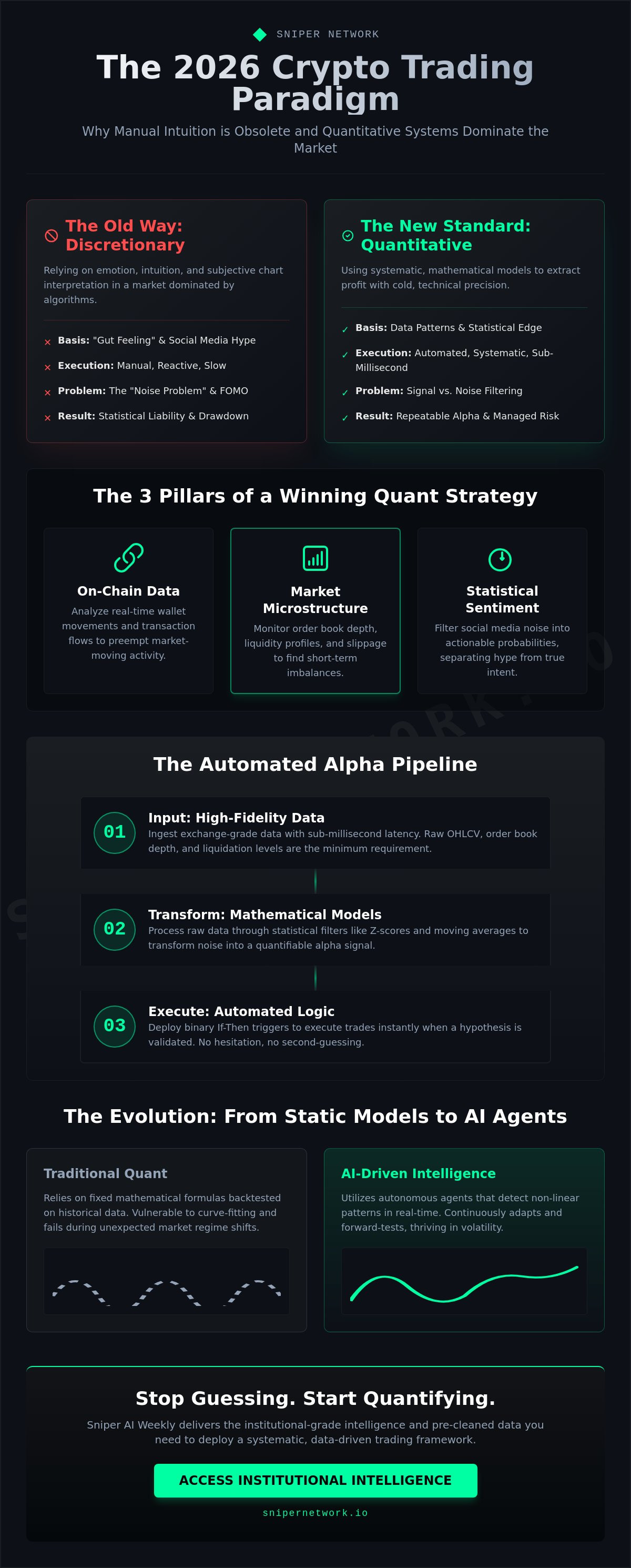
Quantitative analysis (QA) is the systematic use of mathematical and statistical models to identify trading opportunities. By 2026, this approach is no longer optional. It is a requirement for survival. The transition from "chart patterns" to "data patterns" is now complete. Modern digital asset markets move too fast for manual interpretation. To maintain a competitive edge, traders must utilize quantitative crypto analysis to process sub-millisecond data feeds. If your system cannot validate a hypothesis before a candle closes, you aren't trading; you're reacting to history.
Professional Quantitative analysis in finance provides the foundational math for these methods. However, crypto adds layers of complexity that traditional markets lack. Effective QA now rests on three specific pillars: on-chain data, market microstructure, and sentiment analysis. On-chain metrics track real-time wallet movements. Microstructure analysis monitors order book depth and slippage profiles. Sentiment analysis filters social noise into statistical probabilities. Combined, these pillars create a clinical, data-driven view of market reality.
The Failure of Discretionary Trading
Human emotion remains the primary driver of portfolio drawdown. Discretionary traders often fall victim to the "Noise Problem." Social media sentiment creates a feedback loop of false signals. This leads to entries based on FOMO rather than probability. In high-volatility environments, a "gut feeling" is a statistical liability. A quant framework replaces this with statistical significance. It removes the need for belief. It focuses entirely on backtested probability. Logic must be cold. Decisions must be binary.
Core Components of a Quantitative Model
Building a robust model requires technical precision. It's a three-step pipeline. First, Input Data. This includes OHLCV, order book depth, and liquidation levels. High-fidelity, exchange-grade data is non-negotiable. Second, Mathematical Transform. Here, raw data is processed using Z-scores, moving averages, or mean reversion formulas, often requiring multi-timeframe confirmation. This identifies the alpha. A Z-score of +3.0 triggers a mean reversion hypothesis. The system executes; the human observes. Finally, Execution Logic. This uses If-Then statements to trigger trades. No hesitation. No second-guessing. Tools like Sniper AI Weekly automate this research process, allowing individual traders to deploy institutional-grade quantitative crypto analysis without manual interference, backed by 24/5 monitoring to align with professional standards.
The Quantitative Infrastructure: Data Integrity and Feature Engineering
High-fidelity data is the bedrock of quantitative crypto analysis. In 2026, using retail-grade webhooks or delayed public APIs is a recipe for liquidation. You need exchange-grade data. Institutional desks utilize co-located servers in hubs like GCP Tokyo to reduce latency to sub-millisecond levels. Without this infrastructure, your "edge" is just a delay. Reliable infrastructure ensures that when a signal triggers, your execution logic processes it before the rest of the market can react.
Raw price data is mostly noise. Feature engineering transforms this noise into predictive signal. You aren't simply looking at price; you're looking at the rate of change in order book imbalance or the Z-score of volume profiles. This is where alpha is found. However, even the best features fail if the testing phase is flawed. Backtesting shows what worked in the past. Forward testing shows what works now. Avoid the trap of curve-fitting. A model that perfectly predicts the 2025 bull run will likely fail in a 2026 regime shift because it was over-optimized for specific historical conditions.
Data Acquisition and Cleaning
Normalizing data across Binance, Bybit, and Coinbase is essential. These exchanges use different timestamps and API structures that must be synchronized for multi-timeframe confirmation. Gaps in historical data must be filled with synthetic interpolation or removed to prevent backtest bias. Data cleaning is the process of removing outliers that skew statistical results. Without this step, a single exchange glitch can invalidate your entire strategy. Accessing this level of data doesn't require a dedicated dev team; you can leverage Sniper AI Weekly to access pre-cleaned, institutional-grade datasets.
Advanced Statistical Metrics
Standard deviation and volatility clusters help predict market breakouts before they occur. Correlation matrices are equally vital. In 2026, understanding how specific altcoins decouple from Bitcoin is a key profit driver. Use the Sharpe and Sortino ratios to measure risk-adjusted performance. A high return with a low Sortino ratio suggests unmanaged downside risk. 5 AI agents. 8 signal filters. These metrics allow you to monitor market health with clinical precision, ensuring your strategy remains grounded in math rather than hope.
Traditional Quant vs. AI-Driven Intelligence
Traditional quantitative crypto analysis relied on static algorithms. These models used linear math to predict price action. In 2026, this approach is outdated. Market conditions shift too rapidly for static formulas to adapt. The evolution has moved toward autonomous AI agents. These agents don't just calculate; they learn. They identify non-linear patterns that traditional math simply misses. By processing vast datasets in parallel, they find correlations between seemingly unrelated assets that a human analyst would never detect.
Efficiency requires reducing the "human-in-the-loop" delay. If a human must approve every trade, the alpha vanishes. High-frequency environments demand sub-millisecond execution. Using 5 AI agents in parallel provides multi-timeframe confirmation. One agent monitors the 1-minute order book depth. Another analyzes the 4-hour trend structure. A third validates on-chain wallet movements. This parallel processing ensures that every signal is backed by a consensus of data points, not a single indicator. It's a move from simple automation to true market intelligence.
The Rise of AI Market Scanners
Manual scanning is impossible. There are thousands of trading pairs across dozens of chains. AI agents scan these markets simultaneously to detect narrative shifts before they hit mainstream social media. They don't just look at price. They use Natural Language Processing (NLP) to quantify sentiment. By analyzing thousands of data points from sources like Reuters and on-chain social protocols, they turn "fear" and "greed" into actionable Z-scores. For those seeking this level of detection, an ai crypto trend scanner provides the institutional-grade intelligence required to stay ahead of retail movements.
Filtering Market Noise
Most trading bots fail because they lack sophisticated filters. They execute on every RSI cross or moving average touch. This leads to overtrading and high drawdown. Professional quantitative crypto analysis requires an 8-layer validation framework. This framework moves from raw signal to execution only after multiple confirmations. It filters out "fake-outs" and low-liquidity traps. By combining systematic crypto trading with real-time AI validation, you remove the guesswork. The system validates. The system executes. The system monitors. This clinical approach ensures that only the highest probability trades reach the execution engine. Sniper AI Weekly delivers this intelligence directly, removing the need for manual coding or subjective analysis.
The 2026 Risk Management Framework for Quants
Risk management in 2026 isn't about avoiding loss. It's about quantifying it. Most retail strategies fail because they treat risk as an afterthought. Professional quantitative crypto analysis treats risk as the primary variable. You must apply the Kelly Criterion to determine optimal position sizing based on your win-loss ratio. This mathematical formula prevents over-leverage while maximizing growth based on your specific edge. Combine this with fixed-ratio allocations to ensure no single trade compromises your entire portfolio during high-volatility events.
Static stop losses are a relic. They are easily hunted by liquidity-seeking algorithms. Use the Average True Range (ATR) to create dynamic stops that breathe with market volatility. This ensures your position remains open during normal fluctuations but closes immediately when the trend invalidates. Regime detection is equally critical. You must identify when the market shifts from trending to ranging. A model optimized for a bull trend will bleed out in a sideways range. Diversify across multiple uncorrelated assets to reduce idiosyncratic risk. If all your assets move with Bitcoin, you aren't diversified; you're just leveraged.
Security is non-negotiable. "Your API key, your funds" is the only standard Sniper Network accepts. We never hold user assets. This eliminates counterparty risk entirely. Black Swan events are a statistical certainty. You need automated circuit breakers to halt execution when volatility exceeds predefined thresholds or when smart contract vulnerabilities are detected. Stress test your 2026 models against 2022-style market crashes. If your model doesn't survive a 70% drawdown simulation, it isn't ready for production. Clinical precision requires preparing for the worst-case scenario before it happens.
Don't trust a backtest that looks too good. Follow this validation framework:
- Step 1: Hypothesis formation. Base your logic on market microstructure and order flow, not just lagging price indicators.
- Step 2: Out-of-sample testing. Validate your model on data it hasn't seen to ensure the logic isn't overfit to historical noise.
- Step 3: Monte Carlo simulations. Run thousands of iterations with randomized data to understand your true maximum potential drawdown.
To deploy these institutional-grade risk protocols and automate your execution logic, access Sniper AI Weekly today. This ensures your capital is protected by the same mathematical rigor used by professional desks. Transitioning from reactive gambling to systematic execution is the only way to survive the 2026 crypto landscape.
Institutional Intelligence for Individual Traders: Sniper AI Weekly
Speculation is a legacy process. Systematic execution is the future. Professional quantitative crypto analysis is often gate-kept by institutional desks with massive compute power and specialized development teams. Sniper AI Weekly breaks this barrier by providing individual traders with the same mathematical rigor used by elite firms. It automates the research cycle entirely. It replaces manual chart scrolling and social media noise with clinical intelligence. You receive a structured, data-backed framework every week. This creates a repeatable process that removes the emotional exhaustion of constant market monitoring.
Security is the absolute foundation of this architecture. We never ask for custody of your digital assets. You maintain 100% control of your funds on Bybit or Binance. Your API key, your funds. This non-custodial standard is the only professional protocol for 2026. It eliminates counterparty risk and ensures you aren't exposed to platform insolvency or third-party mismanagement. While others gamble with custodial bots, you operate with a secure, transparent partner. Our clinical style prioritizes reliability and institutional-grade performance over emotional appeals or speculative promises.
The Sniper AI Architecture
The system runs on high-tier infrastructure designed for maximum speed. ◈ 5 AI agents. 8 signal filters. Sub-millisecond data processing. We utilize GCP Tokyo and co-located servers to ensure zero-lag data acquisition. These agents work in parallel to validate market microstructure and on-chain movements across thousands of pairs. This architecture feeds directly into the Sniper AI Weekly reports. You get the distilled output of a multi-million dollar quant desk. The system monitors the market 24/5 to align with institutional hours. It validates every trend before it reaches your dashboard.
Getting Started with Systematic Analysis
Transparency defines our partnership. We offer 'No Card Required' trials because we value your time and security. This is the standard for any high-end financial tool. You don't need to be a programmer to leverage quantitative crypto analysis. The system handles the complex math while you handle the execution logic. Integrate these AI-driven insights into your existing trading routine to filter out market noise. Your first step is moving from curiosity to data-backed execution. The 2026 market doesn't wait for human intuition. It responds to math and speed. Stop guessing. Start calculating.
Transitioning to Systematic Execution
The era of manual speculation has ended. Markets in 2026 demand a clinical approach where data replaces gut feeling. By mastering quantitative crypto analysis, you move from reacting to price action to predicting statistical probabilities. Success requires exchange-grade infrastructure and a rigid risk management framework that accounts for both volatility and systemic events.
You now have the blueprint to implement institutional-grade intelligence. 5 AI agents. 8 signal filters. This architecture ensures every trade is validated by multiple data points before execution. Our non-custodial model maintains the professional standard: Your API, your funds. You keep 100% control of your assets while leveraging the speed of co-located servers.
It's time to stop fighting algorithms with intuition. Start your AI-driven market intelligence trial; No card required. Transitioning to a data-backed weekly cycle is the most powerful move you can make for your portfolio. We're ready to help you execute with precision.
Frequently Asked Questions
What is the difference between technical analysis and quantitative analysis?
Technical analysis relies on subjective visual patterns like "head and shoulders" or "triangles." Quantitative crypto analysis uses mathematical models to find statistical edges in raw data. While technical analysis is often discretionary, quantitative methods are purely systematic. It removes the human element by focusing on backtested probabilities rather than visual intuition.
Do I need to know how to code to use quantitative crypto analysis?
No, manual coding is no longer a barrier to entry. While institutional desks use Python and C++, Sniper AI Weekly provides the intelligence framework for you. You get the output of sophisticated quantitative crypto analysis without writing a single line of code. This allows you to focus on strategy execution rather than infrastructure maintenance.
Is quantitative trading profitable in highly volatile crypto markets?
Profitability in crypto depends on volatility. Quants don't fear market swings; they exploit them. High volatility creates the price inefficiencies and mean reversion gaps that mathematical models are designed to capture. Without movement, there is no alpha. A well-constructed model thrives when the market is most active.
What is a 'black box' in quantitative trading?
A black box is a trading system where the underlying logic and decision-making process are hidden from the user. These systems are risky because you can't audit why a trade was triggered. We prioritize transparency. Our 8-layer validation framework ensures you understand the data points driving every signal before execution happens.
How much historical data is needed for a reliable crypto backtest?
Reliability requires data from multiple market regimes. You need enough historical data to cover bull, bear, and sideways trends. For most crypto strategies, this means using at least two years of high-fidelity, exchange-grade data. This ensures the model isn't just overfit to a specific trending period but can survive a major regime shift.
Can AI really predict crypto price movements?
AI identifies patterns; it doesn't possess a crystal ball. It processes non-linear correlations that human brains can't see. By analyzing thousands of data points simultaneously, it finds high-probability setups. It's about shifting the odds in your favor through massive data processing rather than making perfect predictions about the future.
What are the risks of using automated quantitative tools?
Automation carries execution and model risks. API latency can lead to slippage, and models can decay if they don't adapt to new market conditions. This is why circuit breakers and dynamic stop losses are essential. A professional tool must include these safety protocols to protect capital during "Black Swan" events or sudden liquidity gaps.
How do I ensure my funds are safe when using AI crypto tools?
Safety is achieved through non-custodial architecture. Never use a service that requires you to deposit your assets into their wallet. Use API connections with restricted permissions on exchanges like Binance or Bybit. Your API key, your funds. This keeps you in 100% control of your capital at all times while the AI provides the intelligence.