
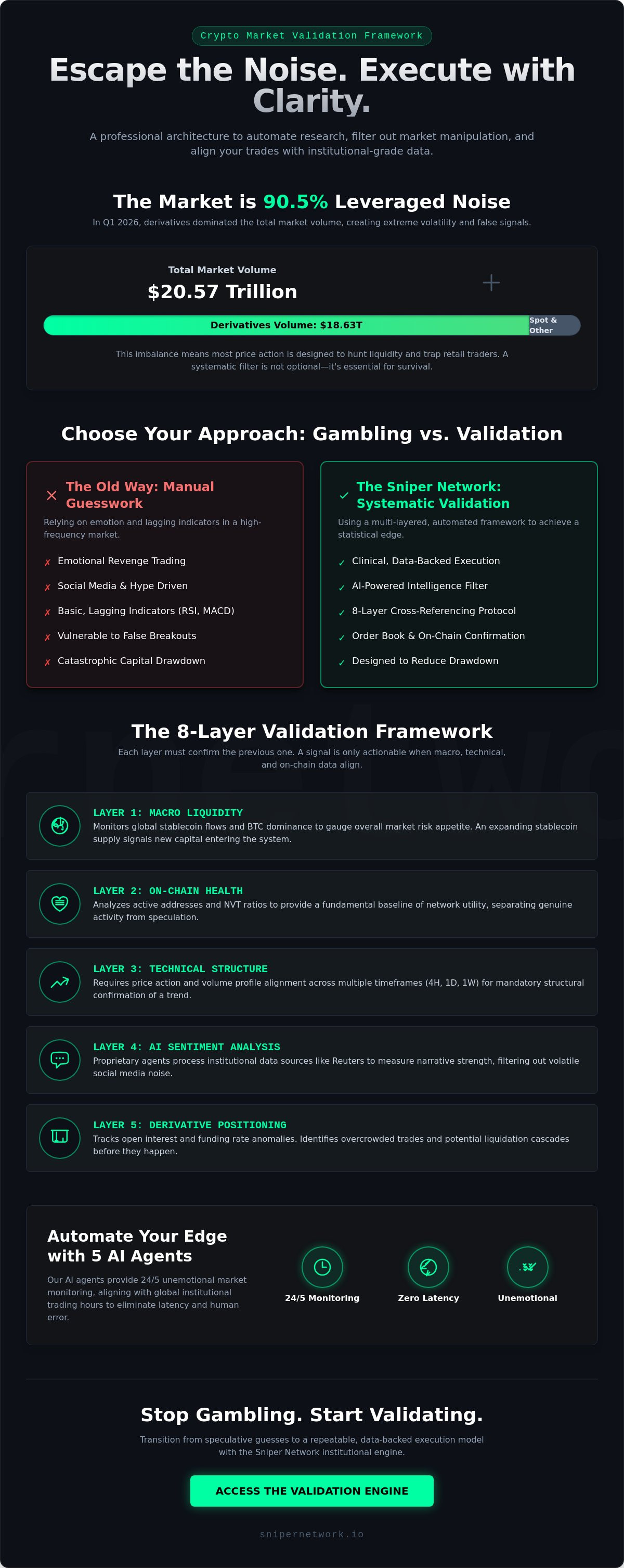
In Q1 2026, derivatives trading accounted for $18.63 trillion of the total $20.57 trillion market volume, proving that most price action is nothing more than leveraged noise. For the retail trader, this volatility creates a high-risk environment where emotional revenge trading leads to catastrophic drawdowns. You need a clinical crypto market validation framework to strip away the social media hype and align your entries with institutional-grade data. Without a systematic filter, you're simply gambling against high-frequency algorithms.
You're likely exhausted by the constant information overload and the shifting regulatory landscape under the new SEC/CFTC taxonomy. It's difficult to maintain composure when the global market cap fluctuates by 20% in a single quarter. This guide delivers a professional architecture to automate your research process using Sniper Network's proprietary AI intelligence. We'll preview the eight specific layers of validation, including order book analysis and AI conviction scoring, that transform speculative guesses into data-backed executions. You'll master a repeatable checklist designed to reduce drawdown and filter out the assets that don't meet institutional standards.
Key Takeaways
- Transition from basic technical analysis to a multi-timeframe cross-referencing process to isolate structural trends from market noise.
- Implement a clinical crypto market validation framework utilizing eight distinct layers of data, from macro liquidity to on-chain health.
- Eliminate the latency of manual signal groups by utilizing automated AI agents that remain unemotional during extreme volatility.
- Execute a five-step validation template to identify volatility anomalies and confirm breakouts with precise order book analysis.
- Scale your research with five AI agents performing 24/5 monitoring to align with global institutional trading hours.
Defining the Crypto Market Validation Framework in 2026
Validation is a binary process. It either confirms a structural trend or it identifies a trap. In the high-velocity environment of 2026, a crypto market validation framework acts as the institutional bridge between raw data and executable intelligence. It's the process of cross-referencing multi-timeframe data across technical, fundamental, and on-chain metrics to ensure a signal isn't a statistical outlier. Relying on a single indicator is no longer viable when global market caps fluctuate by 20% in a single quarter. You need a clinical architecture to filter out the noise generated by $18.63 trillion in derivatives volume.
The 2026 market requires more than basic technical analysis. With the U.S. SEC and CFTC now enforcing a strict five-category taxonomy, an asset's regulatory classification directly impacts its liquidity and risk profile. Subjective "gut feelings" lead to revenge trading and equity drawdown. Objective validation replaces intuition with cold, backtested data points. The core objective is simple: reduce the false-positive rate of entry signals through rigorous, multi-layered filtering. By the time a trade is triggered, it has already passed through a gauntlet of institutional-grade checks.
Signal vs. Noise: The Modern Trader's Dilemma
Market noise is the primary cause of retail capital erosion. In a 24/7 environment, high-frequency algorithms generate thousands of "hallucinated" signals designed to hunt liquidity in volatile futures markets. These false breakouts often lack any structural support from on-chain volume or macro flows. Utilizing automated crypto news analysis serves as your first line of defense. It filters out the social media echo chamber and focuses on verified regulatory updates and institutional movements. This ensures you're reacting to market-moving events rather than ephemeral hype.
The Architecture of Objective Validation
Elite technicians don't rely on RSI or MACD alone. They build a stack. This involves integrating Fundamental analysis with real-time order book depth and exchange net flows. A robust framework demands non-custodial intelligence. You must maintain total control of your assets while the system validates the environment. This "Elite Technician" approach prioritizes security and technical precision over speculative gambles. It treats every potential trade as a hypothesis that must be proven by data before a single dollar is risked. 5 AI agents. 8 signal filters. This is the standard for 2026.
The 8-Layer Validation Framework: A Systematic Architecture
Systematic validation requires structural depth. We break the market into eight distinct layers of intelligence. This is a protocol, not a suggestion. A crypto market validation framework is only as strong as its weakest layer. We operate on a hierarchy of data where each layer must confirm the previous one before a signal is deemed actionable. This architecture ensures that every entry is backed by macro, technical, and on-chain alignment.
- Layer 1: Macro Liquidity. We monitor global stablecoin flows and BTC dominance. When stablecoin supply expands, liquidity enters the system. BTC dominance serves as our risk-on/risk-off switch.
- Layer 2: On-Chain Health. Active addresses and NVT ratios provide the fundamental baseline. This aligns with the framework for valuing cryptocurrencies used by major financial institutions to separate utility from speculation.
- Layer 3: Technical Structure. We use multi-timeframe price action and volume profiles. Alignment across the 4H, 1D, and 1W charts is mandatory for structural confirmation.
- Layer 4: AI Sentiment Analysis. Our agents process data from Claude AI and Reuters. We measure narrative strength rather than social media noise.
- Layer 5: Derivative Positioning. We track open interest and funding rate anomalies. High funding rates often signal local tops and impending liquidations.
If you're looking to upgrade your execution, explore our institutional engine to see how these layers integrate in real-time.
On-Chain Metrics and Technical Synergy
On-chain data is the truth layer. Price action can be manipulated by low-volume wash trading; wallet movements cannot. By utilizing systematic crypto trading, we link price action directly to large-scale capital flows. We specifically monitor exchange net flows to identify supply shocks. Whale accumulation patterns often precede technical breakouts. When on-chain accumulation meets a technical resistance flip, the probability of a sustained trend increases significantly. We ignore retail distribution and follow the smart money.
Sentiment and Narrative Validation
Narratives drive the most aggressive price moves in crypto. Layer 6 is Social Dominance, where we measure the velocity of asset mentions to find emerging trends. Layer 7 is the Narrative Lifecycle. We distinguish early adoption from exit liquidity hype. Through sentiment analysis in cryptocurrency, we quantify fear and greed with mathematical precision. This identifies when a trend is exhausted and prevents you from buying the top of a social media frenzy. We validate the narrative before it becomes common knowledge.
AI Agents vs. Manual Signal Groups: The Efficiency Gap
Latency is the silent killer of retail capital. In the 2026 market environment, the delta between a validated entry and a liquidity trap is measured in milliseconds. Manual signal groups operate with an inherent delay that makes them obsolete in a landscape dominated by high-frequency institutional algorithms. While a human analyst manually parses a chart, the market has already moved. A crypto market validation framework is only effective if it can be executed at the speed of the data it processes.
Human analysts fail during flash crashes because they are governed by neurobiology. Fear and greed are not just emotions; they are physiological responses that cloud judgment and lead to "revenge trading" or frozen indecision. AI agents are immune to these pressures. They maintain clinical precision, executing complex 8-layer filters in sub-milliseconds without hesitation. This speed ensures that your entry remains aligned with the structural trend identified by the data, rather than a lagging reaction to price movement that has already occurred.
Transparency is the final differentiator. Manual groups often rely on "curated" screenshots of winning trades while burying the losses in a deleted history. AI-driven systems provide verifiable, backtested results across thousands of data points. This allows for an objective assessment of performance. You aren't following a "guru"; you're utilizing a high-end financial tool designed for technical precision.
The Downfall of the 'Signal Group' Model
The "signal group" model is structurally flawed. Many are designed as "pump and dump" mechanics where the group owner front-runs the members. Beyond the ethical concerns, the technical risks are severe. Custodial signals, where you are encouraged to move funds to obscure platforms, are a primary vector for asset loss. We operate on a "Your API key, your funds" protocol. You maintain total asset control while the engine validates the market. Effective crypto risk management tools must be automated to counter the speed of modern volatility. Manual intervention is too slow to protect equity during a $20 trillion quarterly volume surge.
Automated Intelligence as a Competitive Edge
We leverage GCP Tokyo infrastructure to ensure minimal data latency and co-location with major exchange engines. This is the institutional standard. The math of market coverage is simple: 5 AI agents can monitor thousands of asset pairs simultaneously across multiple timeframes. A human mind cannot compete with this scale. Automated research insights don't just find better trades; they reduce trader burnout and the psychological urge of FOMO. By the time the notification hits your device, the heavy lifting of validation is already complete. This is how the elite technician maintains a competitive edge in 2026.
Implementation Template: Validating Assets in 5 Steps
Executing a crypto market validation framework is a high-stakes protocol. It requires a rigid sequence of operations to ensure capital preservation. In 2026, manual entry is a liability. You need a systematic implementation template that moves from broad market scans to granular execution in under a second. This five-step process is the operational standard for the elite technician. It removes the psychological friction of decision-making and replaces it with data-driven triggers.
- Step 1: Scan for volatility anomalies. You don't browse charts. You deploy an automated crypto market scanner to isolate assets showing abnormal volume or price deviations. This is your top-of-funnel filter.
- Step 2: Cross-reference technical breakouts. Validate the technical resistance flip with on-chain volume confirmation. If the price moves without a corresponding increase in active addresses or exchange outflows, the signal is discarded.
- Step 3: Filter news sentiment. AI agents parse real-time feeds from Reuters and social channels. We detect artificial hype by analyzing narrative velocity. If the sentiment is driven by bot-driven echo chambers rather than structural news, we pass.
- Step 4: Check derivatives funding. We analyze open interest and funding rate anomalies. This step identifies crowded trades and potential long-squeeze traps. We only enter when the positioning is balanced or showing signs of shorts being trapped.
- Step 5: Execute via non-custodial API. The trade is triggered through a secure API with pre-set risk parameters. Your API key, your funds. No manual intervention required.
To begin securing your entries with these protocols, deploy the 5-step template today.
The Sub-Millisecond Execution Checklist
Hardware is the foundation of speed. We utilize co-located servers in GCP Tokyo to minimize data latency between our agents and exchange engines. Security is non-negotiable. Every connection is AES-256 encrypted to protect your API credentials. For signal validation, we employ the "Rule of Three." This requires a multi-timeframe confirmation across the 15M, 1H, and 4H charts. Only when all three timeframes align with the 8-layer framework does the system trigger an execution. 5 AI agents. 8 signal filters. Sub-millisecond precision.
Risk Assessment within the Framework
A trade without an exit plan is a gamble. We define the Invalidation Point before the trade is placed. The Invalidation Point is the clinical price level where the 8-layer thesis is statistically void. Once this level is hit, the engine executes a hard stop. Portfolio allocation is never static. We use validation strength scores to determine position sizing. A signal that passes all 8 layers with high conviction scores receives a larger allocation than a 5-layer partial confirmation. This clinical approach ensures that your drawdown remains controlled even during periods of 20% market volatility.
Sniper AI Weekly: Automating the Validation Architecture
Sniper AI Weekly is the operational realization of the crypto market validation framework. It's not a suggestion; it's a system. For the elite technician, manual research is a bottleneck that leads to missed entries and emotional fatigue. We've automated the entire gauntlet. 5 AI agents. 8 signal filters. This engine operates 24/5 to align with the institutional hours of the global financial markets. It transforms raw data into clinical, actionable intelligence. We don't guess. We validate.
We bridge the gap between retail limitations and institutional capabilities. By integrating high-tier data feeds from Reuters and leveraging the reasoning power of Claude AI, we provide a level of market depth previously reserved for professional trading floors. Our non-custodial architecture ensures that you maintain total control. Your API key, your funds. We provide the intelligence; you retain the assets. This protocol eliminates the risk of custodial failure while providing the data-driven edge needed to navigate a $20 trillion quarterly market volume.
Inside the Sniper Intelligence Engine
The engine utilizes multi-timeframe algorithms to identify structural trends before they become obvious to the retail crowd. This isn't about chasing candles. It's about trend identification through mathematical alignment. Every subscriber receives a weekly data-driven report. This is your strategic playbook for navigating market volatility. It breaks down the 8-layer validation for the week's most promising assets, providing a clinical overview of macro liquidity and on-chain health. We offer a "No Card Required" trial. This allows serious traders to verify the system's technical precision without friction. You get immediate access to backtested results and real-time signal filters.
Why Systematic Traders Choose Sniper
Systematic traders prioritize logic over luck. Our analysis is clinical and entirely unemotional. We strip away the noise of social media influencers and focus on the data that moves markets. Sniper Network acts as the bridge between high-tier infrastructure, like our co-located servers in GCP Tokyo, and your individual trading desk. You get the speed of a professional firm with the autonomy of an individual trader. This architecture is designed to reduce drawdown and maximize the efficiency of your crypto market validation framework. Our 5 AI agents work in constant motion to ensure no structural shift goes unnoticed.
◈ Start your Sniper AI Weekly trial and automate your validation framework.
Institutional Execution for the Modern Technician
The transition toward a clinical crypto market validation framework is a requirement for survival. Manual analysis is too slow to counter the high-frequency algorithms that dominate the 2026 market landscape. By automating your research gauntlet, you eliminate the emotional bias that leads to revenge trading. You replace subjective intuition with cold, backtested data points. This systematic approach ensures that every entry is backed by macro, technical, and on-chain alignment before capital is committed.
Our architecture leverages 5 AI agents and 8 signal filters to monitor the market 24/5. We provide the essential bridge between retail limitations and professional trading floors through GCP Tokyo infrastructure and institutional-grade Claude AI integration. This ensures sub-millisecond precision and technical alignment across all eight layers of validation. Your capital deserves the protection of high-end financial tools. Secure your portfolio with the same infrastructure used by elite technicians.
◈ Access Sniper AI Weekly: The Automated Validation Engine
It's time to trade with the precision of an elite technician. Secure your edge today.
Frequently Asked Questions
What is a crypto market validation framework?
A crypto market validation framework is a clinical architecture designed to cross-reference technical, fundamental, and on-chain data to confirm structural trends. It replaces subjective intuition with objective, backtested data points. This process ensures that every entry signal is filtered through multiple layers of intelligence to reduce the false-positive rate. It is the institutional bridge between raw market noise and executable data.
Why is manual crypto validation failing in 2026?
Manual validation is too slow for the 2026 environment. With $18.63 trillion in derivatives volume during Q1, market shifts occur in sub-milliseconds. Human analysts suffer from emotional bias and cognitive latency, leading to revenge trading and missed entries. A manual approach cannot process 24/5 global data feeds at the speed required to protect equity during high-volatility events. Automated systems are now the mandatory standard.
How do AI agents improve market intelligence?
AI agents provide a competitive edge by executing 8-layer filters with sub-millisecond precision. They monitor thousands of asset pairs simultaneously across multiple timeframes. By integrating high-tier data from Reuters and Claude AI, these agents identify narrative velocity and structural shifts before they're visible to retail traders. They remain entirely unemotional, executing trades based on mathematical alignment rather than market fear or greed.
What are the 8 layers of crypto validation?
The framework consists of Macro Liquidity, On-Chain Health, Technical Structure, AI Sentiment, and Derivative Positioning. It also includes Social Dominance, Narrative Lifecycle, and a clinical Risk/Invalidation check. This crypto market validation framework ensures that a signal is only triggered when all layers align. This gauntlet filters out "hallucinated" signals generated by high-frequency liquidity hunting algorithms in the futures markets.
Is Sniper AI Weekly a custodial service?
No. Sniper AI Weekly is a non-custodial intelligence service. We provide the data-driven validation, but we never hold your funds. You maintain total asset control via secure API connections. Our protocol follows the "Your API key, your funds" mantra. All connections are AES-256 encrypted to ensure your credentials remain secure while our engine monitors the market.
Can I use this framework for Bybit futures trading?
Yes. The framework is specifically designed to handle the volatility of platforms like Bybit. By analyzing derivative positioning and funding rate anomalies, it identifies potential long-squeeze traps common in futures trading. The 5-step implementation template ensures that entries are validated against order book depth and open interest. This clinical approach helps minimize drawdown during the rapid liquidations typical of leveraged environments.
How does on-chain data confirm a market signal?
On-chain data serves as the truth layer of the framework. While price action can be manipulated, wallet movements and exchange net flows are transparent. Metrics like the NVT ratio and active address counts confirm whether a technical breakout has structural support. If a price move lacks corresponding on-chain accumulation from "whales," the framework identifies it as exit liquidity hype and discards the signal.
What is the difference between a signal group and a validation framework?
Signal groups are manual, lagging, and often lack transparency. They frequently rely on curated screenshots and subjective "analyst" opinions. A validation framework is an automated, clinical architecture built on high-tier infrastructure like GCP Tokyo. It provides verifiable, backtested results and executes filters in real-time. Unlike signal groups, a framework prioritizes technical precision and institutional-grade data over social media hype.