
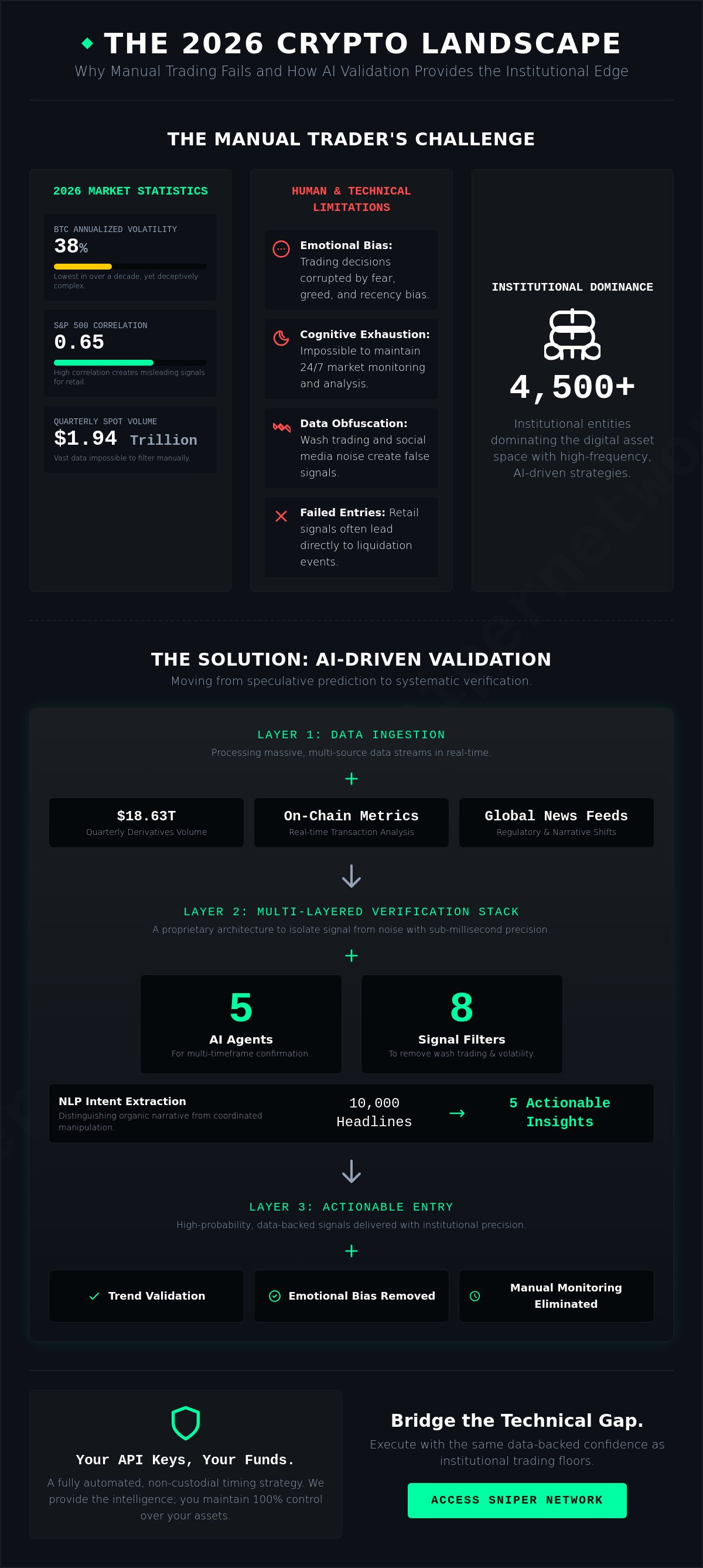
Bitcoin's annualized volatility reached 38% in early 2026, the lowest level in over a decade. Despite this apparent stability, the S&P 500 correlation hit a high of 0.65 on March 12, creating a complex environment where retail signals often lead to liquidation. You're likely experiencing the emotional exhaustion of 24/7 monitoring and the frustration of signals that fail the moment they're executed. The challenge isn't a lack of data. The challenge is filtering the $1.94 trillion in quarterly spot volume to find actionable entries. Mastering the process of using AI to identify crypto market trends is the only way to separate institutional signal from retail noise.
You'll learn how to utilize multi-layered AI algorithms to filter market noise and identify high-probability trend reversals with institutional precision. This article provides a systematic validation framework designed for the 2026 market landscape. We'll break down the technical requirements for multi-timeframe confirmation and explain how to deploy a verification stack that mirrors professional trading floors. By the end, you'll understand how to execute with the same data-backed confidence as the 4,500 institutional entities now dominating the digital asset space. We move past speculative hype. We focus on technical proof.
◈ Trend Validation: Recognize why price prediction is a marketing construct and how using AI to identify crypto market trends provides the only reliable framework for 2026 market timing. It's about technical validation. This approach filters noise to focus on high-probability reversal points with institutional precision.
◈ Advanced Noise Filtration: Identify real growth by filtering wash trading and artificial volatility from genuine institutional volume. AI agents process on-chain metrics to ensure you aren't reacting to manipulated data or false signals common in 24/7 markets.
◈ Multi-Layered Verification Stack: 5 AI agents. 8 signal filters. This architecture isolates actionable entries with sub-millisecond precision. Multi-timeframe confirmation drives every signal, removing emotional bias and the exhaustion of manual monitoring.
◈ Institutional Intelligence Ingestion: Bridge the gap between retail limitations and professional execution through NLP intent extraction and global news feed processing. The system monitors the agentic economy to align your strategy with the 2026 market reality.
◈ Sniper AI Weekly Framework: Deploy an automated, non-custodial timing strategy that maintains the "Your API key, your funds" security standard. This system delivers institutional-grade intelligence without requiring direct asset custody or manual group participation. It's your technical bridge.
The Volatility Gap: Why Manual Market Timing Fails in 2026
Market timing in 2026 is no longer a matter of intuition. It is the objective identification of trend exhaustion and reversal points. In a market where Bitcoin's annualized volatility sits at 38%, manual analysis is structurally insufficient. The 24/7 nature of digital assets creates a paradox. Human cognitive limits cannot process sub-millisecond price movements across a $1.94 trillion quarterly spot market. Using AI to identify crypto market trends has shifted from a luxury to a technical necessity. Precision requires automation.
The environment is saturated with noise. Social media sentiment and sophisticated wash trading distort traditional technical indicators. Retail traders often mistake artificial volume for organic growth. This leads to entries at local tops and exits at local bottoms. Systematic, data-driven validation is the only way to filter this distortion. You aren't just fighting price action. You're fighting data obfuscation. Without a systematic framework, you're trading against a ghost in the machine.
The Cognitive Cost of Manual Analysis
Manual trading carries a heavy psychological burden. Emotional bias frequently corrupts chart pattern recognition. Recency bias is particularly dangerous in volatile cycles. Traders over-weight the last 48 hours of price action while ignoring macro exhaustion. Manual stop-losses face another structural threat. Algorithmic liquidity providers often hunt these clusters to trigger liquidations. This creates artificial volatility that stops out retail positions before the actual trend resumes.
Institutional Dominance and the Retail Edge
The 2026 market is an institutional arena. Over 4,500 entities now hold spot Bitcoin ETFs. These players utilize Algorithmic trading to execute at speeds inaccessible to humans. High-frequency trading firms use AI to front-run retail sentiment. Bridging this gap requires institutional-grade intelligence. Transition from guessing to verifying. Systematic tools ingest on-chain metrics in real-time. This provides a technical edge. It identifies trend reversals before they become obvious to the broader market.
The Mechanics of AI-Driven Crypto Market Intelligence
◈ Infrastructure is the foundation of validation. In the 2026 market, data is a flood, not a stream. Successful execution depends on processing $18.63 trillion in quarterly derivatives volume alongside real-time on-chain metrics. Effective systems for using AI to identify crypto market trends ingest order book depth and global news feeds simultaneously. This requires co-location in high-tier environments. GCP Tokyo provides the sub-millisecond connectivity necessary to monitor liquidity shifts before they manifest in retail price action. Machine Learning (ML) models then identify non-linear correlations across multi-timeframe data. They spot anomalies in DeFi lending rates, where 30-day volatility has dropped below 0.25 on average. These subtle shifts in capital efficiency often precede major trend reversals. Precise data ingestion ensures the system reacts to reality, not lag.
NLP and Sentiment Filtering
Natural Language Processing (NLP) serves as the primary filter for narrative noise. It distinguishes between organic narrative shifts and coordinated shilling campaigns. 10,000 daily headlines are reduced to 5 actionable insights. This is critical for real-time regulatory impact assessment. For example, when the SEC and CFTC issued their joint interpretive release on March 17, 2026, AI agents analyzed the legal intent within seconds. This automation removes the lag between news breaking and trend confirmation. It identifies whether a headline is a fundamental shift or a temporary volatility spike. It's about extracting actionable intent from the noise of the 24/7 news cycle.
Quantitative Pattern Recognition
Quantitative models in 2026 move beyond legacy indicators like RSI or MACD. AI agents detect hidden liquidity clusters where institutional orders are parked. Every signal undergoes 8-layer validation to reduce false positives. This involves multi-timeframe confirmation, where a 15-minute breakout is validated against 4-hour trend strength. Using AI for crypto trading allows for the detection of intent-based execution patterns. These patterns reveal where large players are positioning. The system monitors protocols like x402, which forecasts weekly volumes exceeding $100 million for automated agent transactions. By analyzing these autonomous flows, the ML models identify the next phase of market structure before the retail crowd reacts. If you want to see this precision in action, explore how automated intelligence handles sub-millisecond volatility.
Validation vs. Prediction: Filtering Noise to Identify Real Trends
"Price prediction" is a marketing construct designed to appeal to retail hope. In a professional setting, we discuss "Trend Validation." Prediction is speculative. It attempts to guess the future. Validation is the mathematical confirmation of an existing shift in market structure. By using AI to identify crypto market trends, we move from guessing where the price might go to verifying where the capital is actually moving. Validation requires a search for disproof. A system that only looks for reasons to enter is a liability. Our framework searches for data points that invalidate a trend before a signal is ever generated. We prioritize technical proof over speculative hype.
Noise is the primary enemy of precision. In Q1 2026, the $18.63 trillion derivatives market was flooded with synthetic volume. AI agents identify wash trading by analyzing the sub-millisecond relationship between order book changes and executed trades. If volume growth lacks corresponding on-chain depth, the signal is discarded. This clinical approach is vital for navigating crypto market volatility with AI analysis. For example, during the March 2026 correlation peak, our agents identified a trend reversal by filtering out SPX-driven noise. The system stayed flat while retail groups were liquidated on a false breakout. It's about protecting capital through data.
The 8-Layer Validation Framework
We utilize a multi-tiered verification stack to ensure institutional precision. It's a systematic filter.
Layers 1-3. Technical indicators. Volume-price divergence.
Layers 4-6. On-chain wallet movements. Exchange net flows.
Layers 7-8. Macro sentiment. Cross-asset correlations.
Specifically, we monitor the 0.65 correlation between the S&P 500 and digital assets. This stack ensures no single data point triggers an execution. Every signal must survive eight layers of scrutiny. If one layer fails, the trade is voided. This is how using AI to identify crypto market trends produces high-probability results.
Reducing False Positives
False signals often manifest as "dead cat bounces" or "liquidity grabs." AI filters these by requiring multi-timeframe confirmation. If a 15-minute breakout isn't supported by 4-hour trend strength, it's ignored. This protects capital from traps where algorithmic providers hunt retail stop-losses. The exit is as clinical as the entry. The system triggers an exit before trend exhaustion becomes visible to manual chartists. We don't try to be the user's friend. we try to be the user's most powerful tool. We prioritize reliability over the exuberance of "catching the exact top."
Implementing a Data-Driven Timing Strategy
◈ Implementing a strategy for using AI to identify crypto market trends is a technical deployment. It's not a creative exercise. Successful execution requires a rigid 4-step protocol to bridge the gap between retail speculation and institutional-grade results. Precision is the priority. We move from theory to execution through a systematic verification stack that eliminates the cognitive fatigue of manual monitoring.
◈ Step 1. Define your risk parameters. Utilize a crypto risk management tools framework to establish mathematical boundaries. This ensures every AI-validated signal operates within predefined drawdown limits.
◈ Step 2. Select a non-custodial intelligence source. Security is a structural requirement. We adhere to the "Your API key, your funds" mantra. Intelligence should be an external layer, never a custodian of your capital.
◈ Step 3. Establish a weekly review cycle. Digital asset narratives shift rapidly. A weekly review allows you to adjust your model to new regulatory interpretations or liquidity shifts, such as the March 12 correlation high of 0.65.
◈ Step 4. Automate the research phase. Manual data ingestion is a liability. Automation ensures that using AI to identify crypto market trends remains a clinical process, unaffected by the emotional exhaustion of 24/7 markets.
The Non-Custodial Advantage
Custodial "managed" AI bots represent a significant security risk. They create a single point of failure. The only viable standard for 2026 is a non-custodial architecture. Your assets stay on your exchange. The AI intelligence validates the trend and triggers the execution via encrypted API. This setup removes the risk of platform insolvency or unauthorized access to your core funds. It's about maintaining absolute control while leveraging institutional-grade speed.
Transitioning to Systematic Trading
Systematic trading is the antidote to FOMO. You must move from daily "chart-watching" to a weekly "intelligence-reviewing" mindset. Use systematic crypto trading to build a data-driven framework that ignores the noise of social media shilling. Trust the data. The machine doesn't feel the pressure of a 38% volatility spike. It only sees a validation point or an invalidation point. Developing this clinical mindset is what separates profitable technicians from speculative gamblers. If you're ready to deploy this level of precision, start your automated intelligence trial today.
Sniper AI Weekly: Automated Institutional-Grade Timing
◈ Professional market timing requires more than a collection of indicators. It requires a verification stack. Sniper AI Weekly provides the technical bridge for retail traders to access institutional-grade precision. We don't offer a manual signal group. We provide a clinical intelligence framework. 5 AI agents. 8 signal filters. This architecture performs the heavy lifting of using AI to identify crypto market trends, allowing you to focus on execution rather than data ingestion. We prioritize technical proof over speculative hype. Our system operates as a silent engine, validating market structure in the background while you maintain absolute control over your capital.
◈ Security is a structural requirement. We never hold user funds. Our non-custodial intelligence model adheres to the "Your API key, your funds" mantra. We provide the validated data; you maintain the assets on your chosen exchange. This removes the counterparty risk associated with custodial managed bots. By using AI to identify crypto market trends through a weekly delivery cadence, we align our intelligence with institutional market cycles. This approach eliminates the emotional exhaustion of 24/7 monitoring. It replaces "guessing" with "verifying."
Automated Research, Manual Control
The weekly cadence is a deliberate design choice. It matches the rhythm of professional trading desks. Manual analysis often leads to analysis paralysis, where 100+ indicators provide conflicting signals. Sniper AI Weekly reduces this complexity. We deliver curated, high-probability trend data. During the Q1 2026 volatility phase, our system monitored the $1.94 trillion spot market to identify critical support at $72,400. While retail groups were trapped by "dead cat bounces," our agents identified the actual trend exhaustion. This allowed our users to remain flat or position for the reversal with data-backed confidence.
Institutional Infrastructure for Individuals
Our stack utilizes high-tier infrastructure typically reserved for HFT firms. We leverage Claude AI for NLP intent extraction and GCP Tokyo for sub-millisecond co-location. This ensures our data ingestion is faster than the retail crowd. Performance is transparent. We provide backtested results alongside real-world market execution data. We don't try to be your friend; we try to be your most powerful tool. The "Elite Technician" persona demands data, not persuasion. We deliver exactly that.
◈ Start your 7-day trial of Sniper AI Weekly (No card required)
Professionalizing Your Execution Framework
The 2026 market landscape demands a shift from discretionary guessing to systematic validation. You've learned how a multi-layered verification stack protects capital by filtering synthetic volume and narrative noise. Success no longer depends on 24/7 screen monitoring. It depends on the technical precision of your intelligence layer. Mastering the process of using AI to identify crypto market trends is the final step in professionalizing your trading operation. You've transitioned from reacting to the market to validating it with institutional speed.
Precision is a technical requirement. Sniper AI Weekly provides the bridge. 5 AI agents. 8 signal filters. Sub-millisecond data processing. Our framework ensures you maintain absolute control while leveraging the same infrastructure as high-frequency trading floors. It's time to trade with data-backed confidence. The "Elite Technician" persona values results over hype. We provide the data to drive those results.
◈ Access Institutional-Grade AI Intelligence with Sniper AI Weekly
Your API key, your funds. The system is ready for your deployment.
Frequently Asked Questions
Is AI for crypto market timing more accurate than human analysis?
AI is objectively more accurate because it eliminates cognitive biases like FOMO and recency bias. Human traders cannot process sub-millisecond data across a $1.94 trillion quarterly spot market. Using AI to identify crypto market trends allows for the simultaneous analysis of on-chain metrics, order books, and macro correlations that exceed human processing limits. It replaces emotional guessing with technical validation.
How does AI filter out fake trading volume or "wash trading"?
AI agents analyze the mathematical relationship between order book depth and executed trades. If a volume spike lacks corresponding on-chain movement or liquidity support, the system flags it as synthetic. This multi-layered verification ensures that signals are based on organic capital flows rather than manipulated exchange data. It's about identifying real intent behind the noise.
Can AI predict crypto market crashes before they happen?
Professional AI models focus on trend validation rather than speculative prediction. They identify trend exhaustion by monitoring cross-asset correlations, such as the 0.65 correlation between the S&P 500 and Bitcoin. When multiple layers of the verification stack signal a divergence, the system identifies a high-probability reversal point. This allows for defensive positioning before the broader market reacts to the volatility.
Do I need to give an AI tool access to my private keys?
No. Professional standards require a non-custodial architecture. You should only utilize tools that connect via encrypted API keys with "Trade Only" permissions. This follows the "Your API key, your funds" security protocol. You maintain absolute control over your assets while the AI provides the intelligence layer necessary for using AI to identify crypto market trends with precision.
What is the difference between an AI signal group and Sniper AI Weekly?
Sniper AI Weekly is a systematic intelligence framework, not a manual signal group. Most groups rely on discretionary analysis from individuals, which introduces human error. Sniper AI Weekly utilizes 5 AI agents and 8 signal filters to produce clinical, data-backed reports. It's a technical bridge designed for the Elite Technician who demands institutional-grade performance over social media hype.
How often should I update my strategy based on AI market trend data?
A weekly review cycle is the institutional standard for 2026. This cadence matches professional market cycles and prevents the over-trading common in 24/7 retail markets. Updating your strategy once a week based on validated intelligence allows you to adjust to narrative shifts without falling into the trap of reacting to temporary volatility spikes.
Can AI identify "gem" coins before they trend on social media?
AI identifies technical validation and institutional positioning rather than speculative "gem" hunting. It spots volume-price divergence and exchange net flows that suggest large-scale accumulation. By the time a token trends on social media, the high-probability entry point has often passed. AI identifies these shifts in market structure before the retail narrative begins.
Is AI-driven market timing suitable for beginner traders?
It's highly suitable because it removes the steep learning curve of technical analysis. Beginners often suffer from analysis paralysis or emotional exhaustion from 24/7 monitoring. A systematic AI framework provides a clear, data-backed path for execution. It allows new traders to follow an institutional-grade protocol rather than relying on unverified advice from manual analysis groups.