
Analysis paralysis isn't a psychological flaw. It's a technical failure of your filtering stack. With the total crypto market capitalization at $2.55 trillion and the July 1 MiCA deadline forcing rapid regulatory shifts, the data volume is engineered to overwhelm. You're experiencing crypto information overload because your current process relies on manual synthesis. It's impossible to reconcile conflicting expert opinions while Bitcoin fluctuates in a tight $63,000 range. You're currently trading with fatigue instead of data, watching entries pass while you verify outdated charts.
You can't outwork a 24/5 global market, but you can automate the validation. This guide will show you how to transition from emotional hesitation to clinical execution by leveraging AI-driven validation frameworks. We'll outline a repeatable system to reduce your screen time while maintaining institutional-grade intelligence. We'll examine how to deploy filters that mirror the precision of professional trading desks, allowing you to ignore the noise and execute only on verified signals. It's time to stop monitoring the market and start executing against it.
Key Takeaways
- Deploy an 8-layer validation framework to eliminate the liquidation risks associated with single-indicator trading strategies.
- Identify and neutralize crypto information overload by filtering out social "cheap fakes" and unverified market noise.
- Transition from manual, hours-long research to sub-millisecond AI validation to remove emotional bias and FOMO.
- Execute a systematic "Information Diet" to audit your data inputs and implement a non-custodial intelligence layer.
- Leverage Sniper AI Weekly to consolidate 40 hours of manual analysis into a clinical, automated intelligence stream.
The Cognitive Cost of Crypto Information Overload
In the high-velocity 2026 market, crypto information overload is a measurable technical bottleneck. It's defined as the saturation of decision-making capacity where the volume of incoming data exceeds the processing bandwidth of the technician. This isn't just a psychological state; it's a structural failure of the filter. When your cognitive load is maxed out, your ability to execute clinical trades drops to zero. You aren't trading the market. You're trading your own confusion. This phenomenon of information overload is a historical constant, but it has reached a lethal velocity in digital asset markets.
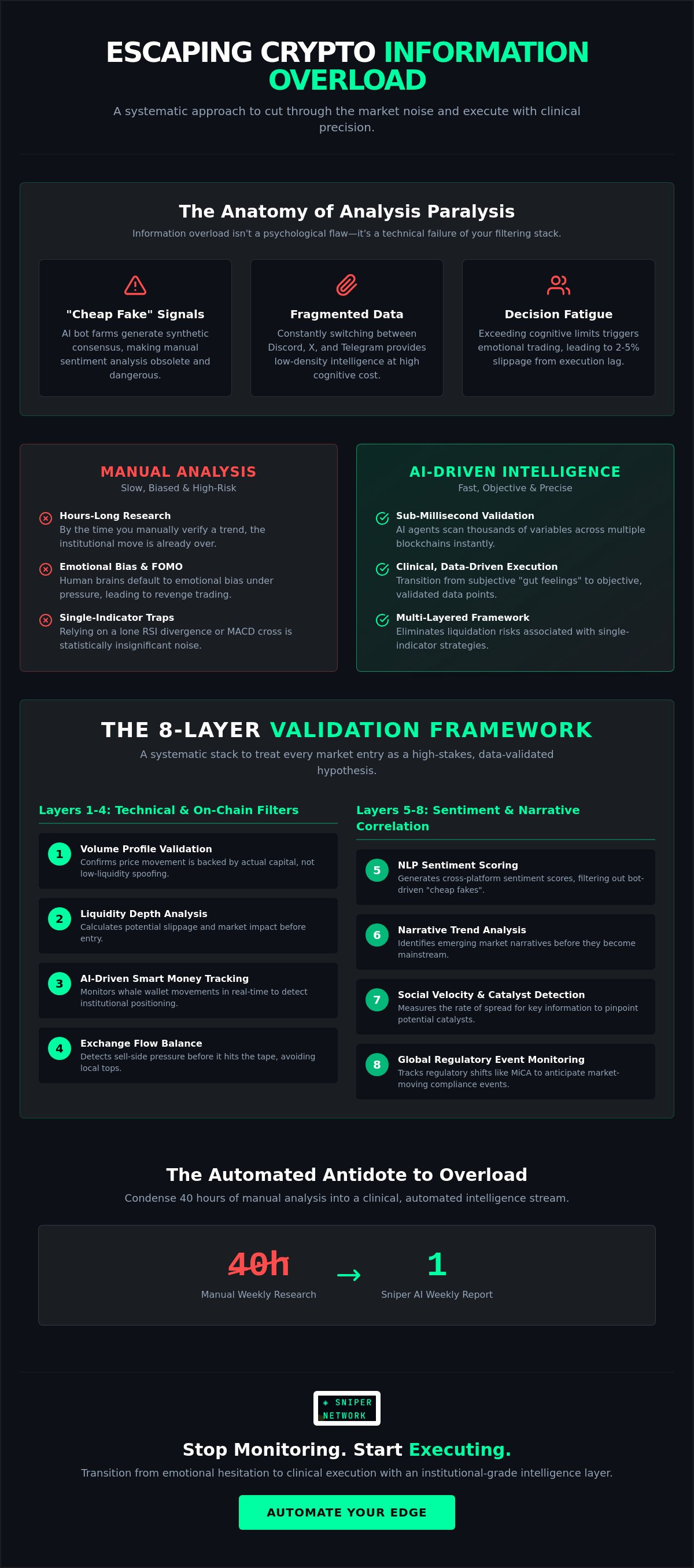
The "Cheap Fakes" problem has reached a breaking point. Social signaling, once a viable metric for sentiment, is now heavily manipulated by AI-driven bot farms. These systems generate synthetic consensus across X and Discord in milliseconds. Relying on manual sentiment analysis in 2026 is like bringing a knife to a drone strike. This reliance on unreliable data leads to analysis paralysis. Technical observations show that traders suffering from execution lag often lose between 2% and 5% in slippage per trade. This cost is the direct result of waiting for manual confirmation in a sub-millisecond market. Transitioning from "manual research" to "systematic intelligence" is the only path to maintaining a competitive edge.
The Anatomy of Market Noise
Market noise is the delta between social media sentiment and on-chain reality. While an influencer's Telegram group might signal a "buy," the blockchain often shows institutional distribution. Manual signal groups fail to scale because they rely on human observation; this is inherently slow and biased. Fragmented data sources like Discord, Telegram, and X act as productivity killers. They demand constant attention but provide low-density intelligence. If you're still manually refreshing feeds, you're the liquidity for those who have automated their filters.
Decision Fatigue and Trading ROI
Human data processing has a biological limit. Miller’s Law suggests the average person can only process seven, plus or minus two, pieces of information at once. In a market with thousands of active pairs and 24/5 volatility, you surpass this limit within minutes of opening your browser. This leads to decision fatigue. Emotional exhaustion triggers revenge trading and high-risk entries as a shortcut to bypass the pain of analysis. An automated filter isn't a luxury. It's a necessary component of your trading infrastructure. It preserves your cognitive capital for high-level strategy rather than low-level data sorting. Just as digital crafters visit Embroidery n Sewing to leverage precision machine designs instead of manual digitizing, traders use automated filters to maintain high standards without the cognitive drain. Quantifying the value of an automated filter begins with measuring the time saved and the reduction in unforced errors.
Signal vs. Noise: The 8-Layer Validation Framework
Relying on a single indicator is a recipe for liquidation. In the fragmented liquidity environment of June 2026, a lone RSI divergence or MACD cross is statistically insignificant noise. Professional execution requires a multi-timeframe validation framework that treats every market entry as a high-stakes hypothesis. Most retail participants fail because they lack this technical rigor, opting instead for "gut feelings" that lead to catastrophic drawdowns. To survive, you must move from subjective insights to objective data points validated by a systematic stack.
AI agents now perform "pre-flight" data checks that were previously impossible for human analysts. These agents scan thousands of variables across multiple blockchains in sub-milliseconds to confirm if a signal is authentic or a synthetic trap. Recent academic research into the psychology of crypto investment highlights that without these automated filters, the human brain defaults to emotional bias under pressure. By the time you manually verify a trend, the institutional move is already over. You need a system that validates, triggers, and executes before the retail crowd even sees the notification.
Layer 1-4: Technical and On-Chain Filters
The first four layers focus on hard data. Volume profile validation ensures that price movement is backed by actual capital, not just low-liquidity spoofing. This is paired with liquidity depth analysis to calculate potential slippage. AI-driven smart money tracking monitors whale wallet movements in real-time, detecting when institutional players are positioning. Finally, exchange flow balance monitors the net movement of assets into or out of centralized platforms. This detects sell-side pressure before it hits the tape, allowing you to sidestep local tops with clinical precision.
Layer 5-8: Sentiment and Narrative Correlation
The final layers filter for context. Natural language processing (NLP) generates cross-platform sentiment scoring, stripping away bot-driven "cheap fakes" to find true community conviction. Narrative lifecycle tracking identifies whether a trend is in its "early" phase or reaching "exhausted" levels of saturation. This is cross-referenced with macro correlation, monitoring how Bitcoin reacts to traditional finance triggers like the recent June 2026 OCC reporting updates for stablecoins. The final layer is multi-timeframe confirmation, ensuring the trend holds from the 1-minute to the daily chart. Automating this 8-layer stack is how elite technicians neutralize crypto information overload and maintain institutional-grade performance.
Manual Analysis vs. AI-Driven Market Intelligence
Human research is a legacy process. It takes hours to synthesize a single trade idea, manually checking charts, order books, and social feeds. By the time you verify a candle close, the institutional move is often finished. AI-driven market intelligence operates at sub-millisecond speeds. It validates data across 1,000+ pairs simultaneously. You can't compete with a 5-coin watchlist against a machine that monitors the entire $2.55 trillion market in real-time. This automation removes the FOMO that fuels poor decision-making. It turns trading from a reactive emotional struggle into a proactive technical execution.
The elite technician uses AI as a tool, not a "black box" replacement for strategy. It's about distinguishing signal from noise through high-tier infrastructure. You aren't guessing based on a thread you read on X. You're executing on backtested probabilities. This shift directly solves the core issue of crypto information overload by delegating low-level data sorting to high-performance agents. It preserves your cognitive energy for high-level risk management and portfolio architecture.
Why Manual Signal Groups are Obsolete
Telegram signal groups are a failure of speed. There's a lethal lag between the signal provider's entry and the actual post time. Most groups lack backtested results or transparent performance data. You're effectively trading on someone else's latency. Why Data-Backed Insights Beat Manual Signal Groups is a matter of technical verification. Manual groups rely on social signaling and "vibes." AI relies on hard on-chain metrics and multi-timeframe technical confirmations that don't sleep or get tired.
The Institutional Edge for Retail Traders
Professional desks use co-located data feeds in GCP Tokyo to minimize latency. They utilize multi-agent systems, including Claude AI, for complex pattern recognition that human eyes miss. You can now access this same infrastructure. These tools operate on a strictly non-custodial basis. Your API key, your funds. No third party holds your assets. This setup provides the security of a cold wallet with the execution speed of a high-frequency trading firm. It's institutional-grade intelligence designed for the individual technician who values precision over hype.
Building a Systematic Filter: A 2026 Practical Guide
Eliminating crypto information overload requires a transition from passive consumption to active data architecture. Your first step is an Information Diet. Audit every input. Delete manual signal groups. Unfollow social media influencers whose primary metric is engagement rather than backtested data. In the 2026 market, raw data is the only asset that matters. Once you've cleared the noise, implement a non-custodial intelligence layer. This system should connect directly to blockchain nodes and co-located exchange feeds, ensuring you receive information before it's filtered through the bias of a third-party analyst.
Precision execution depends on defining "No-Trade" parameters. Use AI volatility filters to identify regimes where liquidity is thin or spoofing is high. In these environments, the machine simply refuses to trigger. This preserves capital during periods of irrational volatility. Finally, shift your focus to weekly macro-intelligence. By analyzing the market on a 7-day cycle, you identify long-term trend shifts that are invisible on the 15-minute chart. This systematic approach allows you to ignore daily fluctuations and focus on high-probability institutional moves.
Implementing a Validation Framework
Automated alerts must bypass social media entirely. Set up triggers based on volume profile shifts and whale wallet movements. Integrating systematic crypto trading principles into your daily routine turns your workstation into a clinical environment. Use multi-timeframe confirmation to filter out local anomalies. If the 4-hour trend doesn't align with the daily volume profile, the signal is discarded. This rigor reduces false positives and ensures every entry is backed by a confluence of technical data points.
Risk Management in the Age of Overload
Emotional hesitation is a risk factor. Set hard stops based on AI-calculated support levels that account for real-time liquidity depth. Utilizing crypto risk management tools allows you to automate your exit strategy before you enter the trade. This removes the "hope" element from your recovery process. The 8-layer validation framework serves as the ultimate risk buffer by ensuring no trade executes without technical, on-chain, and sentiment alignment. You can automate your validation stack to maintain this level of discipline without constant manual monitoring.
Sniper AI Weekly: The Automated Antidote to Overload
Sniper AI Weekly is the technical antidote to crypto information overload. It isn't a speculative signal group or a community-driven chat. It's a clinical intelligence stream delivered every seven days. This system replaces 40 hours of manual research with sub-millisecond data processing. By utilizing 5 AI agents and 8 signal filters, the engine validates market conditions across the entire $2.55 trillion landscape. It filters out synthetic sentiment and "cheap fakes," providing you with a refined list of institutional-grade opportunities. The result is a transition from analysis paralysis to clinical execution.
The system's architecture leverages high-tier infrastructure typically reserved for professional trading floors. Data feeds are co-located in GCP Tokyo to ensure minimal latency. Intelligence is cross-referenced with Reuters terminal streams and on-chain node data. This provides the individual technician with the same information density as a hedge fund. You no longer need to monitor 1,000+ pairs simultaneously. The AI agents do the sorting. You do the executing. This is how you reclaim your cognitive bandwidth while maintaining a competitive edge in the 2026 market.
Automated Research, Manual Control
The weekly report identifies structural reversals before they become "Twitter news." It uses multi-timeframe confirmation to ensure every identified trend has a high probability of continuation. Transparency is the core of the Sniper Network protocol. Every report is backed by clinical data and backtested results. There are no "gut feelings" here. Security is maintained through a strictly non-custodial framework. ◈ Your API keys, your funds. This mantra ensures that while the intelligence is automated, the control of your assets remains entirely in your hands. All data is protected with AES-256 encryption, providing a professional-grade security seal.
Getting Started with Sniper Network
Regaining your time requires a shift in how you process market data. Sniper Network offers a "No card required" trial to provide frictionless access to this high-tier intelligence. This allows you to experience the speed of the validation stack without immediate financial commitment. You can learn how to use data-driven crypto trading to eliminate emotional bias from your portfolio. Stop fighting the noise and start leveraging the filter. It's time to regain your edge with Sniper AI Weekly and execute with the precision of an elite technician.
Transition to Clinical Execution
The era of manual research is obsolete. In the high-velocity market of 2026, the only way to maintain a competitive advantage is to automate your validation stack. You've seen how an 8-layer framework removes the emotional fatigue that leads to unforced errors. By shifting from subjective observation to machine-driven intelligence, you effectively neutralize crypto information overload and reclaim your decision-making bandwidth. This isn't about working harder; it's about deploying superior technical architecture.
Sniper Network provides the institutional infrastructure required for this transition. 5 AI agents. 8 signal filters. Our system delivers high-density data via GCP Tokyo and Reuters terminal streams directly to your dashboard. The protocol is strictly non-custodial. We never hold your funds. This ensures your capital remains secure while your execution speed reaches sub-millisecond precision. Stop reacting to synthetic social noise and start executing against backtested probabilities. Regain your edge with Sniper AI Weekly; Start your clinical market analysis today. It's time to trade with the precision of an elite technician.
Frequently Asked Questions
What is crypto information overload?
It's the saturation of decision-making capacity where the volume of incoming data exceeds the processing bandwidth of the trader. In the 2026 market, this is a technical failure of filtering rather than a psychological flaw. It's driven by 24/5 volatility and the proliferation of AI-generated social signals that create synthetic consensus.
How can I stop being overwhelmed by crypto news?
Shift from manual consumption to a systematic intelligence stack. Stop following social influencers and start auditing your information inputs. By implementing a non-custodial filter, you process raw data points like volume profiles and on-chain flows before they are distorted by social media bias or "cheap fakes."
Does AI actually help in filtering crypto market noise?
Yes. AI agents perform sub-millisecond validation across thousands of variables that are impossible for humans to track. These systems remove emotional bias and FOMO by identifying authentic on-chain movements. They distinguish between genuine institutional positioning and low-liquidity spoofing designed to trap retail traders.
What is a crypto validation framework?
A validation framework is a technical stack that requires multiple data points to confirm a trade hypothesis. Instead of relying on a single indicator, an 8-layer framework cross-references technicals, on-chain whale movements, and sentiment. No trade executes unless all layers align, which significantly reduces the risk of liquidation.
How do I identify a market reversal using AI?
AI identifies reversals by detecting divergence between price action and liquidity depth. By monitoring institutional distribution through co-located feeds in GCP Tokyo, the system spots structural shifts before they become public news. It analyzes order book imbalances and exchange flow balances to predict where the tape will move next.
Is Sniper AI Weekly a custodial service?
No. Sniper AI Weekly is strictly non-custodial. We provide clinical market intelligence and automated reports, but we never hold your funds. Your assets remain on your exchange or in your cold wallet. The system operates on the "Your API key, your funds" mantra to ensure maximum security.
How much time can automated market intelligence save me?
Automated intelligence typically replaces 40 hours of manual research every week. It monitors 1,000+ pairs simultaneously, a task that would require a full team of human analysts. This allows you to focus on high-level strategy and execution rather than spending your day sorting through fragmented data sources.
Can beginners use institutional-grade crypto data?
Yes. Sniper AI Weekly is designed to bridge the gap between professional trading floors and individual technicians. It delivers complex data from sources like Reuters and GCP Tokyo in a clinical, actionable format. This allows beginners to bypass crypto information overload and execute with the precision of an institutional desk.