
The most profitable crypto narratives of 2026 aren't found in Discord chats; they're visible on-chain weeks before the first tweet. Relying on social media for alpha is a high-latency strategy that often results in being the exit liquidity for institutional players. You're likely struggling with the sheer volume of data, where distinguishing a sustainable trend from a short-term pump requires more hours than the day provides. With Real-World Assets (RWA) yielding 185.8% year-to-date returns, the penalty for slow identification is severe.
This guide offers a clinical evaluation of the high-tier crypto narrative analysis tools required to identify, validate, and execute on market-moving shifts with technical precision. We'll move beyond editorial guesswork to establish a systematic workflow that filters noise through automated intelligence. You'll discover how to combine SQL-based on-chain tracking with AI-driven sentiment validation to reduce your research hours. This is the institutional-grade framework for identifying sustainable narratives before they reach the retail crowd.
Key Takeaways
- Define narrative analysis as the systematic tracking of liquidity migration and social consensus across blockchain sectors.
- Deploy high-tier crypto narrative analysis tools to bridge the technical gap between raw on-chain data and multi-platform social sentiment.
- Neutralize the "Echo Chamber" trap by validating social hype against real-time on-chain liquidity anomalies and volume spikes.
- Implement an 8-layer validation framework to confirm narrative sustainability across X, Telegram, and Discord before committing capital.
- Leverage Sniper AI Weekly for non-custodial, automated intelligence delivered directly to your technical dashboard.
What is Crypto Narrative Analysis in 2026?
In the current market environment, narrative analysis is no longer an editorial exercise. It's the systematic tracking of liquidity migration and social consensus across blockchain sectors. By 2026, data indicates that narratives drive approximately 70% of cryptocurrency price action. This makes crypto narrative analysis tools the primary infrastructure for any serious participant. We define a narrative as the convergence of on-chain capital flow and high-velocity social sentiment. It's the technical "why" behind the "what" of price movement.
The market has shifted fundamentally. Exuberant, hype-based cycles have been replaced by utility-backed sectors. Real-World Assets (RWA) emerged as the most profitable narrative of 2025, delivering average price returns of 185.8% year-to-date. DePIN and ZK-Rollups followed a similar data-backed trajectory. Detecting these shifts requires sub-millisecond data extraction. You must identify capital rotation before it becomes common knowledge. Technical speed is the only true hedge against volatility.
The Lifecycle of a Crypto Narrative
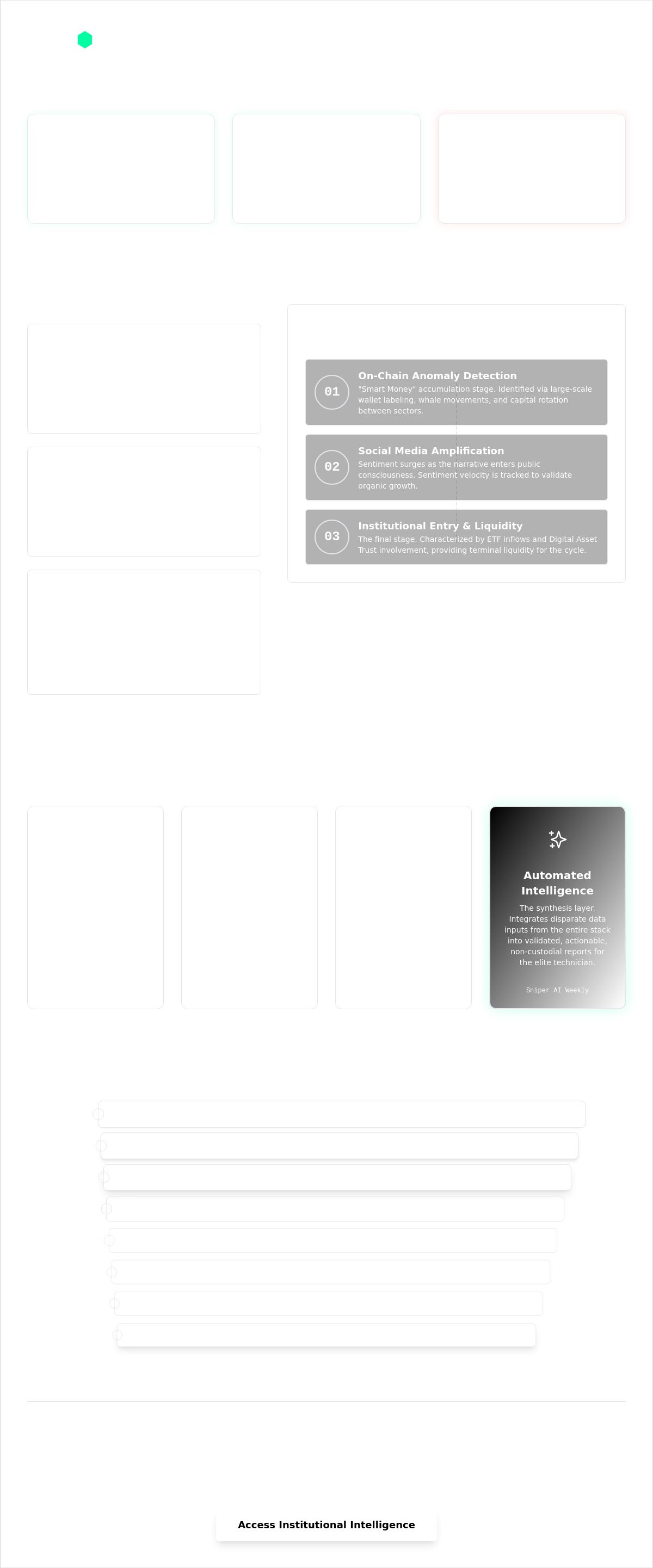
Every market-moving theme follows a repeatable, three-phase technical progression. Phase 1 involves on-chain anomaly detection. This is the "Smart Money" accumulation stage, often visible through large-scale wallet labeling and whale movements. Phase 2 triggers social media amplification. Sentiment surges as the narrative enters the public consciousness. Phase 3 marks institutional entry. This final stage is characterized by ETF inflows and Digital Asset Trust Company involvement, providing the terminal liquidity for the cycle.
Why Manual Narrative Tracking Fails
Attempting to track these phases manually is a recipe for catastrophic failure. The "Noise Floor" problem is pervasive; industry data suggests that 95% of social signals are generated by sybil-coordinated bot networks. Human eyes cannot filter this at scale. Latency issues further degrade manual performance. By the time a ticker appears on a "top-10 trending" list, the alpha has already been extracted by automated systems. Finally, cognitive bias remains a silent killer. Manual traders often ignore data that contradicts their chosen thesis. Conversely, crypto narrative analysis tools remain entirely unemotional. They prioritize backtested results over personal conviction. Reliability requires automation.
The Essential Crypto Narrative Analysis Stack
Effective narrative tracking requires a multi-layered infrastructure. No single platform provides a complete view of the market's internal mechanics. You need a stack that integrates raw liquidity data with high-fidelity social signals. Technical precision requires the integration of four distinct tool categories to eliminate blind spots and reduce research latency. By 2026, the standard for crypto narrative analysis tools has evolved from simple price trackers to complex data synthesizers.
- On-Chain Intelligence: Platforms like Dune, DefiLlama, and Arkham. These provide the foundational data on TVL, volume, and entity-specific movements.
- Sentiment Analyzers: LunarCrush and Santiment. These monitor the social consensus and measure the velocity of mention across multiple timeframes.
- Narrative Aggregators: CoinGecko and DexScreener. These act as the terminal for real-time price-action confirmation and token-specific liquidity checks.
- Automated Intelligence: Sniper AI Weekly. This layer synthesizes disparate inputs into validated, actionable reports for the elite technician.
On-Chain Data: The Source of Truth
On-chain data remains the ultimate source of truth. It represents committed capital rather than speculative discourse. By tracking "Smart Money" wallets, you can identify sector-specific accumulation before price appreciation begins. Arkham Intelligence, for instance, has labeled over 500 million addresses across multiple chains, allowing for precise entity tracking. Monitoring bridge flows across Layer 1 and Layer 2 ecosystems reveals where liquidity is migrating in real-time. To manage this volume, sophisticated traders use ai for crypto market analysis tools to automate pattern recognition and detect anomalies across thousands of smart contracts.
Social Sentiment: The Momentum Trigger
Social sentiment acts as the momentum trigger. While on-chain data shows accumulation, sentiment drives the expansion phase. The primary challenge is the "Noise Floor" created by sybil-coordinated bot networks. You must distinguish between organic community growth and coordinated influencer shilling. Measuring "Sentiment Velocity" is critical. This metric tracks how fast a topic spreads across platforms like X, Farcaster, and Telegram. Integrating advanced sentiment analysis in cryptocurrency allows you to filter out artificial noise and focus on high-conviction signals. This ensures you enter the narrative during the amplification phase rather than at the peak of the hype.
The goal is a frictionless transition from research to execution. For those requiring a pre-validated feed of these market shifts, Sniper AI Weekly delivers this intelligence directly to your dashboard. This non-custodial approach ensures you maintain full control while benefiting from institutional-grade filtration. Your API key, your funds, our intelligence.
On-Chain vs. Social Data: Building a Validation Framework
Validation is a technical requirement, not a suggestion. You must reconcile raw on-chain metrics with high-velocity social sentiment to avoid two primary failure modes. The "False Breakout" trap occurs when on-chain volume spikes but social consensus remains flat. This often indicates isolated wash trading, non-narrative-driven whale transfers, or internal treasury rebalancing. Conversely, the "Echo Chamber" trap involves extreme social hype without corresponding on-chain liquidity backing. This is retail FOMO at its most dangerous, where the social noise lacks the signal of committed capital. High-tier crypto narrative analysis tools solve this by cross-referencing Total Value Locked (TVL) with organic social engagement rates. Reliability requires 24/5 monitoring to capture shifts across global timezones. Crypto never sleeps, but institutional markets operate on specific cycles. Aligning your research with these windows ensures your data reflects the current institutional reality.
Identifying Sector Rotations Early
Capital rotation is the primary driver of alpha in 2026. Detecting the migration from high-risk "Meme" sectors to utility-backed narratives like RWA or AI requires visual liquidity heatmaps. These maps track where the "Smart Money" is positioning before social momentum triggers. For example, a sudden decrease in DEX volume for speculative assets paired with a TVL increase in RWA protocols is a high-conviction signal. Implementing systematic crypto trading allows you to manage these rotations without emotional interference. You don't guess where the money is going. You follow the data flow. This technical approach removes the cognitive bias that often plagues manual traders during rapid market shifts.
Technical Filters for Narrative Legitimacy
Narrative identification is useless without technical validation. You must analyze tokenomics for "Anti-Sniper" protections and bonding curve structures that might trap liquidity. High-tier crypto narrative analysis tools automate this by scanning smart contracts for malicious functions or excessive developer allocations. Developer activity provides the second filter. Use GitHub data to verify if the underlying technology matches the social hype. Real-world utility leaves a paper trail of commits and pull requests. If the code hasn't been updated in months, the narrative is likely a fabrication. Finally, assess exchange listing probability by analyzing current liquidity depth and volume-to-MCap ratios. This multi-layered filtration process ensures you're backing a legitimate technological shift rather than a coordinated exit scam. Data doesn't lie; people do.
The 8-Layer Validation Framework for Narrative Assets
Validation requires more than a single data point. It requires a multi-layered filtration system that removes human error from the equation. The elite technician uses a structured framework to ensure that a narrative has both the liquidity and the social consensus required for sustainability. By 2026, high-tier crypto narrative analysis tools have integrated these layers into automated workflows. This framework acts as a technical gatekeeper, preventing capital allocation into low-conviction trends.
- Layer 1: On-chain volume anomaly detection. We monitor for sub-millisecond spikes in DEX and CEX volume that precede social mentions.
- Layer 2: Multi-platform sentiment confirmation. Validation requires a simultaneous sentiment surge across X, Telegram, and Discord.
- Layer 3: Institutional-grade data cross-referencing. We integrate trust markers from Reuters and co-located GCP Tokyo feeds to confirm macroeconomic alignment.
- Layer 4: Smart money wallet tracking. This layer analyzes the distribution of tokens among high-conviction entities to ensure accumulation isn't just a temporary bridge flow.
- Layer 5: AI-driven pattern recognition. Automated agents scan for reversal signals, identifying when a narrative has reached its saturation point.
Filtering Market Noise with AI Agents
Manual research is a legacy bottleneck. A fleet of 5 AI agents can process more raw data than a 50-person research team, operating with zero fatigue. These agents automate the "Problem-Solution" flow by asking a single question: Does this narrative solve a real technical hurdle? If the answer is negative, the narrative is flagged as speculative noise. Implementing data-driven crypto trading allows you to remove emotional bias from the validation process. You rely on backtested logic rather than social media hype. This is the only way to maintain institutional-grade performance in a high-volatility environment.
Managing Narrative Risk
Risk management is the final layer of the framework. You must set systematic exit points for narratives that lose social momentum or exhibit on-chain distribution. Diversifying across 3-4 uncorrelated narratives hedges your portfolio against sector-specific crashes. For instance, balancing a DePIN allocation with a ZK-Rollup thesis reduces systemic risk. Applying crypto risk management tools ensures your automated narrative portfolios remain within defined drawdown parameters. Speed is an asset; protection is a requirement.
Secure your technical edge and validate market shifts in real-time with Sniper AI Weekly. Our system provides the intelligence; you maintain the control.
Sniper AI Weekly: Automated Intelligence for the Elite Technician
Sniper AI Weekly represents the terminal layer of the modern narrative stack. While standard crypto narrative analysis tools provide raw data, this system delivers validated intelligence. It produces a clinical evaluation of emerging sectors directly to your dashboard. The infrastructure is built for institutional-grade performance. We are co-located on GCP Tokyo to ensure sub-millisecond data retrieval and execution. This isn't a speculative signal group. It's a technical engine designed for precision.
The "Your API key, your funds" mantra is our recurring seal of security. Sniper Network never holds user assets. We provide the intelligence; you maintain the execution. Our system utilizes backtested AI models to filter out the exuberant hype that characterizes retail markets. There are no shills. No paid influencers. We prioritize AES-256 encrypted protocols and transparent data flows. The result is a cold, authoritative stream of market-moving insights.
- Validated Intelligence: Direct delivery of filtered market shifts.
- Technical Infrastructure: Co-located on GCP Tokyo for maximum speed.
- Non-Custodial: You maintain full control of your API keys and funds.
- Clinical Precision: Backtested models that ignore speculative noise.
The Sniper AI Intelligence Process
The research process is rigorous and automated. Each week, the system performs deep-dives into emerging narratives. These are validated by 8 distinct signal filters before reaching your dashboard. Our AI agents summarize complex on-chain SQL data into actionable reports. This removes the legacy bottleneck of manual querying. We provide continuous 24/5 monitoring of global crypto market volatility. This aligns your research with traditional institutional hours. You receive data-backed confirmation of liquidity migration across all major chains without the need for manual oversight.
Why Automation Beats Manual Research
Speed is the primary differentiator in a high-volatility environment. AI agents react to narrative shifts in milliseconds. A human researcher takes hours to identify a trend, validate volume, and check social sentiment. By the time a manual report is finished, the entry window has often closed. Objectivity is the second technical advantage. Our data-backed insights ignore market FOMO and anxiety. We use proprietary filters to maintain a technical perspective. The system identifies the "Problem-Solution" flow of a narrative, ensuring it has real-world utility before it's flagged as a high-conviction signal.
◈ Start your Sniper AI Weekly trial — Institutional-grade intelligence for the modern trader.
Deploying Institutional-Grade Narrative Intelligence
Technical success in the 2026 market requires a definitive shift from manual research to automated validation. You've seen how narratives drive 70% of price action; identifying these shifts early isn't optional. By reconciling on-chain liquidity with social sentiment velocity, you move beyond speculative guesswork. This systematic approach ensures you avoid exit liquidity traps and focus on utility-backed sectors. Integrating high-tier crypto narrative analysis tools into your workflow is the only way to maintain a competitive edge against institutional latency.
Optimizing this workflow further requires a dedicated management system. Using TrackMyBusiness allows teams to coordinate their research tasks and operational steps, ensuring that every data-driven insight is executed with institutional-grade efficiency.
Sniper AI Weekly provides the terminal layer for this data-driven workflow. Our infrastructure utilizes 5 AI agents and 8 signal filters to deliver validated market shifts with clinical precision. Co-located on GCP Tokyo, the system ensures sub-millisecond data retrieval without compromising your security. We operate on a strictly non-custodial basis; your API key, your funds, our intelligence. It's time to stop fighting the noise and start executing on backtested results.
Access Sniper AI Weekly: Automated Crypto Intelligence and secure your technical advantage today.
Frequently Asked Questions
What are the most important crypto narratives to watch in 2026?
AI integration and DePIN (Decentralized Physical Infrastructure Networks) represent the high-conviction sectors for 2026. These narratives rely on verifiable hardware utilization and autonomous agent coordination. Technicians track these by monitoring specific tokenized compute marketplaces and GPU-sharing protocols. Capital rotation into these sectors is often preceded by developer activity spikes on GitHub and early-stage seed funding from institutional digital asset trusts.
How do I use SQL for crypto narrative analysis on Dune?
Access Dune's abstraction layers to query the dex.trades or erc20.transfers tables. You must write queries that isolate volume anomalies within specific timeframes, such as sub-hourly windows. Successful analysis requires joining social engagement data with these SQL results to confirm that liquidity isn't just wash trading. This process reveals the internal mechanics of how a narrative gains its initial on-chain momentum.
Can AI really predict which crypto narrative will pump next?
AI identifies high-probability liquidity shifts by processing multi-platform sentiment and on-chain anomalies. It doesn't predict future prices in a speculative sense but flags when social consensus aligns with committed capital. By analyzing sub-millisecond data feeds, AI agents detect accumulation patterns that are invisible to manual researchers. This provides a technical edge by identifying the amplification phase of a narrative before it reaches retail saturation.
What is the difference between sentiment analysis and narrative analysis?
Sentiment analysis measures the emotional tone of social discourse across platforms like X and Farcaster. Narrative analysis is a broader technical synthesis that includes sentiment as just one variable. It tracks the migration of capital, liquidity depth, and technological utility alongside social consensus. While sentiment tells you if people are excited, narrative analysis tells you if that excitement is backed by real-world on-chain value.
Are there free tools for tracking crypto narratives?
Foundational data is available through the free tiers of platforms like Dune, DefiLlama, and Arkham. These tiers allow you to monitor TVL changes, basic wallet movements, and top-level DEX volume without cost. While these free crypto narrative analysis tools lack automated intelligence layers, they provide the raw metrics required for manual validation. They serve as a starting point for technicians who are building their first research stack.
How does Sniper AI Weekly validate emerging market trends?
Validation occurs through a non-custodial process co-located on GCP Tokyo infrastructure. The system applies backtested models to filter out artificial social noise and confirm liquidity depth across multiple chains. By monitoring global markets 24/5, it identifies when a trend meets specific institutional trust markers. This ensures that only high-conviction, data-backed shifts are delivered to your technical dashboard, removing human bias from the research flow.
What are the risks of trading based on crypto narratives?
The primary risk is the Echo Chamber trap, where social hype exists without on-chain liquidity backing. Narratives can collapse rapidly if the underlying technological utility fails to materialize or if institutional volume exits the sector. Additionally, high volatility can trigger stop-losses before a narrative reaches its expansion phase. Effective risk management requires diversifying across uncorrelated themes and setting systematic exit points based on liquidity distribution.
How often should I update my narrative analysis stack?
Monthly audits of your technical stack are the standard for maintaining an edge. The landscape of crypto narrative analysis tools evolves as new data providers and AI models enter the market. You must also account for regulatory shifts, such as the SEC and CFTC 2026 harmonization efforts, which impact how data is reported. Regular updates ensure your research flow remains optimized for speed, reliability, and institutional-grade precision.