
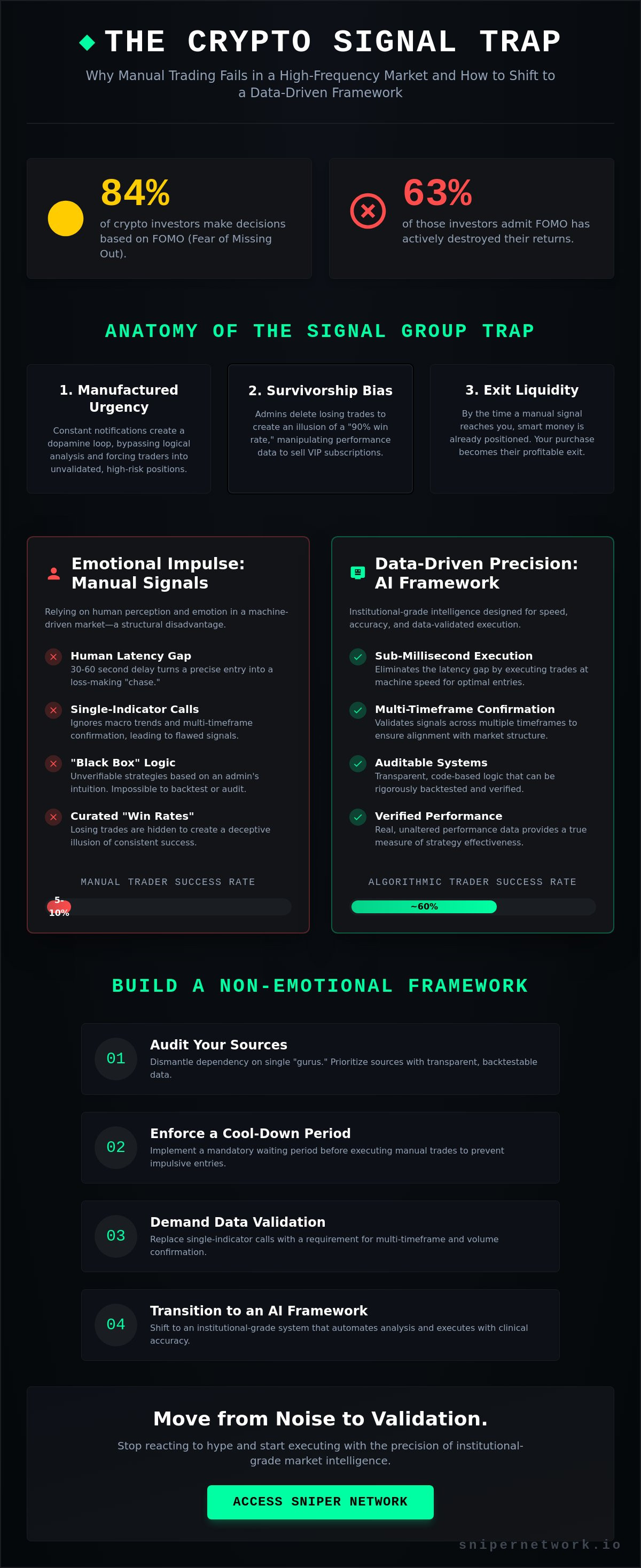
84% of crypto investors admit to making investment decisions based on FOMO, and 63% of those acknowledge it has actively destroyed their returns. You've likely felt the exhaustion of monitoring 24/7 Telegram alerts, only to enter a trade just as the liquidity exits. The chaos of crypto signal groups fomo isn't an emotional weakness. It's a technical failure. Manual trading in a sub-millisecond market is a structural disadvantage. It leads to late entries. It causes capital erosion. High-frequency environments demand precision, not panic.
You know the frustration of mistaking market noise for actionable data. It's time to stop reacting and start executing. This guide teaches you how to dismantle psychological triggers and replace them with a clinical, data-driven validation framework. You'll learn to transition from reactive entries to a systematic trading routine that prioritizes reliability over hype. We'll preview the shift toward institutional-grade market intelligence that separates elite technicians from the speculative crowd. Protect your capital with logic. Replace impulse with data. Move from noise to validation.
Key Takeaways
- Identify the psychological triggers and survivorship bias used by manual crypto signal groups fomo to manufacture false urgency.
- Analyze why the "Human Latency Gap" and single-indicator calls fail to meet the standards of professional data validation.
- Build a systematic trading routine by auditing information sources and enforcing a mandatory cool-down period for manual entries.
- Discover how sub-millisecond execution and multi-timeframe confirmation replace emotional impulse with technical precision.
- Shift to an institutional-grade intelligence framework designed to monitor markets with clinical, automated accuracy.
The Anatomy of the Crypto Signal Group FOMO Trap
In the high-frequency environment of 2026, Fear of Missing Out (FOMO) is an engineered neurological response. It isn't an accident. It's the primary product of manual signal providers. These groups utilize manufactured scarcity and social proof to trigger the amygdala. This bypasses the prefrontal cortex. It forces traders into high-risk, unvalidated positions. When you see a "Buy Now" alert, your brain prioritizes speed over logic. This is a structural disadvantage. Most crypto signal groups fomo rely on this physiological hijack to drive engagement. They don't sell data. They sell the relief of being "in" on a trade.
The transition from a public channel to a "VIP" pitch is a calculated funnel. It begins with curated "free value." This builds a false sense of authority. Once the user is hooked on the dopamine loop of notifications, the group introduces predatory subscription models. They promise "institutional alpha" but deliver retail-grade noise. This pivot exploits the trader's desire for a shortcut. It replaces a systematic trading routine with a dependency on an anonymous admin's intuition. You're no longer analyzing the market. You're following a person.
The Psychology of Manufactured Urgency
Telegram notification rhythms are designed to create a dopamine loop. Each ping suggests a missed opportunity. Signal groups often use "whale alerts" to trigger immediate action without validation. These alerts lack context. They ignore multi-timeframe confirmation. Manual signals rely on your speed to execute before the pump ends. This forces you to ignore your own risk management protocols. You aren't trading a strategy; you're reacting to a rhythm. This constant state of high-alert leads to emotional exhaustion. It's a technical failure disguised as a market opportunity.
Survivorship Bias in Public Results
The "Profit Screenshot" is a mirage used by many crypto signal groups fomo to distort reality. Admins frequently delete losing trades to maintain an illusion of a "90% win rate." This is classic survivorship bias. You only see the successes. You never see the liquidated accounts. There's a fundamental difference between a single-indicator signal and comprehensive market analysis.
- Curated History: Removing evidence of failed calls to manipulate performance data.
- Exit Liquidity: Using the group's collective buying power to provide an exit for the admin.
- Lack of Depth: Signals rarely include stop-loss logic or volume profile validation.
Why Manual Signals Fail the Data Validation Test
Manual signals are architecturally obsolete. They fail the data validation test because they rely on human perception in a market dominated by high-frequency algorithms. Currently, 50-80% of all crypto trading volume is algorithmic. Retail traders relying on crypto signal groups fomo are essentially bringing a knife to a kinetic missile fight. It's a mismatch of speed, logic, and infrastructure. Manual "calls" lack the objective verification required for institutional-grade performance.
The "Black Box" problem is the most significant risk. You cannot backtest a manual signal group's logic. There's no code to audit; there is no historical dataset to verify against different market conditions. You're following a person's intuition, not a proven system. This lack of transparency is why only 5-10% of manual day traders show positive annual returns, while approximately 60% of retail algorithmic traders succeed. Transitioning to automated intelligence is the only way to close this gap and remove the guesswork from your portfolio.
The Latency Problem in Manual Trading
Sub-millisecond execution is the standard for professional desks. Manual trading creates a massive Human Latency Gap. An admin spots a trend. They type a Telegram message. You receive the notification. You log into your exchange. By the time you execute, 30 to 60 seconds have passed. This delay turns a precise entry into a "chase." Chasing the green candle is a mathematically losing strategy. Professional systems use co-located infrastructure in GCP Tokyo to bypass these delays. Manual groups can't compete with that speed.
Single-Point Failure in Strategy
Manual traders often ignore macro trends for micro-scalps. They focus on a single indicator. This is dangerous. Without Multi-Timeframe Confirmation (MTF), a signal is just a guess. Most signal groups lack crypto risk management tools like automated drawdown limits or volatility adjustments. Academic research on The Dangers of Financial Advice on Social Media confirms that these platforms prioritize engagement over accuracy. Emotional attachment to a specific "coin" further ruins signal accuracy. Data doesn't have favorites. Humans do. This bias is why manual strategies eventually collapse under market volatility.
Systematic Filter vs. Emotional Impulse: A Comparison
Professional market participation requires a transition from intuition to objective validation. Human intuition is a liability in a high-frequency environment. It's inconsistent. It's prone to exhaustion. Manual crypto signal groups fomo operate on narrative-driven positioning. This often ignores the underlying liquidity profile of an asset. A systematic filter utilizes volatility-adjusted positioning. It calculates risk based on mathematical certainty rather than social media hype. Transparency is the ultimate differentiator. A Telegram post is easily edited or deleted to hide failures. An AI report log is immutable. It provides a clinical audit trail of every trigger and execution.
The source of truth determines the quality of the outcome. Narrative-driven strategies rely on "feeling" the market. Data-driven strategies rely on "measuring" the market. This shift in perspective removes the emotional burden from the trader. It replaces panic with a predictable, automated intelligence framework. You aren't guessing the next move. You're validating a statistical edge.
Data Fidelity: AI Agents vs. Telegram Admins
Capacity is the primary bottleneck for manual analysis. A single admin monitors five to ten pairs at most. They miss 99% of the market opportunities. 5 AI agents scan thousands of pairs simultaneously across multiple exchanges. They identify patterns invisible to the human eye. Systematic crypto trading requires this level of high-fidelity data. Sentiment analysis plays a critical role here. It filters out "pump and dump" noise by cross-referencing social volume with real-time order book depth. If the social hype doesn't match the institutional capital flow, the signal is discarded. This prevents you from becoming exit liquidity for manufactured volatility.
Verifiable Performance vs. Flashy Screenshots
Flashy screenshots of 1000% gains are marketing tools, not performance metrics. They often lack context regarding the total portfolio impact. You must demand backtested results over curated images. A professional strategy is defined by its maximum drawdown and recovery factor. Manual groups often utilize curve-fitted strategies. They find a single successful trade and build a narrative around it. This is statistically irrelevant. Automated systems provide verifiable logs that cover multiple market cycles. They validate every trigger against historical volatility. This ensures the strategy is robust enough to survive a "black swan" event. Demand data. Ignore the screenshots.
How to Build a Non-Emotional Trading Framework
Transitioning from reactive to proactive participation requires a structural overhaul of your workflow. The first step is to audit your information sources. Remove all "hype" notifications immediately. These alerts are the primary triggers for crypto signal groups fomo. They serve no technical purpose. Second, implement a mandatory 10-minute "cool-down" rule for all manual entries. If a trade is only viable for sixty seconds, it lacks the structural support required for a professional position. If the opportunity vanishes during your cool-down, you have successfully avoided a pump-and-dump trap.
Third, require triple-layer validation for every position. No trade should be executed without confirmation from Volume, Trend, and Sentiment. Fourth, utilize a non-custodial intelligence tool to automate the research phase. This removes human bias from the initial data collection. Finally, document every trade in a systematic journal. You aren't just tracking price points; you're tracking emotional triggers. Note your heart rate, your level of urgency, and the source of the signal. This data allows you to identify patterns in your own behavior that lead to capital erosion. Logic must always precede execution.
Implementing the Validation Framework
Professional operators prioritize mastering data-driven crypto trading to confirm signals before committing capital. An "8-Layer Validation" concept is the gold standard. This involves filtering market noise through multiple AI agents that verify liquidity depth and order book pressure. You aren't looking for a "good feeling." You're looking for a statistical alignment across multiple timeframes. Hard stop-losses must be set based on volatility metrics, such as Average True Range (ATR), rather than an arbitrary percentage. This ensures your risk is mathematically adjusted to the current market environment. To begin automating these technical requirements, deploy your clinical trading engine and remove the burden of manual validation.
Managing the "Anxiety of Omission"
Accepting that "missing a trade" is a core component of a professional strategy is essential. In a 24/7 market, 100% participation is a mathematical impossibility. Attempting it leads to burnout and poor decision-making. A weekly intelligence report is often superior to hourly alerts for busy traders. It provides a macro perspective that hourly noise obscures. This shift from a "gambler" to a "systematic operator" mindset is what separates retail liquidity from institutional-grade participants. You don't need to catch every move. You only need to catch the moves that meet your clinical criteria. Precision is more profitable than frequency.
Transitioning to Sniper AI Weekly: Professional Intelligence
Manual crypto signal groups fomo are structurally incapable of providing the data fidelity required for consistent results. They rely on human perception. They are limited by human speed. You need a system that operates at the speed of the market. Sniper AI Weekly provides a clinical alternative to the emotional chaos of manual Telegram alerts. It replaces human intuition with a multi-layered intelligence framework. Our AI agents utilize Claude and GCP Tokyo infrastructure for sub-millisecond analysis. This ensures every data point is validated before it reaches your dashboard. Logic replaces impulse. Precision replaces panic.
Security is the foundation of our technical stack. We operate on a strict non-custodial model. Your API key, your funds. Sniper Network never holds user capital. This is a recurring verbal seal of our commitment to transparency. We use AES-256 encryption to secure all technical communications. This protocol ensures that your trading environment remains uncompromisingly secure while you leverage institutional-grade intelligence. You maintain total control. We provide the data-driven edge. It's a professional partnership designed for the elite technician.
The Sniper AI Advantage
Our system monitors market movements 24/5. This aligns crypto volatility with traditional institutional hours for maximum efficiency. While manual admins are scrolling through charts, our 5 AI agents are filtering noise across thousands of pairs. Multi-timeframe confirmation is automated. Every signal must pass through 8 distinct filters before it is considered actionable. Automated research beats manual Telegram scrolling every time. It removes the latency inherent in human communication. You receive high-fidelity data that has been scrubbed of "pump and dump" sentiment. This is systematic intelligence for the retail trader.
Start Your Data-Driven Journey
Accessing professional-grade intelligence is frictionless. We offer a "no card required" trial for Sniper AI Weekly. This allows you to experience the precision of our automated market intelligence reports without any upfront commitment. Your first report will provide a clinical breakdown of market liquidity, volume trends, and sentiment metrics.
- Sub-millisecond validation: Data processed through co-located GCP Tokyo servers.
- Multi-agent filtering: 5 AI agents cross-referencing thousands of data points.
- Institutional reporting: Weekly intelligence that prioritizes long-term capital preservation.
Transition to Clinical Execution
The era of reactive trading is over. Manual crypto signal groups fomo are a structural liability. They rely on human latency and survivorship bias. Professionalism requires a shift to clinical, data-driven validation. You've seen how a systematic framework dismantles emotional triggers. It replaces panic with multi-timeframe confirmation. By implementing a mandatory cool-down and triple-layer validation, you protect your capital from manufactured urgency and social media noise.
Sniper AI Weekly is your technical edge. 5 AI agents. 24/5 market monitoring. Our stack utilizes Claude AI and co-located GCP Tokyo infrastructure for sub-millisecond precision. We maintain a non-custodial architecture. Your API key, your funds. This protocol ensures total security while providing institutional-grade intelligence to the retail trader. Stop monitoring Telegram alerts. Start executing with a system designed for the elite technician. Move beyond the noise of manual calls and enter the realm of automated intelligence.
Access the Sniper AI Weekly Institutional-Grade Intelligence Report
Master the market through logic. Your transition to a systematic operator is ready. Precision is now within your reach.
Frequently Asked Questions
Why do crypto signal groups always seem to post wins but I only have losses?
Admins utilize survivorship bias to distort reality. They delete losing trades to maintain a curated 90% win rate illusion. Most crypto signal groups fomo rely on retail traders entering late. You become exit liquidity for the group's manufactured volatility while the admin exits at the peak. This cycle ensures the provider stays profitable while the follower absorbs the drawdown.
How can I tell if a Telegram signal group is a scam?
Identify red flags like "guaranteed profits" or a lack of verifiable drawdown metrics. Scams often use edited screenshots to simulate success. If a provider requires direct asset custody rather than restricted API access, it's a predatory model designed to seize your principal. Professional services never ask to hold your funds. They provide data and execution triggers only.
Can AI really predict crypto market movements better than humans?
AI agents monitor thousands of pairs 24/5 with sub-millisecond precision. Humans are limited by cognitive bias and physical latency. AI validates data through multi-timeframe confirmation and sentiment analysis. This removes the emotional impulse that leads to capital erosion in manual trading. Automation doesn't predict the future; it identifies high-probability statistical edges that humans miss.
What is the best way to manage FOMO when a coin is pumping?
Implement a 10-minute cool-down rule for every manual entry. Require triple-layer validation across Volume, Trend, and Sentiment before committing capital. If the structural logic disappears during the cool-down, discard the trade. Professional strategy prioritizes capital preservation over participation in unvalidated price spikes. Logic must always precede execution to avoid the crypto signal groups fomo trap.
Is it possible to automate my trading without giving up control of my funds?
Yes. Non-custodial automation utilizes restricted API keys to execute trades on your behalf. You never transfer your principal to the service provider. Your API key, your funds. This architecture ensures you maintain total withdrawal control while leveraging automated intelligence. It's the standard for secure, professional trading in the digital asset space.
What is the difference between a signal group and a market intelligence service?
Signal groups provide unvalidated calls based on human intuition. Market intelligence services provide clinical data aggregation. Services like Sniper AI Weekly utilize co-located GCP Tokyo infrastructure and AI agents to filter market noise into institutional-grade reports. Intelligence is data-driven and backtested. Signals are narrative-driven and often lack technical depth or risk management protocols.
How many indicators should I use to validate a crypto signal?
Require at least three distinct layers of confirmation. Validate through Volume, Trend, and Sentiment to prevent single-point failure. Professional systems often utilize an 8-layer validation framework. This ensures every trigger is backed by high-fidelity data rather than a single-indicator gut feeling. More layers reduce the probability of entering a false breakout or a manufactured pump.
Why is non-custodial trading safer for retail investors?
Non-custodial trading eliminates counterparty risk. You don't trust a third party with your assets. This protects retail investors from exchange failures or fraudulent service providers. Security is maintained at the user level through restricted API permissions and AES-256 encrypted communications. It ensures that even if a service is compromised, your principal remains secure in your own account.