In a market where Bitcoin dominance holds at 58% and institutional ETF flows exceed $150 billion, your "gut feeling" is a liability. Speculative trading relies on luck. Institutional success relies on math. Most retail portfolios succumb to social media noise and high-volatility emotional triggers. This lack of technical precision leads to inconsistent returns. You need a system that functions like a cold, silent engine. By implementing data-driven crypto trading strategies, you replace cognitive bias with backtested validation.
The 2026 landscape is complex. Between the GENIUS Act and new IRS 1099-DA reporting requirements, the margin for error is gone. Successful participation requires a repeatable framework that mirrors professional trading floors. This article details the 2026 systematic framework for transitioning from manual speculation to institutional-grade execution. We will examine multi-layered validation protocols, AI-driven market intelligence, and the automation steps necessary to eliminate emotional stress from your portfolio management. ◈
Key Takeaways
- Execute data-driven crypto trading strategies by replacing subjective sentiment with objective, multi-source data inputs.
- Deploy a 5-layer validation framework to identify macro trends and on-chain accumulation phases before entering positions.
- Filter engineered market noise using AI agent intelligence to bypass "fake-outs" that typically trigger retail indicator decay.
- Protect capital with institutional-grade risk management, including ATR-based stop-losses and non-custodial "Your API key, your funds" protocols.
- Automate market oversight 24/5 using Sniper AI Weekly to maintain a systematic edge in high-volatility environments.
Defining Data-Driven Crypto Trading Strategies in 2026
In 2026, data-driven crypto trading strategies are defined as execution frameworks where every buy or sell trigger originates from objective, multi-source data inputs. This approach eliminates subjective sentiment. It replaces "gut feeling" with backtested mathematical probability. In a market where Bitcoin maintains a 58% dominance and derivatives drive the majority of volume, relying on intuition is a systemic risk. High volatility doesn't just create opportunity; it creates noise. Traditional algorithmic trading principles have evolved. Static technical indicators like RSI or MACD are no longer sufficient in isolation. They decay. They're often manipulated by larger players to engineer retail "fake-outs."
Holistic market intelligence is the new standard. This requires processing sub-millisecond data streams that were previously unavailable to the individual trader. AI agents now filter these streams in real-time. They distinguish between organic accumulation and inorganic price manipulation. "Gut feeling" is a cognitive trap. It's often just a reaction to social media hype or temporary price spikes. In the 2026 regulatory environment, where MiCA in the EU and the GENIUS Act in the US have increased market transparency, large-scale capital moves with calculated precision. If your entry isn't backed by cold data, you're the liquidity for someone else's exit. ◈
Institutional vs. Retail Data Gaps
Professional trading desks operate with a massive infrastructure advantage. They use co-located servers in GCP Tokyo and proprietary data feeds from Reuters. These tools allow them to see market shifts before they reflect on retail charts. Bridging this gap is the primary goal of modern systems. By accessing institutional grade crypto data, retail traders can finally compete on a level playing field. Automated filtering is mandatory. Human reaction time can't process a 24/7 global market. Systems must monitor, validate, and execute without fatigue. 5 AI agents. 8 signal filters. This is the baseline for professional participation.
The Core Components of Data-Driven Insights
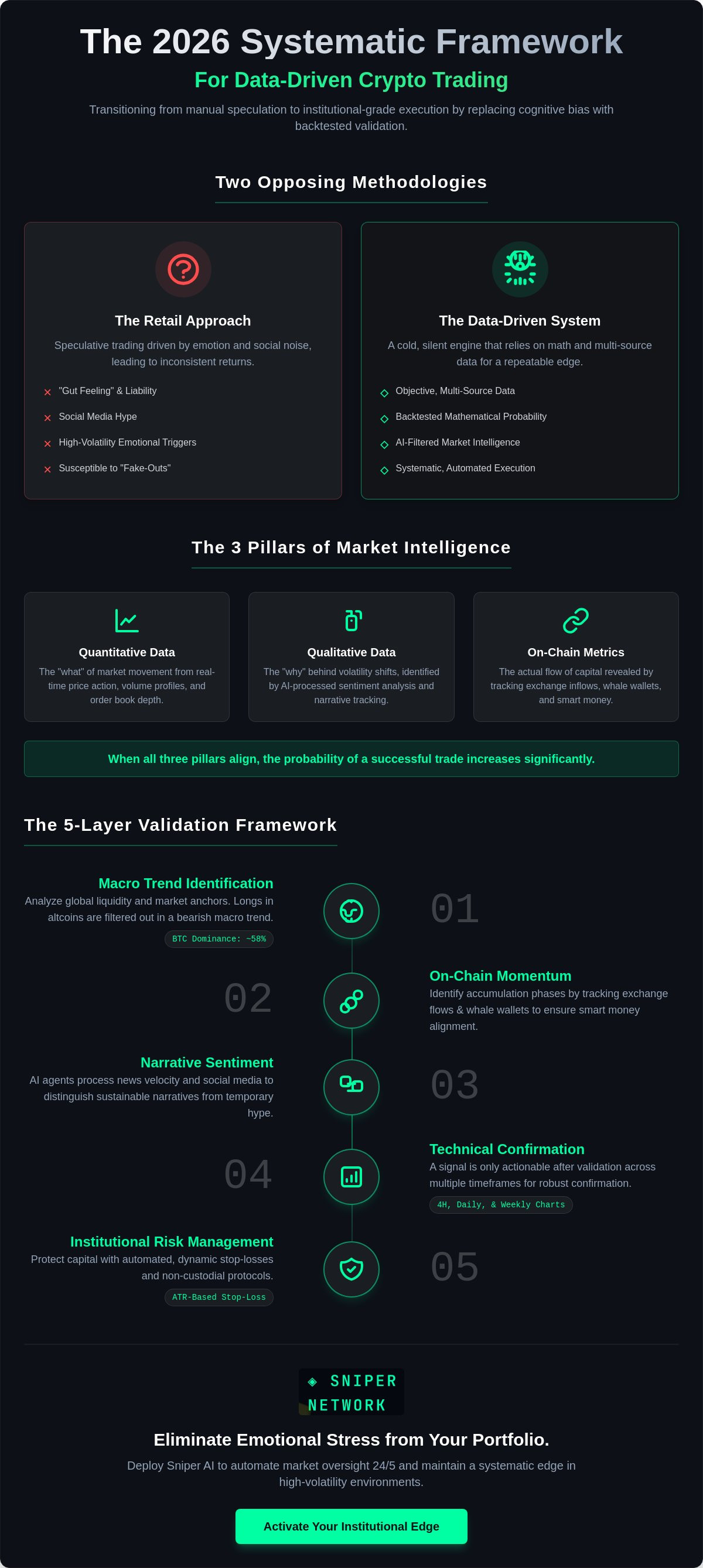
A robust framework relies on three distinct data pillars. These aren't suggestions; they're requirements for systematic edge. AI agents process these streams to identify high-probability setups while you sleep.
- Quantitative Data: Real-time price action, volume profiles, and order book depth. This provides the "what" of market movement.
- Qualitative Data: AI-processed sentiment analysis and narrative tracking. This identifies the "why" behind sudden volatility shifts.
- On-Chain Metrics: Tracking exchange inflows, whale wallet movements, and smart money positioning. This reveals the actual flow of capital across the blockchain.
When these three pillars align, the probability of a successful trade increases significantly. Without this multi-timeframe confirmation, you're trading in the dark. Data doesn't lie. It doesn't have an ego. It simply validates or invalidates a thesis based on historical and real-time facts.
The 5-Layer Validation Framework for Systematic Edge
Successful data-driven crypto trading strategies require more than a single signal. They demand a multi-dimensional filter. Most retail traders fail because they rely on isolated indicators like a simple moving average or RSI. A systematic edge is built on layers. Each layer acts as a fail-safe. If one layer invalidates the thesis, the trade is discarded. This clinical approach ensures that only high-probability setups reach execution. 5 layers. 1 objective: capital preservation through technical precision.
- ◈ Layer 1: Macro Trend Identification. We analyze global liquidity and Bitcoin dominance. In 2026, BTC dominance remains a critical anchor at approximately 58%. If the macro trend is bearish, long signals in altcoins are filtered out.
- ◈ Layer 2: On-Chain Momentum. This involves identifying accumulation phases via blockchain data. We monitor exchange inflows and whale wallet movements to ensure smart money is positioned alongside our trade direction.
- ◈ Layer 3: Narrative Sentiment. AI agents process news velocity and social media shifts. Using tools like Claude AI and Reuters feeds, the system calculates if a price move is backed by a sustainable narrative or just temporary hype.
- ◈ Layer 4: Technical Confirmation. We utilize multi-timeframe price action analysis. A signal must validate on the 4-hour, daily, and weekly charts before it's considered actionable.
- ◈ Layer 5: Liquidity Filtering. Execution is useless without an exit. We monitor order book depth to ensure there's enough liquidity to close a position without significant slippage.
Why Multi-Layer Validation Beats Single Indicators
Single indicators are prone to the "False Positive" problem. An RSI might show an oversold condition, but in a trending market, assets can stay oversold for weeks while prices continue to drop. This is where retail accounts are liquidated. By building a crypto market validation framework, you cross-reference layers to confirm signal strength. AI agents validate the technical setup against on-chain reality. If the data doesn't align across all five layers, the system remains idle. This discipline reduces drawdown and protects the portfolio from engineered market noise. ◈
Automating the Research Process
Manual monitoring of 24/7 global markets is impossible for a human trader. Fatigue leads to emotional errors. Professional desks solve this by using AI agents to scan thousands of pairs simultaneously. These agents convert raw data into actionable intelligence. They don't sleep. They don't have bias. They simply execute the protocol. To maintain this level of oversight without the overhead of a full trading desk, you can automate your intelligence gathering through specialized tools. This transforms thousands of data points into a clear, weekly roadmap for execution. It's the transition from guessing to knowing.
Why Static Indicators Fail Without AI Agent Filtering
Traditional technical analysis is decaying. In an era dominated by high-frequency data-driven crypto trading strategies, static indicators like the Relative Strength Index (RSI) or Bollinger Bands often provide lagging information. These tools were designed for slower, more predictable markets. Today, institutional algorithms use retail indicators as liquidity targets. They engineer "fake-outs" specifically to trigger these signals, trapping retail capital before reversing the trend. Relying on a single, static chart pattern is no longer a viable strategy. It's a vulnerability.
Market noise has become a sophisticated weapon. Wash trading and spoofing create artificial volume spikes that deceive standard filters. AI agent filtering is the only effective defense. By processing sub-millisecond data streams, AI identifies the difference between organic accumulation and algorithmic churn. It separates significant volume from noise. Your strategy must be dynamic. It needs to adapt to shifting volatility regimes in real-time. A framework that worked during a low-volatility accumulation phase will fail during a high-volatility distribution event. Static rules are too rigid for a market that never sleeps. ◈
The Limitations of Manual Signal Groups
Human bias is a systemic risk. Manual signal groups suffer from emotional fatigue and inconsistent execution. There is a critical delay between signal generation, notification, and your eventual trade. In crypto, seconds matter. By the time a human analyst posts a chart, the institutional move is often already complete. This is why alternatives to crypto signal groups are essential for serious traders. You need automated intelligence that operates at the speed of the market, not the speed of a telegram admin. It's about precision, not conversation.
Machine Learning and Pattern Recognition
Machine learning identifies non-linear patterns that the human eye misses. These systems analyze thousands of variables simultaneously, finding correlations across price, sentiment, and on-chain metrics. Backtesting validates these strategies against years of historical data at scale. This isn't about guessing the next move. It's about calculating the highest probability outcome based on a multi-dimensional dataset. The "Elite Technician" mindset requires trading the system, not the price. If the system doesn't trigger, you don't move. Unbiased execution is the only path to long-term profitability. Automation removes the "hope" factor from your portfolio. ◈
Institutional Risk Management: Protecting Capital
Institutional risk management is the final barrier between a validated signal and a profitable outcome. Validation alone does not guarantee success. Execution requires a clinical discipline that most retail participants lack. Successful data-driven crypto trading strategies prioritize capital preservation through mathematical certainty. This involves two primary mechanisms: dynamic stop-loss placement and algorithmic position sizing. Validation is the theory. Risk management is the reality.
Stop-losses must never be arbitrary. We utilize the Average True Range (ATR) to calibrate exits based on real-time volatility. A static 2% stop-loss is ineffective in a market where daily swings can exceed 10%. By using ATR, the system adjusts the exit trigger to the current market environment. Position sizing follows a similar logic. Your entry size is a function of the distance to your stop-loss and your total portfolio risk limit. Data dictates the size. Confidence is irrelevant. ◈
The Non-Custodial Advantage
Counterparty risk is a systemic failure point. We eliminate this by adhering to a strict non-custodial protocol: Your API key, your funds. You never transfer assets to a third-party intelligence provider. These crypto risk management tools integrate directly with your exchange via AES-256 encrypted API connections. This infrastructure ensures that while the intelligence is automated, the custody remains personal. Security is not a feature; it is the foundation of institutional-grade performance.
Removing Emotion from the Execution
Anxiety is the byproduct of uncertainty. A backtested probability framework removes this variable. When you view a trade as one of a thousand iterations in a validated system, individual outcomes lose their emotional weight. You become a Cold Operator. This approach combats FOMO by enforcing hard data limits. If the multi-timeframe confirmation doesn't align, the execution engine remains dormant. It doesn't matter if the market is moving; if the data doesn't trigger, the trade doesn't exist. To see how these protocols function in a live environment, you can explore our automated risk engine. Systematic execution is the only defense against high-volatility stress. ◈
Implementing Sniper AI Weekly: The Data-Driven Solution
Transitioning to data-driven crypto trading strategies requires a shift from manual research to intelligence-led execution. Sniper AI Weekly is the technical bridge. It synthesizes the multi-layer validation and risk protocols discussed in this framework into a single, automated engine. This isn't a signal group. It's an institutional-grade intelligence suite. Our system utilizes 5 specialized AI agents to monitor the global market 24/5. These agents operate with sub-millisecond precision, ensuring that no opportunity is missed due to human fatigue or time-zone gaps. ◈
The core objective is the removal of linguistic and emotional clutter. We provide the data. You maintain the control. By leveraging infrastructure co-located in GCP Tokyo and utilizing feeds from Reuters and on-chain analytics, Sniper AI Weekly delivers a level of precision previously reserved for professional desks. You retain full asset control at all times. Our "Your API key, your funds" protocol ensures that your capital never leaves your chosen exchange. We provide the intelligence; you execute the trade. ◈
What to Expect from Sniper AI Intelligence
Each week, the system processes thousands of data points across 1,000+ assets. This massive data stream is filtered into a curated list of high-probability opportunities. You receive clinical, actionable reports backed by multi-timeframe confirmation and sentiment velocity analysis. There is no hype. There are no "moon" predictions. Every entry is a result of the 5-layer validation framework. This sub-millisecond processing identifies trends before they become retail noise, allowing you to position your portfolio with an institutional edge.
Your First Step Toward Systematic Trading
Modern markets don't wait for manual analysis. Building a systematic crypto trading workflow is a requirement for survival in the 2026 landscape. We've removed the friction from this transition. Our "No Card Required" trial allows you to experience the power of AI-driven intelligence without immediate commitment. You gain instant access to our validated trends and risk management templates. This is the evolution of the retail trader into an Elite Technician. ◈
Stop guessing. Start validating. The transition from speculative "gut" trading to a data-validated approach is a single step away. ◈ Start your Sniper AI Weekly trial today and deploy the 2026 systematic framework to your portfolio. ◈
Transitioning to Institutional-Grade Execution
The 2026 market demands a departure from speculative habits. You've seen how a 5-layer validation framework and ATR-based risk management provide the necessary technical edge. By implementing data-driven crypto trading strategies, you eliminate the emotional fatigue that consistently compromises retail portfolios. The shift is logical. It's the move from guessing to validating. Unbiased execution is the only path to long-term profitability in high-volatility environments.
Precision is the standard. Sniper AI Weekly delivers this through 5 AI agents and 8 signal filters. You maintain full asset control through non-custodial security protocols while leveraging institutional-grade data. There is no need for manual oversight. The system monitors, validates, and triggers 24/5. You can now operate with the speed and clarity of a professional desk. Your transition to a systematic framework starts with objective data. The tools are ready. ◈
Access Institutional-Grade AI Intelligence with Sniper AI Weekly
Frequently Asked Questions
Is data-driven trading better than technical analysis?
Data-driven trading is a holistic evolution of technical analysis. Traditional technical analysis relies on static price patterns and lagging indicators. Data-driven approaches incorporate multi-source inputs, including on-chain metrics, global liquidity, and sentiment velocity. This provides a multi-dimensional validation that static charts cannot offer. It replaces subjective interpretation with objective mathematical probability. ◈
How does AI help in creating crypto trading strategies?
AI processes sub-millisecond data streams to identify non-linear patterns that the human eye misses. It acts as a noise filter, separating organic accumulation from wash trading and algorithmic churn. By automating the validation of data-driven crypto trading strategies, AI ensures that execution is triggered by hard data rather than emotional bias. 5 AI agents. 8 signal filters. Precision is the priority.
Can beginners use data-driven trading strategies effectively?
Beginners can use these strategies effectively by leveraging automated intelligence frameworks. Manual trading requires years of experience to master emotional discipline and technical precision. A systematic framework removes these barriers. It allows individual traders to follow institutional-grade logic without the need for manual oversight. It levels the playing field through automated, unbiased intelligence. ◈
What is a non-custodial crypto intelligence tool?
A non-custodial tool provides market intelligence without requiring custody of your assets. It follows the "Your API key, your funds" protocol. The tool connects to your exchange via AES-256 encrypted API keys to monitor or execute trades while your funds remain in your personal account. This eliminates counterparty risk and ensures you maintain full control over your capital at all times.
How much data does an AI agent analyze for a single trade signal?
AI agents analyze thousands of variables across 1,000+ assets for every signal generated. This includes order book depth, social media velocity, exchange inflows, and macro trend data. Every trigger is the result of a 5-layer validation process. The system filters millions of raw data points into a single, clinical intelligence report. This scale of analysis is impossible for human traders. ◈
What happens if the market becomes extremely volatile?
The system adapts using ATR-based stop-losses and volatility filtering. If the data layers don't align during high-volatility events, the engine remains dormant to prioritize capital preservation. AI agents identify if the movement is driven by organic liquidity or engineered retail traps. If the risk-to-reward ratio doesn't meet the mathematical threshold, no signal is triggered. Safety is built into the logic.
Do I need to know how to code to use Sniper AI Weekly?
No coding knowledge is required to utilize Sniper AI Weekly. The technical complexity is managed by our infrastructure, including co-located servers and proprietary AI agents. You receive the results of data-driven crypto trading strategies in a clinical, actionable format. The focus is on intelligence-led execution rather than technical management. You simply follow the validated roadmap provided by the system. ◈