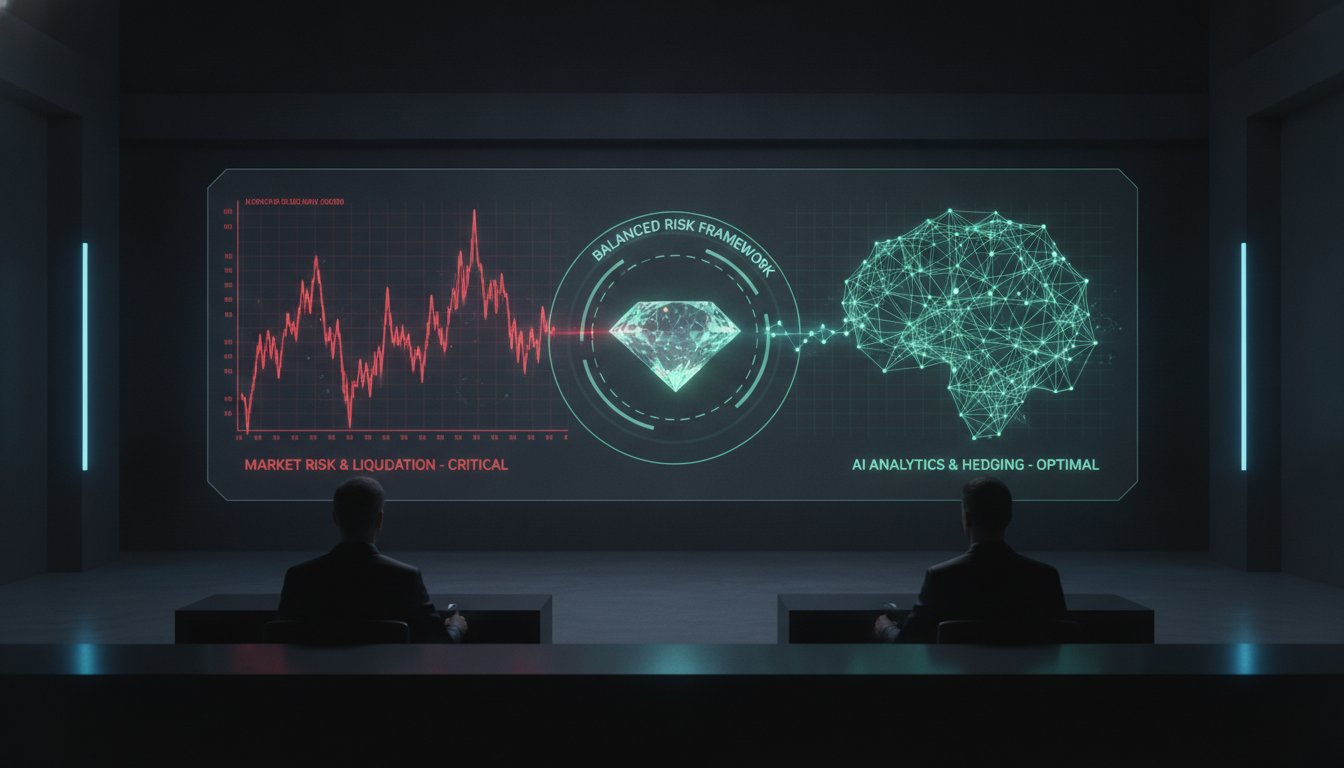
Narratives are not stories. They are measurable liquidity rotations that AI detects before social sentiment peaks. Most retail traders fail because they rely on the delayed noise of Twitter and Discord. By the time a trend hits your feed, institutional capital is often already positioning for an exit. Learning how to find crypto narratives early 2026 requires moving beyond human intuition and adopting a clinical, data-driven approach. You must distinguish between organic growth and artificial hype before capital flows become obvious.
You likely face the exhaustion of information overload. It's difficult to filter signal from noise when the RWA market alone has scaled to $51 billion. This article provides a systematic AI framework to solve that. You'll master a technical methodology for identifying high-liquidity trends before they reach the retail masses. We provide a structured checklist for narrative validation and an analysis of AI-driven market scanners. You will gain the tools to secure early entry into sectors like RWA and DePIN with institutional-grade precision.
Key Takeaways
- Identify the transition from speculative hype to data-backed narratives like RWA and DePIN by analyzing institutional capital flows.
- Master how to find crypto narratives early 2026 through a 4-layer AI framework that monitors liquidity migration and Github commit frequency.
- Detect early-stage market signals by tracking major Layer 1 and Layer 2 infrastructure upgrades that precede new narrative cycles.
- Configure automated scanners for DEX liquidity spikes to execute entries before narratives gain traction on social platforms.
- Utilize Sniper AI Weekly to automate 24/5 market surveillance via five AI agents for clinical narrative validation.
Decoding Crypto Narratives: Why Early Detection Is the Only Edge in 2026
A crypto narrative is a measurable cluster of capital flowing toward a specific technological or cultural theme. It's not just a story. It's a liquidity event. In 2026, the market has matured significantly. Speculative "vaporware" has lost its dominance. Investors now prioritize "reality-based" sectors. These include Real World Assets (RWA) and Decentralized Physical Infrastructure Networks (DePIN). Learning how to find crypto narratives early 2026 is the only way to front-run institutional liquidity before it reaches the retail market.
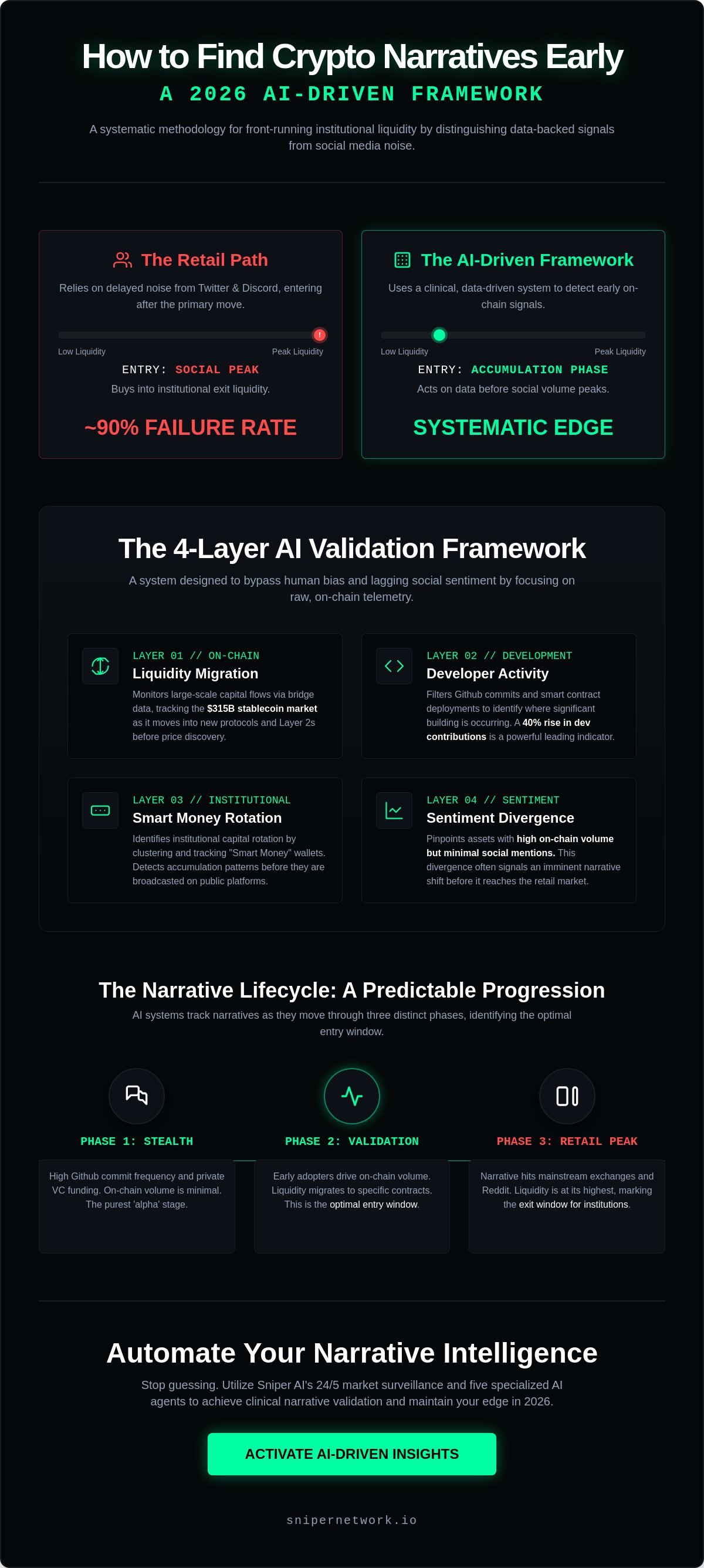
Capital moves in predictable cycles. It typically flows from Bitcoin to Ethereum before cascading into niche sectors. By June 2026, the tokenized RWA market alone has scaled to over $51 billion. Ninety percent of traders fail because they enter at the "Social Peak." They buy when the trend is already viral on X or Discord. Professional traders enter during the "Accumulation Phase." This is when on-chain data shows movement but social volume remains low. You must track the money, not the noise.
The Lifecycle of a Narrative: From Alpha to Exit
Narratives follow a strict progression. Phase 1 is the Stealth Phase. This involves early developer activity and VC seed rounds. You'll see high Github commit frequency and private funding rounds. Phase 2 is the Validation Phase. On-chain volume increases. Liquidity migrates to specific smart contracts. This phase aligns with the diffusion of innovation theory, where early adopters validate the technology before the early majority arrives. Phase 3 is the Retail Peak. The narrative reaches mainstream exchanges and Reddit. Liquidity is at its highest. This is the exit window for institutional players.
Why Manual Scanning Fails in 2026 Markets
The 2026 market moves at sub-millisecond speeds. Narratives that once took months to mature now peak in days. Human cognitive limits make it impossible to monitor 50+ blockchains simultaneously. You cannot track every liquidity spike on Raydium or Uniswap V4 manually. This complexity necessitates systematic crypto trading to maintain an objective edge. Without an automated framework, you are guessing. Data, not emotion, dictates success in this environment. Understanding how to find crypto narratives early 2026 requires removing human bias from the scanning process. You need a system that monitors the global market 24/5.
The 4-Layer AI Framework for Narrative Validation
Social listening is a lagging indicator. By the time a trend gains traction on public forums, the primary liquidity expansion has already occurred. To maintain a technical edge, you must bypass human bias. Our 4-layer AI framework focuses on raw, on-chain telemetry to identify shifts before they become public knowledge. This methodology is the foundation of how to find crypto narratives early 2026. It relies on cold data rather than social sentiment.
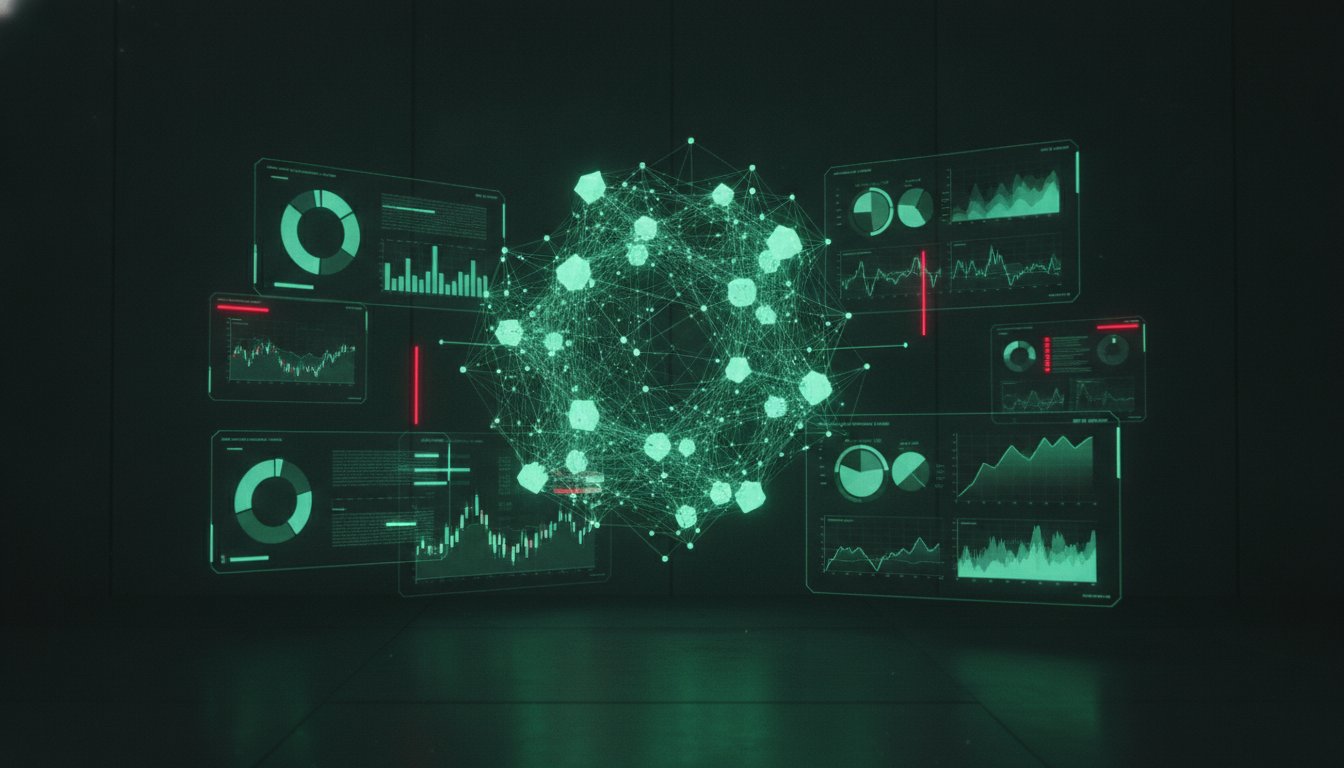
Research into AI's role in crypto trading confirms that predictive modeling is essential for navigating high-volatility environments. We utilize these principles to monitor four critical data layers. Layer 1 tracks liquidity migration, specifically monitoring the $315 billion stablecoin market as it flows into new Layer 2 protocols. Layer 2 analyzes developer activity. We use ai for crypto market analysis tools to filter Github commits and identify where the most significant technical building is occurring. Layer 3 identifies institutional rotation by clustering "Smart Money" wallets. Layer 4 detects sentiment divergence, finding assets with high volume but minimal social mentions.
Layer 1 & 2: The Foundation of On-Chain Reality
Liquidity is the lifeblood of any narrative. We monitor "Bridge Data" to see where new capital enters the ecosystem. Large-scale stablecoin shifts toward specific networks often precede price discovery. Developer growth remains the only reliable leading indicator for technological longevity. Our system tracks smart contract deployments in real-time. If a sector like DePIN shows a 40% increase in unique developer contributions, it validates a narrative shift before the tokens pump. High-tier traders use automated scanners to capture these technical signals 24/5.
Layer 3 & 4: Identifying the Smart Money Edge
Institutional rotation is rarely broadcasted. It's hidden in wallet clusters. We identify the "First Movers" by tracking the initial five wallets that enter a new narrative. These are typically high-conviction entities, not retail speculators. We then apply sentiment analysis in cryptocurrency to measure the gap between on-chain reality and public hype. Genuine narratives show high volume with low social volume. This divergence is your entry signal. Our AI agents filter out Sybil activity and wash trading to ensure we only track genuine demand. This clinical approach is vital for understanding how to find crypto narratives early 2026 without falling for artificial hype cycles.
Identifying Early Signals: From Niche Experiments to Dominant Themes
New narratives emerge after infrastructure shifts. Major L1 or L2 upgrades provide the technical bandwidth for complex applications. This is the "Infrastructure First" rule. When a network increases throughput or introduces native account abstraction, it triggers a migration of capital. Mastering how to find crypto narratives early 2026 requires monitoring these infrastructure triggers before they reach mainstream awareness. You aren't looking for marketing hype. You are looking for the deployment of foundational code that makes new use cases possible.
Tokenomics serve as a secondary validation layer. In 2026, we prioritize monitoring bonding curves and reputation systems. These mechanisms signal narrative maturity. High-quality projects use reputation systems to gate access, ensuring only long-term participants hold influence. Do not be misled by "Anti-Sniper" protection claims. These are often marketing facades. Focus instead on liquidity lock duration and smart contract audits. A narrative is only as strong as its underlying liquidity depth. If the liquidity isn't locked for at least 12 months, the narrative is high-risk speculation.
Cross-pollination creates the most explosive growth. We see this where AI meets DePIN or where Privacy protocols integrate with stablecoins. The intersection of Decentralized AI (DeAI) and physical infrastructure is a primary 2026 theme. By monitoring the $315 billion stablecoin market, we identify which sectors receive the most consistent capital inflows. Large scale shifts in USDC or USDT supply toward specific protocols indicate institutional conviction. This is the signal you need to find crypto narratives early 2026.
Tracking Institutional Capital Rotation
Institutional rails like Circle’s Arc now facilitate massive volume spikes. You must monitor these institutional-grade stablecoin flows to identify sector-wide rotations. The influence of ETFs and Decentralized Asset Trusts (DATcos) has extended narrative longevity. These entities don't trade on short-term volatility. They provide sustained buy pressure for "Anchor Protocols." These protocols define an entire sector. If you identify the anchor protocol of a new niche, you have found the center of the narrative's gravity.
The Role of Prediction Markets in Narrative Forecasting
Prediction markets like PolyMarket provide a more accurate sentiment gauge than social media. In 2026, capital commitment is the only metric that matters. Prediction market volume acts as a hedge against narrative failure. If a narrative is trending on X but has zero volume on prediction markets, it lacks financial backing. Prediction markets validate narrative strength by forcing participants to back their sentiment with measurable capital commitment. This data is clinical and unemotional. It removes the noise of artificial bot activity on social platforms.
A Step-by-Step System to Find Crypto Narratives Before the Crowd
Identification is a prerequisite, but execution is the differentiator. To master how to find crypto narratives early 2026, you must transition from manual observation to automated systems. This process begins with Step 1: configuring scanners for liquidity spikes on high-throughput DEXs like Raydium or Uniswap V4. Sudden shifts in pooled capital often signal the start of a narrative rotation. Step 2 requires applying an 8-layer validation framework. This removes the noise generated by bot-driven hype. Step 3 involves multi-timeframe confirmation. You must verify that the trend isn't a fleeting 24-hour pump. Finally, Step 4 implements crypto risk management tools to protect your principal capital during the discovery phase.
The 2026 market doesn't reward hesitation. When a liquidity cluster forms around a new technological theme, the window for alpha closes in hours. By using a systematic framework, you move beyond the "Social Peak" entries that trap 90% of retail traders. You are looking for the "Accumulation Phase" where volume precedes price. This requires a clinical detachment from market sentiment. You must trust the telemetry provided by your scanners rather than the opinions of influencers. Data is the only objective source of truth in a market saturated with artificial hype.
Configuring Your Data Filters
Precision is mandatory. Set minimum liquidity thresholds to filter out low-cap "rug pulls" in emerging sectors. High-tier traders often require at least $500,000 in locked liquidity before considering a narrative valid. Focus on active user growth rather than total transaction volume. Total volume is easily manipulated via wash trading. Unique wallet interactions provide a clearer picture of organic adoption. Use AI agents to summarize complex protocol whitepapers in seconds. This allows you to understand the technical utility of a project before the market fully prices it in. To automate this entire validation sequence, access our institutional-grade scanner and begin filtering signals with sub-millisecond accuracy.
Validating Through Multi-Timeframe Confirmation
We utilize the "3-Day Rule" for all narrative validation. The strongest trends must survive the first 72 hours of profit-taking. If on-chain volume remains consistent after the initial exit of seed investors, the narrative has structural integrity. Correlate this growth with exchange listing rumors and institutional sentiment. Every valid narrative must solve a specific 2026 market pain point. Whether it's the $51 billion RWA sector's need for transparency or DePIN's requirement for scalable hardware, the utility must be evident. If the narrative doesn't solve a problem, it's a speculative bubble. Check your how to find crypto narratives early 2026 checklist: does the project have a 12-month liquidity lock? If not, the risk of a liquidity exit is too high for a professional framework.
Sniper AI Weekly: Automating Early Narrative Intelligence
Sniper AI Weekly automates the identification of high-liquidity rotations. It moves beyond the limitations of human observation. The system utilizes five specialized AI agents. These agents scan the global market 24/5. They detect narrative clusters the moment they form. This clinical approach is the most effective method for how to find crypto narratives early 2026. It eliminates the delay inherent in social media discovery. You receive data while the majority of retail is still filtering noise on X.
Data-driven insights replace speculative guesswork. Our framework provides institutional-grade intelligence. It operates on a non-custodial basis. ◈ Your API key, your funds. You maintain total asset control at all times. The system triggers reports based on sub-millisecond validation. It monitors liquidity shifts across 50+ blockchains simultaneously. This ensures you enter trades during the accumulation phase, not the social peak. We focus on the $315 billion stablecoin market to track where real value is migrating.
The Sniper Advantage: 5 AI Agents, 8 Signal Filters
Automated market intelligence removes emotional bias from trend discovery. Humans struggle with information overload. AI agents do not. Data-driven crypto trading is the only way to compete with institutional desks in 2026. Our infrastructure utilizes Claude AI and GCP Tokyo co-location. This setup delivers sub-millisecond data processing. Eight distinct signal filters validate every trend. We track stablecoin supply, developer commits, and institutional wallet clusters. This multi-layered verification ensures that only high-conviction narratives reach your dashboard.
Institutional Intelligence for the Individual Trader
Sniper AI Weekly bridges the gap between professional trading floors and individual traders. We provide the same tools used by elite technicians. Transparency is our standard. We provide backtested results and clinical performance metrics. There is no exuberant hype. Only data. This system allows you to master how to find crypto narratives early 2026 with total confidence. You gain the speed of a high-frequency trading engine with the simplicity of a weekly intelligence report. Our 24/5 monitoring ensures you never miss a liquidity shift in the RWA or DePIN sectors.
◈ Start your automated intelligence trial - No card required
Securing the Institutional Edge in 2026 Narrative Cycles
Narrative discovery is a technical discipline. It requires bypassing social noise to monitor raw liquidity shifts across the $315 billion stablecoin market. You've learned how to apply the 4-layer AI framework to validate trends before they reach the retail masses. Success in 2026 depends on clinical detachment and automated precision. Implementing these systematic filters is the definitive strategy for how to find crypto narratives early 2026 without falling for artificial hype cycles or liquidity traps. Data is the only objective source of truth in a market saturated with speculation.
Sniper AI Weekly provides the infrastructure to execute this methodology. 5 AI agents. 8 signal filters. The system delivers sub-millisecond market validation via GCP Tokyo to ensure your data is always current. ◈ Your API key, your funds. You retain total control of your assets while accessing institutional-grade intelligence previously reserved for professional trading floors. Move beyond the exhaustion of manual scanning and the risk of entering at the social peak. Position yourself at the start of the next capital rotation with confidence.
◈ Access Sniper AI Weekly: Institutional Intelligence for Individual Traders
Frequently Asked Questions
How do I know if a crypto narrative is real or just hype?
You distinguish real narratives from hype by monitoring on-chain telemetry. Real narratives demonstrate sustained liquidity migration and increasing developer activity. Hype relies solely on social media volume without capital commitment. Use the 4-layer framework to validate stablecoin supply shifts and smart contract deployments. If social mentions peak without a corresponding volume spike on decentralized exchanges, it is likely artificial hype.
What are the top crypto narratives for the second half of 2026?
The dominant themes for late 2026 include tokenized Real World Assets (RWA) and Decentralized Physical Infrastructure Networks (DePIN). The RWA sector has already exceeded $51 billion in market capitalization. You should also monitor the intersection of AI and blockchain, or DeAI. These sectors solve specific market pain points. They provide structural utility rather than speculative value. This focus is central to how to find crypto narratives early 2026.
Do I need expensive tools to find crypto narratives early?
Basic on-chain analysis can be performed with free block explorers and Github monitors. However, competing with institutional desks requires automated infrastructure. Manual scanning is too slow for the sub-millisecond execution speeds of 2026. You need tools that provide multi-timeframe confirmation and 24/5 monitoring. Professional software removes human bias. It allows you to process data from 50+ blockchains simultaneously.
How much capital do I need to start narrative trading?
Narrative trading doesn't require a specific minimum capital, but it requires high liquidity depth in the target asset. You should only enter sectors with sufficient volume to prevent slippage. Many professional traders allocate capital across multiple emerging themes to manage risk. Focus on the 8-layer validation framework before committing funds. Ensure the project has at least 12 months of locked liquidity to avoid exit scams.
Can AI really predict which crypto sector will pump next?
AI doesn't function as a crystal ball. It identifies measurable clusters of capital before they become obvious to retail traders. By monitoring stablecoin supply shifts and developer commits, AI agents detect the start of a liquidity rotation. It provides a statistical edge rather than a guarantee. This data-driven approach is the most reliable method for how to find crypto narratives early 2026 without emotional interference.
What is the risk of "sniping" new narratives early?
The primary risk involves low liquidity and extreme price volatility. Early-stage narratives often lack the depth to absorb large sell orders. You also face the risk of smart contract vulnerabilities or rug pulls. Mitigate these risks by using advanced crypto risk management tools. Always verify liquidity lock durations. Never enter a narrative that hasn't survived the 72-hour profit-taking window.
How does Sniper AI Weekly differ from a standard signal group?
Sniper AI Weekly is an automated intelligence system, not a manual signal group. It utilizes five AI agents to scan markets 24/5. Signal groups rely on human intuition and subjective calls. Our system provides institutional-grade telemetry and clinical performance metrics. ◈ Your API key, your funds. We never hold user assets. We provide the data, and you maintain total control over execution.
Is narrative trading better than long-term HODLing in 2026?
Narrative trading often outperforms HODLing in 2026 due to rapid liquidity rotations. New regulations like MiCA and DAC8 have matured the market. This maturity creates distinct cycles of capital flow between sectors. Stagnant holdings may miss these rotations. Active narrative trading allows you to capture growth in emerging sectors like RWA or DePIN. It maximizes capital efficiency by moving funds where liquidity is expanding.