Recovery isn't a matter of luck; it's a matter of infrastructure. Most traders fail because they treat a portfolio drawdown as a personal failure rather than a system error. If you're wondering how to recover from a large crypto loss, you must first accept that your manual decision-making process is compromised. The market in June 2026 is no longer a playground for retail speculation. With over 560 million global owners and institutional players dominating the order books, emotional trading is a liability you can't afford.
It's natural to feel the weight of the sunk cost fallacy or the urge to "revenge trade" into the next volatile token. We understand the paralysis that comes when your confidence hits zero. This guide replaces that anxiety with clinical, data-driven protocols. You'll learn to conduct a forensic audit of your failures and implement a non-emotional trading plan. We'll show you how to transition from guesswork to institutional-grade tools like Sniper AI Weekly. By the end of this framework, you'll have a systematic path to rebuild based on technical precision rather than hope.
Key Takeaways
- Halt all manual execution immediately to prevent the revenge-trading spiral. A zero-base audit is required to evaluate every open position as a fresh deployment of capital.
- Conduct a forensic analysis to identify if your failures stemmed from timing, direction, or risk management. This technical audit is the first step in learning how to recover from a large crypto loss without emotional bias.
- Transition to a rules-based intelligence framework. Use AI-driven agents to filter market noise and validate trends with institutional precision.
- Deploy an 8-layer validation framework and hard circuit breakers. Protect your remaining capital by shifting from retail speculation to professional risk protocols.
- Follow a 90-day recovery roadmap focused on consistency over high-risk "home runs." Integrate systematic data feeds into your daily routine for sustained profitability.
Immediate Portfolio Triage: Stopping the Emotional Hemorrhage
The first step in how to recover from a large crypto loss is a total cessation of manual activity. Stop. Close the terminal. Most traders attempt to "win it back" through high-leverage revenge trades. This is a mathematical death sentence. Institutional operators don't trade on emotion; they trade on systems. When your portfolio takes a significant hit, your decision-making is compromised by adrenaline and cortisol. Continuing to trade in this state is not "working harder," it's gambling with the remains of your capital.
You must perform a "Zero-Base" Audit immediately. Look at your current holdings with cold detachment. If you had the liquid cash value of your portfolio in your hand right now, would you buy these specific tokens at their current prices? If the answer is "no," you must liquidate them. Holding "zombie assets" simply because you're down 80% is a failure of logic. These assets often lack institutional-grade data backing or multi-timeframe confirmation. They're dead weight. Clear the board to make room for a data-driven recovery plan.
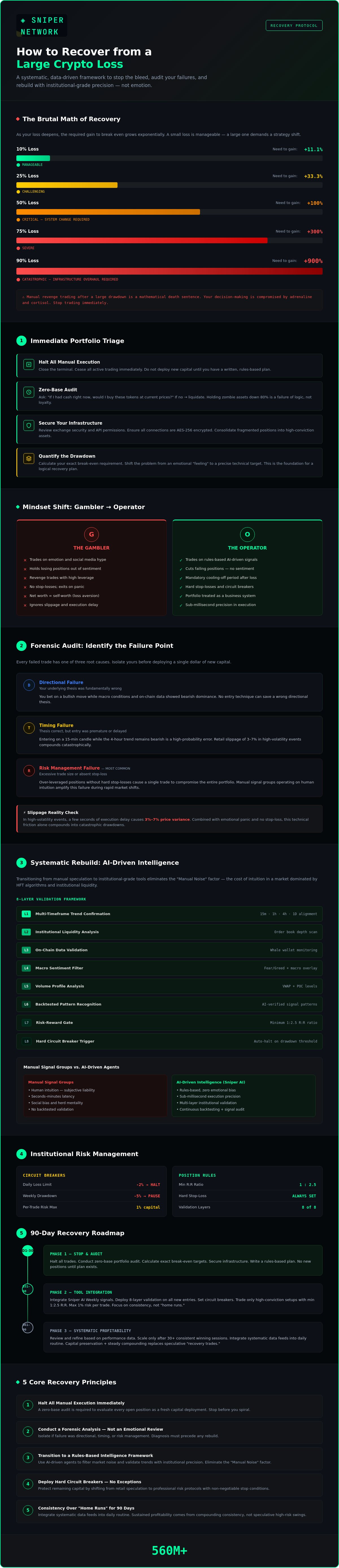
Quantifying the drawdown is the next clinical requirement. You need to understand the brutal mathematics of recovery. A 10% loss only requires an 11.1% gain to break even, but as the loss deepens, the hill becomes a mountain. A 50% loss requires a 100% gain to reach parity. A 90% loss requires a 900% gain. By calculating your exact break-even requirements, you shift the problem from an emotional "feeling" to a technical target. This clarity is essential for anyone learning how to recover from a large crypto loss without falling back into speculative traps.
The Psychology of the Drawdown
Success in volatile markets requires you to decouple your net worth from your self-worth. You are currently battling various cognitive biases, specifically loss aversion and the sunk cost fallacy. These mental loops keep you tethered to failing positions. Transitioning from a "Gambler" to an "Operator" mindset means treating your portfolio like a business. A business doesn't hold onto a failing product out of sentiment. It cuts the line and reallocates resources to high-conviction, backtested strategies.
Technical Triage Steps
Secure your infrastructure before rebuilding. Review your exchange security and API permissions; ensure all connections are AES-256 encrypted. Consolidate fragmented "dust" and small positions into high-conviction assets that show strong institutional signals. Finally, establish a mandatory cooling-off period. Do not deploy new capital until you have a written, rules-based plan. This pause isn't a sign of weakness. It's a strategic reset designed to ensure your next move is executed with sub-millisecond precision and zero emotional interference.
Forensic Audit: Identifying the Failure Point in Your Strategy
Recovery requires more than just a fresh start. It demands a cold, forensic investigation into why your previous strategy failed. The Forensic Audit serves as the foundational protocol for institutional-grade recovery by distilling emotional failure into actionable technical data. You can't fix what you haven't diagnosed. To understand how to recover from a large crypto loss, you must isolate the specific failure points: direction, timing, or risk management.
Directional failure occurs when your underlying thesis is fundamentally wrong. Timing failure happens when the thesis is correct, but the entry is premature or delayed. Risk management failure is the most common; it's when excessive trade size or the absence of a hard stop-loss compromises the entire portfolio. Review your trade execution speed. Retail traders often ignore slippage, but in high-volatility events, a few seconds of delay can result in a 3% to 7% price variance. This technical friction compounds into catastrophic drawdowns when combined with manual execution and emotional panic.
Most failed trades share a common denominator: a lack of multi-timeframe confirmation. Entering a position based on a 15-minute candle while the 4-hour trend remains bearish is a high-probability error. This is the "Manual Noise" factor. It’s the cost of relying on intuition in a market dominated by high-frequency algorithms and institutional liquidity.
Auditing Manual Signal Groups
Most retail losses are triggered by social media hype and manual signal groups. These entities operate on human intuition, which is a subjective liability during rapid market shifts. They lack the infrastructure to process sub-millisecond data feeds or monitor 24/5 volatility. If you're seeking alternatives to crypto signal groups, you must pivot toward systems that prioritize raw market data over human opinion. Expert bias is no substitute for backtested results and multi-agent validation.
Data-Driven Failure Analysis
Compare your manual entry points against AI-detected trend reversals. You'll likely find your exits were as flawed as your entries. Selling at the local bottom due to fear often costs more than the initial market move. Quantifying the impact of these emotional exits is vital for learning how to recover from a large crypto loss. By analyzing your history through an institutional-grade AI intelligence framework, you can replace human error with clinical precision and automated risk controls. Stop guessing. Start validating.
Systematic Rebuild: Transitioning to AI-Driven Intelligence
Manual chart analysis is a relic. In the current 2026 market environment, drawing lines on a screen is insufficient against high-frequency institutional engines. Systematic trading is the solution. It's a rules-based framework that removes human discretion from the execution loop. If you want to know how to recover from a large crypto loss, you must stop being the pilot and start being the operator of an automated system. Discretion is where emotion enters the trade; automation is where it's purged.
AI agents act as the primary filters. They process millions of data points across 500+ pairs in sub-milliseconds. They don't get tired. They don't feel "revenge" after a drawdown. By shifting to automated research, you eliminate the "manual noise" identified in your forensic audit. You maintain total control of your assets through non-custodial API connections while upgrading your intelligence layer to an institutional grade. This ensures security remains a priority while performance scales. You need a system that validates market movements faster than you can react to them.
The Intelligence Upgrade
Modern ai for crypto market analysis tools don't predict the future; they validate the present. They scan for multi-timeframe confirmation and institutional-grade setups that are invisible to the naked eye. Instead of guessing a bottom, these systems wait for verifiable trend reversals across multiple indicators. This shift from prediction to validation is the primary differentiator for successful recovery. It ensures that every trade you enter is supported by technical consensus rather than social media speculation. You're no longer chasing price; you're executing on confirmed momentum.
Sniper AI Weekly: The Recovery Engine
Sniper AI Weekly provides the clinical edge needed to rebuild. It replaces the anxiety of daily chart obsession with structured, automated weekly reports. These reports distill complex market movements into actionable intelligence. You get the data-backed edge of a professional trading floor without the emotional overhead of manual monitoring. It's a frictionless transition. Our "No-Card" trial allows you to validate the performance of the system before committing capital. We don't hold your assets. Your API key, your funds. Recovery is simply a process of upgrading your tools until they match the sophistication of the market. The system monitors the volatility so you don't have to.
Institutional Risk Management: Preventing the Next Drawdown
Recovery is a defense-first operation. Most traders look for how to recover from a large crypto loss by searching for the next 100x gem. This is a strategic error. Institutional recovery focuses on preventing the next drawdown before it starts. You need a proactive framework, not a reactive tax-loss harvesting plan. This process starts with implementing hard "Circuit Breakers." If a portfolio drawdown hits a predetermined threshold, all execution stops. No exceptions. No emotional negotiation. You protect the remaining capital at all costs.
Precision in position sizing is the difference between a minor setback and a catastrophic liquidation. You must use advanced crypto risk management tools to calculate your risk-of-ruin based on real-time volatility. Every trade must have a mathematically validated size derived from your current equity, not your peak portfolio value. This clinical approach removes the "hope" factor from your recovery process. You trade the numbers, not the narrative. By the time you understand how to recover from a large crypto loss, you realize that survival is more important than speed.
The 8-Layer Filter
Sniper Network utilizes 5 AI agents to filter every signal before it reaches your dashboard. We don't rely on single-point indicators. The institutional standard is multi-timeframe confirmation. A signal must be valid on the 1-hour, 4-hour, and daily charts simultaneously before a trigger is generated. We also integrate sentiment analysis as a secondary confirmation layer. This filters out "manual noise" and hype-driven volatility. 8 signal filters. 5 AI agents. Total technical validation. This multi-layered approach ensures that you only deploy capital when the data shows a high-probability convergence of factors.
Operational Security
Large portfolio recovery requires high-tier infrastructure. We use AES-256 encryption and co-located execution to minimize latency and maximize security. Non-custodial tools are mandatory for serious operators. You should never grant withdrawal permissions to any third-party tool or intelligence framework. Your API key, your funds; this is the only acceptable security model for professional recovery. By maintaining asset custody while upgrading your intelligence layer, you eliminate counterparty risk. This setup mirrors the security protocols of top-tier financial firms. Deploy institutional-grade risk management today to secure your path back to profitability.
Executing the Recovery: From Data to Profitability
Institutional recovery is a marathon, not a sprint. To understand how to recover from a large crypto loss, you must abandon the search for a single "moonshot" trade. Instead, implement a 90-day recovery roadmap. This timeframe aligns with institutional reporting cycles and allows for the law of large numbers to work in your favor. Your goal is consistency. You're looking for high-probability setups that deliver steady equity growth while maintaining a manageable risk profile. Base hits win the game; home runs often lead to strike-outs.
Integrating systematic crypto trading into your daily routine is the next phase. This means your trades are triggered by data, not intuition. You check the system, validate the signals, and execute according to the plan. Discretion is minimized. You only scale your capital after the systematic framework proves profitable over a full 30-day cycle. Scaling into a losing system only accelerates ruin. Scaling into a validated system builds wealth. This is the clinical path to portfolio restoration.
Monitor your performance through clinical metrics. Raw profit is a vanity metric. Professional operators focus on the Sharpe ratio and Max drawdown. The Sharpe ratio measures your risk-adjusted return. It tells you if your profits are due to skill or excessive risk-taking. Max drawdown tracks the largest peak-to-trough decline in your portfolio. If your drawdown exceeds your predetermined circuit breaker limit, you stop. This data-driven feedback loop is essential for how to recover from a large crypto loss without repeating previous errors. You're building a business, not a betting slip.
The Sniper Network Advantage
Automated AI-driven market intelligence removes the anxiety of recovery. The market operates 24/7, but institutional liquidity often follows a 24/5 schedule. Sniper Network monitors these windows for you. Transitioning to data-driven crypto trading ensures you aren't guessing at 3 AM. Our AI agents handle the heavy lifting of trend validation and noise filtration. You simply act on the intelligence provided. This keeps your mind clear and your execution sharp.
Final Action Steps
Your recovery starts with a technical upgrade. Sign up for Sniper AI Weekly to receive your first recovery-grade report. Connect your exchange via our secure, non-custodial API for automated validation. This setup ensures you maintain total control while benefiting from elite-level signals.
- Sign up for Sniper AI Weekly to receive the first recovery-grade report.
- Connect your exchange via secure API for automated validation.
- ◈ Start your free 7-day Sniper AI Weekly trial
Transition to Systematic Execution
Recovery isn't a recovery of the past; it's an upgrade for the future. You've stopped the emotional hemorrhage and conducted a forensic audit of your failure points. Now, you must replace human intuition with clinical, rules-based intelligence. Learning how to recover from a large crypto loss requires a fundamental shift from retail speculation to institutional protocols. By implementing hard circuit breakers and validating every entry through multi-timeframe confirmation, you protect your remaining capital while building a path to sustainable profitability.
Sniper Network provides the technical infrastructure required for this transition. Our system utilizes 5 AI agents and 8 signal filters to ensure every trade is backed by data. We leverage sub-millisecond validation via GCP Tokyo to stay ahead of market volatility. Your security is paramount; we operate on a non-custodial model. Your API key, your funds. This is the professional standard for modern digital asset management.
Stop guessing. Start executing with precision. ◈ Upgrade to Institutional Intelligence with Sniper AI Weekly and take control of your recovery. The market moves fast, but your system moves faster. You have the framework; now deploy the tools.
Frequently Asked Questions
How long does it take to recover from a 50% crypto loss?
A 50% drawdown requires a 100% gain to reach parity. Recovery time is a function of your risk-adjusted return and market volatility, not a fixed date on a calendar. Institutional operators use a 90-day roadmap to focus on consistent equity growth rather than seeking a single high-risk recovery trade. Rapid recovery attempts often lead to further liquidation.
Should I sell my remaining crypto to start over?
Execute a Zero-Base Audit to make this determination. If you wouldn't deploy fresh capital into your current positions based on today's technical signals, liquidate them immediately. Holding assets solely because they're down is a sunk cost fallacy. Consolidating into high-conviction, data-backed assets is the only logical move for a systematic rebuild.
Can AI really help me recover lost funds?
AI provides the infrastructure for recovery by purging emotional bias from your execution loop. It validates trends across 500+ pairs in sub-milliseconds using institutional-grade data. This helps you understand how to recover from a large crypto loss by ensuring every future trade meets an 8-layer validation standard before capital is deployed. It replaces guesswork with technical precision.
What is the "revenge trading" trap and how do I avoid it?
Revenge trading is a psychological spiral where traders increase leverage to recoup losses rapidly. It's a primary cause of account liquidation in volatile markets. You avoid this trap by setting hard circuit breakers and transitioning to rules-based automation. Automation ignores emotional impulses and only executes when your predefined technical criteria are met.
Is it better to hodl or trade during a recovery phase?
Neither hodling nor manual trading is optimal for portfolio restoration. Passive holding ignores the technical decay of zombie assets, while manual trading is prone to human error and slow execution. A systematic intelligence framework is the professional alternative. It validates market moves and executes based on multi-timeframe confirmation rather than hope or hype.
How do I know if my crypto loss is tax-deductible?
In the 2026 tax year, crypto capital losses are deductible against capital gains. If your losses exceed your gains, you can deduct up to $3,000 per year against ordinary income. Any remaining loss carries forward to future years. This is a critical component of how to recover from a large crypto loss by reducing your overall tax liability.
What are non-custodial crypto intelligence tools?
Non-custodial tools provide intelligence and execution signals without taking ownership of your assets. They connect to your exchange via AES-256 encrypted API. This ensures your funds remain in your account while you leverage institutional-grade data and AI agents. Your API key, your funds. This model eliminates counterparty risk entirely.
Why do most manual crypto traders lose money in the long run?
Manual traders lack the sub-millisecond speed and technical precision of automated systems. They're vulnerable to manual noise, social media hype, and cognitive biases. Most long-term losses stem from a failure to decouple self-worth from portfolio performance. This leads to catastrophic risk management errors that institutional-grade systems are designed to prevent.