
The "black box" algorithm is a liability, not an asset. Most traders treat machine learning as a magic oracle rather than a technical tool, which often leads to avoidable capital depletion. You've likely been burned by manual signal groups or felt the anxiety of granting a third-party tool access to your exchange API. It's a rational fear. In a market where AI trading is projected to reach a $33.45 billion valuation by 2030, the gap between institutional-grade precision and retail guesswork is widening.
Learning how to trust AI for crypto trading requires moving past emotional hype and into systematic validation. You'll learn the technical criteria required to evaluate AI intelligence and how to construct a framework that protects your capital. This guide provides a checklist for verifying providers, explains the critical security difference between custodial and non-custodial architectures, and introduces a data-driven approach to market analysis. Trust isn't earned through promises; it's verified through technical architecture and backtested performance.
Key Takeaways
- Identify the "black box" risks in opaque algorithms and learn why data integrity must supersede emotional promises for institutional-grade reliability.
- Implement an 8-layer validation framework using multi-agent systems and multi-timeframe confirmation to effectively filter market noise and reduce false positives.
- Understand how to trust AI for crypto trading by prioritizing non-custodial intelligence services that adhere to the "Your API Key, Your Funds" security principle.
- Utilize a systematic audit checklist to verify that AI providers use institutional-grade data feeds and maintain strictly non-custodial architectures.
- Transition from inefficient 24/7 signal groups to automated weekly intelligence that focuses on high-conviction market analysis and capital protection.
The Trust Deficit in AI Crypto Trading: Hype vs. Systematic Reality
Trust in the digital asset space is currently at an all-time low. The reason is simple. Most retail tools are built on marketing rather than mathematics. To understand how to trust AI for crypto trading, you must prioritize data integrity over emotional promises. Institutional players don't "believe" in a bot; they validate its logic. When a system is opaque, it becomes a liability. This "Black Box" problem is the primary driver of skepticism in the industry. If a provider cannot explain the specific data points triggering a trade, the system is likely a speculative gamble rather than a professional tool.
Institutional AI differs from retail tools through its focus on risk management. While retail bots often chase "moon" shots, professional systems prioritize capital preservation. They utilize high-tier infrastructure, such as GCP Tokyo servers and Claude AI integration, to ensure sub-millisecond execution and logic processing. Transitioning from speculative hype to clinical intelligence requires a shift in mindset. You are not looking for a magic oracle. You are looking for a data-driven engine that reduces market noise through systematic validation.
Algorithmic trading established the rules-based foundation for this evolution, but modern AI adds a layer of adaptive intelligence. It doesn't just follow a static script; it validates current market conditions against historical datasets to confirm a signal's validity. This is the difference between a tool that reacts and a tool that analyzes.
The Failure of Manual Signal Groups
Manual signal groups are fundamentally flawed because they rely on human intuition. Human emotion and cognitive bias compromise every manual signal. A "guru" gets a feeling, and your capital is the collateral. These groups lack backtesting and transparency. Systematic crypto trading replaces this unreliable intuition with cold math. By removing the human element, you eliminate the fear and greed that lead to devastating drawdowns. Math doesn't have a "bad day" at the office.
Red Flags in Automated Trading
Identifying fraud in the automated space is a technical necessity. Any platform claiming "guaranteed returns" is an immediate fraud marker. Markets are inherently volatile; no system wins 100% of the time. Another critical danger is the custodial bot. If a tool requires direct access to your funds, you have lost control. Transparency in infrastructure is a non-negotiable trust marker. You must demand to see the security protocols, the data sources, and the execution logic. Your primary mantra should always be: Your API key, your funds.
The 8-Layer Validation Framework: How AI Agents Filter Market Noise
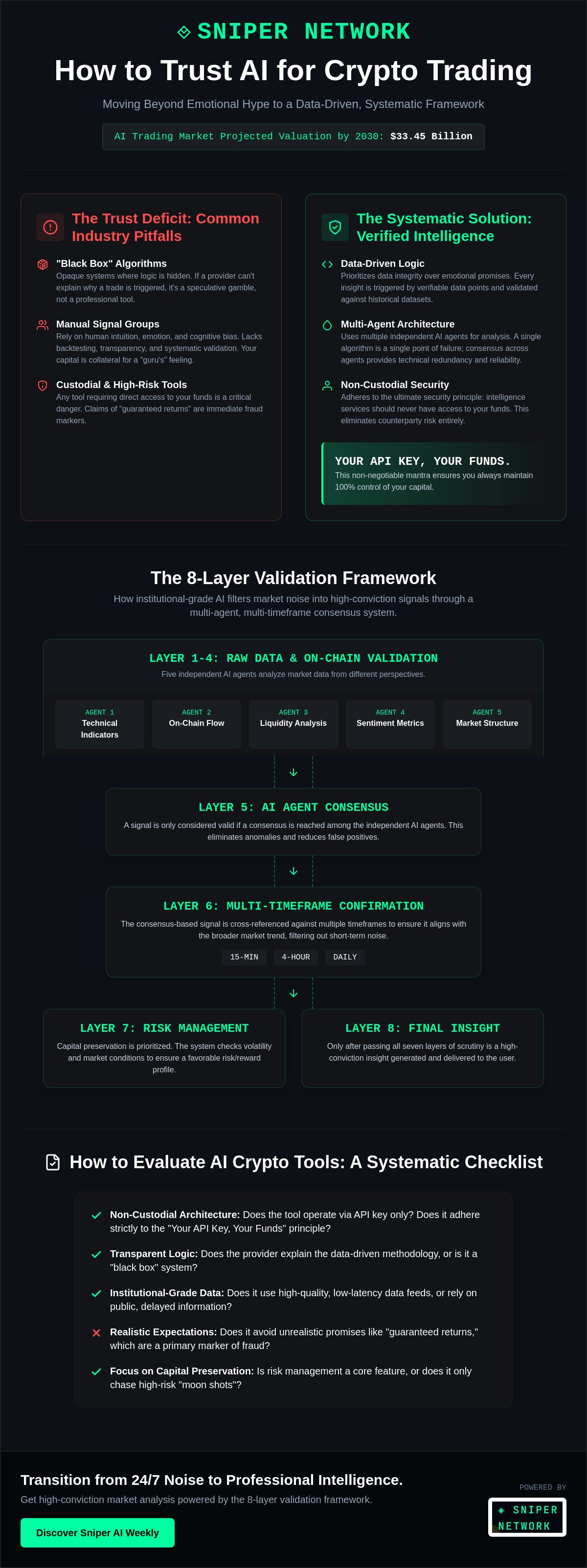
Trust is built through technical redundancy. A single algorithm is a single point of failure. To establish how to trust AI for crypto trading, you must look for a multi-agent architecture. This framework uses 5 independent AI agents to analyze market conditions. Each agent operates with a specific mandate. One analyzes technical indicators. Another monitors on-chain flow. Only when these agents reach a consensus is a signal generated. This process mimics the regulatory framework for algorithmic trading used by institutional desks to manage systemic risk.
Multi-timeframe confirmation is essential for reducing false positives. A signal on a 15-minute chart must be validated by the 4-hour and daily trends. Without this cross-referencing, you are simply trading noise. The system requires a "consensus" before triggering insights. This ensures that every recommendation is backed by a multi-dimensional data set rather than a single technical anomaly. By the time a signal reaches the user, it has already survived five layers of automated scrutiny.
Layer 1-4: Technical and On-Chain Validation
The first four layers focus on raw data execution and liquidity. The system analyzes sub-millisecond data to detect emerging trends before they become obvious to retail participants. It also monitors on-chain flow. This tracks institutional "whale" movements in real-time. By using ai for crypto market analysis tools, the engine scans the market 24/5. It looks for anomalies in volume and price action that indicate institutional accumulation or distribution. This data provides the foundation for any high-conviction trade. It removes the guesswork from liquidity analysis.
Layer 5-8: Sentiment and Narrative Filtering
Data without context is dangerous. The final four layers process market sentiment. Natural Language Processing (NLP) filters scan massive amounts of news noise to identify relevant shifts in narrative. Understanding sentiment analysis in cryptocurrency is the only way to avoid the FOMO traps that liquidate retail traders. The system validates this information through high-tier sources. It utilizes Reuters feeds and co-located GCP Tokyo infrastructure to ensure data integrity. When the technical layers and the sentiment layers align, the probability of a successful outcome increases. You can explore these automated filters to see how they reduce speculative risk through systematic consensus.
Non-Custodial Intelligence: Eliminating Counterparty Risk
Counterparty risk is the most significant threat to capital in the digital asset space. Most traders fail to distinguish between a "trading bot" and a "market intelligence service." This technical distinction is critical for understanding how to trust AI for crypto trading. A legitimate service never touches your principal. It operates on the "Your API Key, Your Funds" principle. This architecture ensures that your assets remain secure on your chosen exchange, even if the intelligence provider suffers a system breach. Security is not a marketing promise. It is a technical configuration.
Non-custodial tools effectively eliminate the possibility of "Steynberg" style Ponzi collapses. These fraudulent schemes thrive on centralized "trading pools" where users lose visibility and control over their assets. By contrast, automated execution via AES-256 encrypted API connections allows the AI to send trade instructions without ever having withdrawal authority. You retain the power to terminate the connection instantly. This setup provides the speed of automation with the security of self-custody. It is the only acceptable model for professional capital management.
Why Intelligence Reports Beat Direct Access
Using AI as a research assistant rather than a fund manager provides a strategic advantage. You maintain full control over withdrawals and asset allocation. Intelligence reports provide the "why" and "when" of a market move, allowing you to validate the logic before capital is committed. This approach drastically reduces the attack surface. You are not handing over your keys to a centralized entity. You are subscribing to high-fidelity data. This separation of intelligence from custody is the hallmark of institutional-grade operations. It replaces blind trust with technical verification.
Evaluating Platform Infrastructure
Trust is a function of infrastructure. Institutional-grade data requires enterprise-level hosting on platforms like GCP or AWS. Co-location and low-latency server environments are essential for processing market fluctuations in real-time. If a provider hosts their tools on substandard servers, the resulting data lag becomes a hidden cost that erodes your edge. Always verify that your provider never requests "Withdrawal" permissions on your API keys. A professional service only requires "Trade" and "View" access. This technical boundary is your primary defense against capital loss. Demand transparency in hosting and permission protocols before granting any API access.
While securing trading infrastructure is paramount, small business owners must also consider their broader security posture. Beyer Bytes offers specialized IT and physical security services to ensure that every aspect of your business, from your office network to your physical premises, is protected against modern threats.
How to Evaluate AI Crypto Tools: A Systematic Checklist
Technical verification is the only path to safety. Social proof and marketing testimonials are easily fabricated; technical architecture is not. To establish how to trust AI for crypto trading, you must subject every provider to a rigorous audit. This process moves beyond surface-level reviews and into the core logic of the system. Use the following five-step checklist to validate any tool before granting API access.
- Step 1: Audit the custody model. The system must be strictly non-custodial. Verify that the provider only requests "Trade" and "View" permissions. If they ask for "Withdrawal" access, terminate the onboarding immediately.
- Step 2: Verify data sources. Retail-grade data leads to retail-grade losses. Ensure the tool utilizes institutional-grade feeds from sources like Reuters or co-located exchange servers.
- Step 3: Review validation layers. A single algorithm is insufficient. Look for multi-agent consensus models that filter noise through technical, on-chain, and sentiment analysis.
- Step 4: Assess the pricing model. Avoid "profit sharing" schemes. These models incentivize the provider to take extreme risks with your capital to maximize their fee. A transparent subscription model aligns interests by focusing on long-term tool utility.
- Step 5: Test the output. Does the system provide actionable intelligence or just raw data? Professional tools deliver high-conviction insights backed by clear logical triggers.
Analyzing Backtested Results
Simulated performance is often a hall of mirrors. You must distinguish between "backtested" (historical simulation) and "live" (real-time execution) data. Backtesting is a baseline for logic, but it cannot account for slippage or sub-millisecond liquidity shifts. Be wary of any platform claiming a 100% win rate. This is a mathematical impossibility in volatile markets and serves as a definitive fraud signal. Legitimate systems prioritize crypto risk management tools, such as automated stop-loss triggers and position sizing, over unrealistic win-rate promises. Capital preservation is the primary objective of any professional AI.
Transparency and Team Accountability
Anonymity is a liability in financial software. Verify that the service is operated by a registered entity, such as Sniper Network Ltd. This provides a layer of legal and professional accountability. Transparency also extends to reporting. A trustworthy provider delivers clear, weekly intelligence on market trends and system performance. The most effective way to verify these claims is through a "no card required" trial. This allows you to test the automated intelligence output in real-time without financial commitment. Verification should always precede capital allocation.
Sniper AI Weekly: Professional Intelligence Without the Noise
Sniper AI Weekly operationalizes the systematic framework described in the previous sections. It is not a speculative bot; it is a clinical intelligence engine. Understanding how to trust AI for crypto trading requires a definitive move away from the chaotic noise of 24/7 signal groups. This service implements the 8-layer validation framework to provide high-conviction market analysis. It filters out the volatility that frequently liquidates retail traders. You maintain 100% asset control at all times. By accessing data-driven crypto trading insights, you utilize the same technical logic used by institutional desks while keeping your principal on your own exchange.
The advantage of automated weekly intelligence over "signal spam" is clarity. Most retail tools trigger hundreds of low-conviction alerts that lead to overtrading and capital depletion. Sniper AI Weekly prioritizes quality over frequency. It analyzes the market 24/5 to identify the most significant institutional movements. This approach bridges the gap between high-frequency institutional speed and the practical need for individual retail control. You aren't chasing every candle; you are following the data-backed trend.
5 AI Agents. 8 Signal Filters.
The infrastructure is built for technical precision. The system processes market data through a clinical pipeline involving 5 independent AI agents. This "consensus" model ensures no single data point triggers a report. The system utilizes Claude AI for advanced logic processing and co-located GCP Tokyo servers for sub-millisecond data ingestion. This setup ensures that the information you receive is based on the most accurate, low-latency feeds available.
- Technical validation layers monitor price action and volume anomalies.
- On-chain filters track institutional "whale" movements in real-time.
- Sentiment analysis via NLP processes global news noise to identify narrative shifts.
- Consensus triggers only occur when all agents align on a specific market direction.
Weekly reports provide the necessary perspective to ignore short-term market manipulation. They allow for multi-timeframe confirmation, ensuring your strategy is aligned with the macro trend rather than local noise. This is the difference between gambling and systematic execution.
Start Your Systematic Journey
Integration into your existing workflow is frictionless. You don't need to change your exchange or grant withdrawal permissions. You simply enhance your decision-making with institutional-grade data. This is the "Elite Technician" approach to navigating 2026 market volatility. It is a data-driven, unemotional strategy that prioritizes capital preservation and technical verification. It's time to stop guessing and start validating.
◈ Access Sniper AI Weekly: Professional Intelligence, Zero Asset Risk
Transition to Systematic Market Intelligence
Trust in the digital asset space is no longer a matter of faith; it is a matter of technical verification. You've learned that true security relies on a non-custodial architecture where you retain 100% control. Your API key, your funds. This is the only acceptable standard for professional capital management. By implementing an 8-layer validation framework, you replace speculative noise with high-conviction data. Learning how to trust AI for crypto trading is the definitive step toward institutional-grade performance in 2026.
Sniper AI Weekly provides the infrastructure necessary to execute this transition. It utilizes 5 AI agents and 8 signal filters to process market movements with sub-millisecond precision. Powered by Claude AI and co-located on GCP Tokyo servers, the system validates every insight against multi-timeframe datasets before it reaches your dashboard. You don't need to guess when you can verify. High-conviction trading is the standard for those who prioritize data over hype.
◈ Experience Institutional-Grade Intelligence: Start Your Sniper AI Weekly Trial
Frequently Asked Questions
Is it safe to link my crypto exchange to an AI trading tool?
Linking an exchange is safe if the tool utilizes a strictly non-custodial architecture. You must restrict API permissions to "View" and "Trade" only. Never grant "Withdrawal" access. This technical setup ensures that your principal remains under your direct control at all times.
Can AI really predict crypto price movements accurately?
AI focuses on noise reduction rather than fortune-telling. It identifies high-probability setups by validating technical volume against sentiment data. Success relies on institutional-grade infrastructure, such as GCP Tokyo, to process sub-millisecond market shifts that are invisible to manual traders.
What is the difference between a trading bot and an AI agent?
Trading bots execute rigid, if-then scripts. AI agents are adaptive systems that process complex variables. Sniper AI Weekly utilizes 5 independent AI agents to create a consensus. This multi-layered approach filters out the false positives that typically plague basic automated bots.
Why should I prefer a non-custodial AI service?
Non-custodial services are the industry standard for security. They remove the risk of third-party fund mismanagement. Understanding how to trust AI for crypto trading starts with the "Your API key, your funds" mantra. You retain full asset custody while benefiting from automated intelligence.
How do I know if an AI crypto signal is a "black box" scam?
Scams prioritize marketing over math. If a tool promises 100% win rates or lacks infrastructure transparency, it is a liability. Legitimate providers use high-tier logic like Claude AI and provide clear logic for every signal. Always test the output via a trial before committing capital.
Does Sniper AI Weekly require me to transfer any funds?
No funds are ever transferred to the service. Sniper AI Weekly is an intelligence layer, not a custodian. Your capital stays on your exchange. The system only transmits data-driven execution instructions to your account via an AES-256 encrypted API connection.
What technical infrastructure is required to trust an AI tool?
Institutional trust requires enterprise hosting on GCP or AWS. Sub-millisecond precision is only possible through co-located servers. A professional tool must also integrate with institutional data feeds like Reuters to ensure the integrity of the market analysis.
How often should I review AI-generated market intelligence?
Weekly reviews are recommended for strategic clarity. The AI monitors the market 24/5, but constant "signal spam" often leads to emotional errors. A weekly intelligence cadence provides the necessary macro perspective to execute a systematic, data-driven framework effectively.