A recent study found that 74% of professional fund managers believe they are above average. In the hyper-volatile 2026 market, this overconfidence is a primary driver of portfolio liquidation. You've experienced the physical anxiety of a 20% flash crash or the compulsive 'chart-slot-machine' loop of constant checking. These aren't just bad habits. They're hardwired biological responses that sabotage your PnL.
Overcoming cognitive bias in crypto trading is not a matter of willpower. It's a matter of infrastructure. You need a method to neutralize emotional interference by replacing impulsive decision-making with a clinical, AI-driven validation engine. This is about institutional-grade precision. ◈
We'll show you how to implement the 2026 Execution Framework. You'll learn to trade without stress and reduce screen time through superior intelligence. We provide a systematic path to consistent execution, regardless of market noise or sudden volatility. It's time to trade like a machine.
Key Takeaways
- Identify the biological failure points of the human limbic system that trigger account-liquidating errors during high-volatility events.
- Implement an 8-layer validation engine for overcoming cognitive bias in crypto trading, shifting from "vibe-based" intuition to clinical, rule-based execution.
- Learn to externalize your trading logic in a "cold state" to neutralize the destructive impulses of FOMO and revenge trading.
- Discover how 5 specialized AI agents filter market noise to provide an institutional-grade shield against emotional decision-making.
- Establish a systematic framework to reduce screen time and ensure consistent execution regardless of 24/7 market noise.
The Biological Failure of the Human Brain in 24/7 Crypto Markets
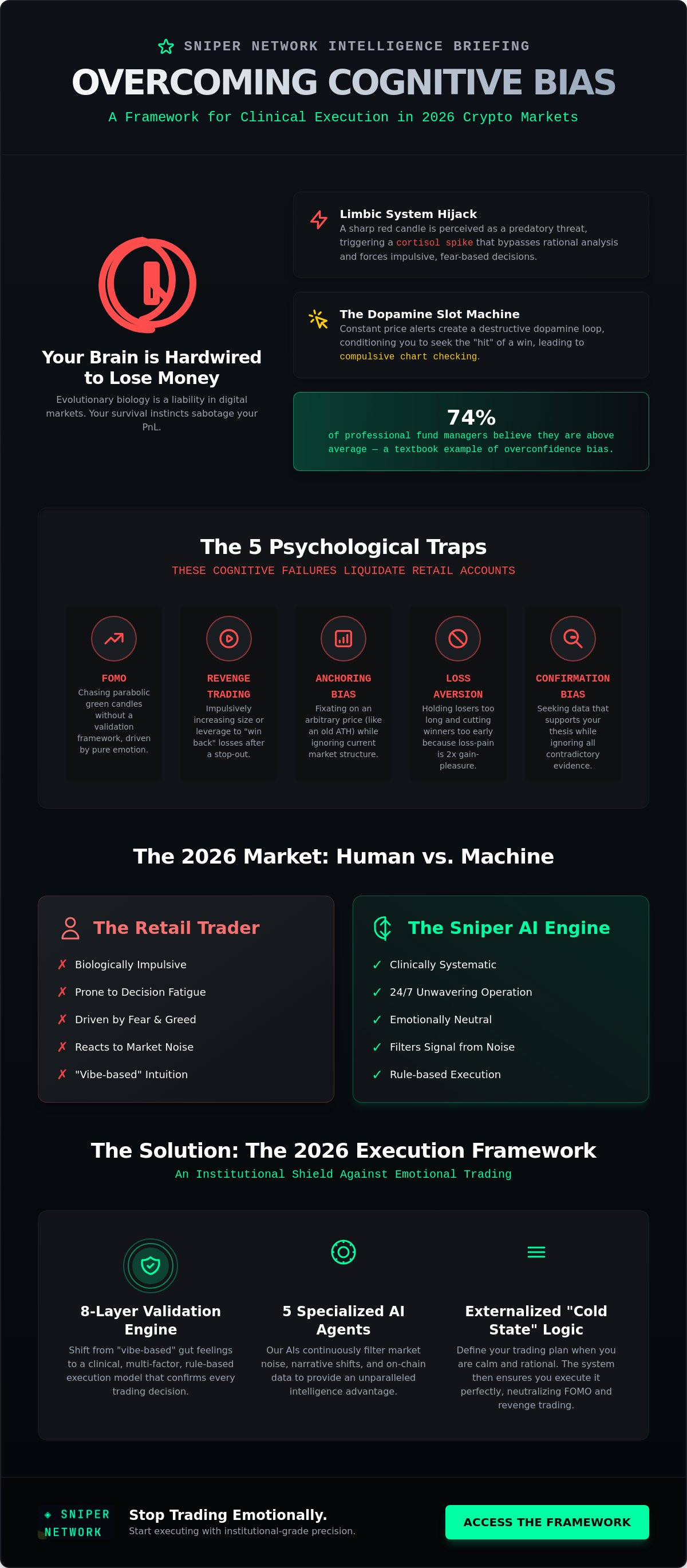
Crypto trading psychology is the mental lens through which market data is interpreted. It isn't an abstract concept; it's a biological filter. For the retail trader, this filter is often clouded by evolutionary hardware designed for physical survival, not digital asset speculation. The human limbic system is biologically unequipped for 24/7 volatility. It perceives a sharp red candle as a predatory threat. This triggers a cortisol spike that bypasses the prefrontal cortex. Rational analysis stops. Survival takes over.
Constant price alerts create a destructive dopamine loop. Each notification mirrors the mechanics of a high-stakes slot machine. This intermittent reinforcement conditions the brain to seek the "hit" of a winning trade, leading to compulsive, low-value chart checking. When the market moves against a position, the brain enters a defensive state. Objective analysis becomes impossible. Overcoming cognitive bias in crypto trading requires acknowledging that your biological hardware is working against your financial interests. Willpower is a finite resource. It's a chemical battery that drains with every decision made. During high-volatility events, this battery hits zero. The trader is left vulnerable to impulsive, fear-based execution.
The Survival Brain vs. The High-Frequency Market
Your brain operates on a fight or flight mechanism. In the context of a 20% flash crash, this manifests as panic selling or frozen indecision. Both are survival responses. The 24/7 nature of the crypto market compounds this stress. There's no closing bell to signal a recovery period. Decision Fatigue is the physiological depletion of executive function that serves as the primary cause of late-night trading errors. Without a clinical protocol, the survival brain will eventually override your trading plan. You can't out-think a biological imperative with simple grit.
Why 2026 Market Dynamics Hit Harder
The 2026 market is defined by sub-millisecond AI execution and institutional-grade algorithms. Retail traders are competing against machines that don't experience fatigue, hunger, or fear. Narrative shocks on social media amplify these biological vulnerabilities. A single viral post can trigger a cascade of cognitive biases, leading to mass-market irrationality. Survival in this environment requires a shift from passive HODL strategies to systematic validation. Overcoming cognitive bias in crypto trading is no longer optional. It's a prerequisite for capital preservation. ◈
The 5 Psychological Traps That Liquidate Retail Accounts
Liquidation is rarely a failure of technical analysis. It's a failure of cognitive architecture. While professional fund managers often fall victim to overconfidence, a study showed 74% believe they are above average at investing. Retail traders face a more aggressive set of biological hurdles. These traps are coded into our DNA. In a sub-millisecond market, they are lethal. Overcoming cognitive bias in crypto trading requires identifying these five specific failure points before they trigger a margin call.
- FOMO (Fear Of Missing Out): Chasing parabolic green candles without a multi-timeframe validation framework. This is a high-frequency error driven by the amygdala.
- Revenge Trading: The irrational impulse to "win back" losses by increasing leverage or position size immediately after a stop-loss hit.
- Anchoring Bias: Fixating on an arbitrary price point, such as a previous All-Time High, while ignoring current bearish market structures.
- Loss Aversion: The psychological pain of a loss is twice as powerful as the joy of a gain. This causes traders to hold losing positions indefinitely while cutting winning trades prematurely.
- Confirmation Bias: Filtering social media and news feeds to find data that supports an existing bias, effectively blinding the trader to bearish divergence or structural shifts.
The Anatomy of a Revenge Trade
The cycle begins with a sharp emotional trigger. A stop-loss is hit. The brain perceives this as a personal defeat rather than a cost of doing business. The technical error occurs when the trader deviates from their systematic crypto trading plan to "fix" the PnL. By doubling down on a losing thesis, the trader escalates the risk-of-ruin. This is emotional gambling disguised as market participation. ◈
Anchoring and the Sunk-Cost Fallacy
Waiting to "get back to even" is one of the most expensive phrases in finance. It's a psychological trap where the trader negotiates with the market based on their entry price rather than current reality. The market doesn't care where you bought. To succeed, you must reset your mental anchor using objective, real-time data. Overcoming cognitive bias in crypto trading involves cutting the cord to past prices and executing based on present probability. If your current thesis is invalidated, the position must be closed. No exceptions. No negotiations. For those seeking to remove these human errors entirely, utilizing automated validation tools is the only logical step toward institutional-grade consistency.
Beyond Journals: Building a Data-Driven Validation Framework
Most retail traders are told to keep a manual journal. This is a flawed strategy. A journal records your biases; it doesn't remove them. Overcoming cognitive bias in crypto trading requires a fundamental shift from "vibe-based" entry to "rule-based" execution. We replace the subjective "I feel bullish" with an 8-layer validation engine. Each layer acts as a binary filter. If one filter fails, the trade is discarded. No exceptions. This clinical approach treats the market as a series of data points rather than an emotional battlefield. ◈
Objective intelligence is the only antidote to the volatility that breaks human traders. Relying on crypto risk management tools ensures that every action is dictated by backtested logic. Clinical data doesn't feel fear. It doesn't hope for a reversal. It validates market structure, volume profile, and liquidity depth before a single dollar is risked. By the time a signal reaches your screen, it has already survived a gauntlet of institutional-grade scrutiny. This is how you bridge the gap between retail speculation and professional asset management.
Replacing Intuition with Institutional-Grade Analysis
A "gut feeling" is usually just a collection of unexamined biases. It's the brain recognizing a pattern that may no longer be relevant in a sub-millisecond environment. Modern ai for crypto market analysis tools provide a "cold" second opinion. These systems monitor the market 24/5, filtering out the social media noise that triggers human error. By using non-custodial intelligence tools, you maintain total control of your capital. Your API key, your funds. The software provides the technical edge; you provide the final execution approval. This separation of analysis and execution is a core institutional protocol.
The 1% Rule and Systematic Risk Management
Emotional traders move their stop-losses because they "believe" in the asset. Systematic traders define risk before entry. The 1% rule dictates that no single trade should impact the total portfolio by more than one percent. Position sizing is calculated based on the distance between entry and the invalidation point, not on a trader's confidence level. This removes the "all-in" impulse. Sizing a trade from the stop-loss is the ultimate psychological shield. When the math is fixed, the emotion is neutralized. You aren't trading a coin; you're trading a statistical probability. ◈
5 Practical Crypto Trading Psychology Tips for 2026
Theory without execution is just noise. Overcoming cognitive bias in crypto trading requires a tactical shift in how you interact with market data. You can't rely on your brain to remain objective when your capital is at risk. These five steps provide a biological and technical firewall between your impulses and your exchange account. ◈
- Step 1: Automate Your Research. Use AI to filter market noise before you ever look at a chart. If the data doesn't meet your pre-set parameters, you don't open the terminal.
- Step 2: Externalize Your Logic. Define your entry and exit criteria in a "cold state" when markets are closed or quiet. A plan that only exists in your head will vanish during a 10% drawdown.
- Step 3: Enforce a 24-Hour Reset. After an emotional loss or an unexpected liquidation, disconnect all trading interfaces for one full day. Your brain needs a chemical reset to restore executive function.
- Step 4: Use Multi-Timeframe Confirmation. Never enter a trade based on a single 15-minute candle. Validating across H4 and Daily timeframes removes the noise of local volatility.
- Step 5: Adopt a Non-Custodial Intelligence Service. Utilize weekly institutional reports to maintain an unbiased macro view. This prevents "tunnel vision" on a single asset or narrative.
Tip 1: The Power of Automated Market Intelligence
Automated reports eliminate the need for "doom-scrolling" Telegram and X. These platforms are designed to trigger emotional responses. By using sentiment analysis in cryptocurrency, you can detect crowd euphoria or panic before it influences your decision. The Elite Technician approach is simple. Scan first. Validate second. Trade third. If the AI doesn't confirm the trend, there is no trade. This preserves your mental capital for high-probability setups. It's about data, not hype.
Tip 3: The 24-Hour Reset Protocol
The brain requires a chemical cooldown after a significant PnL swing. Whether it's a massive win or a painful loss, your dopamine and cortisol levels are compromised. Use this 24-hour window to review your process score rather than the dollar amount. Did you follow your rules? Was the entry validated? Re-enter the market only after the data confirms a new setup and your biological state has returned to baseline. Overcoming cognitive bias in crypto trading is impossible if your nervous system is still in "fight or flight" mode. To ensure your execution remains clinical, leverage automated validation engines that operate without human fatigue. ◈
Sniper AI Weekly: The Institutional Shield Against Emotional Trading
Sniper AI Weekly acts as the technical firewall between your portfolio and your biological impulses. It's a clinical validation engine designed for the 2026 market structure. By delegating your research to an automated system, you bypass the biological failure points of the human brain. This is the definitive strategy for overcoming cognitive bias in crypto trading. 5 AI agents. 8 signal filters. 24/5 institutional monitoring. The system works while you rest. ◈
We operate with a strict "Your API key, your funds" protocol. We never hold user assets. This non-custodial approach ensures total security and transparency for every user. Weekly data-backed reports are the ultimate cure for FOMO and the anxiety of 20% flash crashes. You gain a cold, objective macro perspective that prioritizes capital preservation over speculative hype. It's a bridge between retail speculation and institutional-grade professionalism.
Automating the Research Process
Research fatigue is the primary driver of impulsive, late-night trading errors. Sniper AI Weekly delivers validated market structures directly to your inbox. This removes the "chart-slot-machine" loop that drains your mental capital. You no longer need to monitor Telegram or X for narrative shifts. Our AI agents filter the noise; providing high-tier infrastructure validation from Claude AI and GCP Tokyo. You get the intelligence of a hedge fund without the emotional baggage. Scan the data. Approve the setup. Maintain your edge.
Your Path to Systematic Success
Trading in 2026 is a battle of infrastructure. Data-driven crypto trading is no longer a luxury; it's a survival trait. You need a system that validates every move with sub-millisecond precision. Implementing a framework for overcoming cognitive bias in crypto trading starts with changing your tools. Join a network focused on clinical results and backtested logic. Neutralize your biological triggers. ◈ Start your Sniper AI Weekly trial today
The Evolution of Clinical Execution
The 2026 market structure doesn't reward intuition. It rewards infrastructure. You've identified the biological failure points that lead to account liquidation and the psychological traps that sabotage retail capital. Success now depends on replacing the limbic system's "fight or flight" response with a clinical validation engine. Overcoming cognitive bias in crypto trading is a technical challenge requiring an institutional solution. By externalizing your logic and enforcing systematic resets; you move from speculative gambling to professional asset management.
The transition to a data-driven framework is the only way to neutralize emotional interference in a 24/7 environment. ◈ Access Institutional-Grade AI Intelligence with Sniper AI Weekly. Our system utilizes 5 AI agents to filter market noise; delivering insights validated by data from GCP Tokyo and Reuters. We maintain a strict non-custodial protocol: Your API key, your funds. Gain the edge of a high-end financial tool while retaining total control of your assets. You now have the framework to trade with absolute confidence.
Frequently Asked Questions
What is the most common psychological mistake in crypto trading?
Overconfidence is the most prevalent psychological error. A 2025 study showed that 74% of professional fund managers believe they are above average. This bias leads to excessive risk-taking and the neglect of structural market shifts. It's often the root cause of ignoring stop-losses during a significant drawdown.
How can I stop revenge trading after a large loss?
Implement a mandatory 24-hour reset protocol. Disconnect all trading interfaces immediately after a significant PnL swing. This allows cortisol and dopamine levels to return to baseline. Re-entry should only occur after a clinical review of the process score rather than the dollar loss. ◈
Can AI really help with trading psychology?
AI serves as an objective validation engine for overcoming cognitive bias in crypto trading. It removes the "gut feeling" by processing multi-timeframe data with sub-millisecond precision. By using 5 AI agents to filter market noise, traders can replace impulsive reactions with institutional-grade logic.
Why do I feel anxious when I'm not looking at the charts?
This anxiety is a result of the dopamine loop created by constant price alerts. This intermittent reinforcement mirrors gambling mechanics. The survival brain views missing a move as a threat to resources. Shifting to systematic reports reduces the need for constant monitoring and breaks the "chart-slot-machine" cycle.
Is it possible to trade crypto without any emotion?
Humans cannot eliminate emotion, but they can automate the filters that trigger it. Clinical execution involves using a data-driven framework to bypass the limbic system. By delegating analysis to automated intelligence, you ensure that entries are based on backtested rules rather than fear or greed.
What is the 1% rule in crypto risk management?
The 1% rule states that no single trade should risk more than 1% of your total portfolio capital. This is calculated by the distance between your entry and your technical invalidation point. It shifts the focus from potential profit to mathematical risk; providing a psychological shield against account-liquidating events.
How do I identify confirmation bias in my own research?
Confirmation bias is identified when you only seek data that supports an existing long or short position. To counter this, actively search for bearish divergence when bullish, or vice versa. Utilizing a "cold" second opinion from an AI intelligence service provides an unbiased macro view that ignores social media narratives.
What is the difference between a signal group and an AI intelligence service?
Signal groups rely on manual human input; which is inherently biased and slow. An AI intelligence service like Sniper AI Weekly uses automated agents to monitor 24/5 market data. It provides clinical validation through high-tier infrastructure like GCP Tokyo and Reuters; ensuring technical precision over speculative hype. ◈