
Emotional bias is a structural failure in your trading execution. While retail traders drown in social media noise and panic-sell during volatility spikes, institutional engines are already three steps ahead. They don't guess. They validate. Using AI for crypto volatility forecasting is no longer an optional upgrade; it's the baseline for surviving sub-millisecond market shifts in a 2026 landscape defined by rapid regulatory shifts and Fed-driven liquidity cycles.
You've likely felt the sting of capital loss due to execution latency or information overload. It's the tax paid for manual operation in an automated world. This article provides a systematic validation framework to replace emotional speculation with clinical, data-driven precision. We'll examine how to leverage institutional-grade intelligence to automate entry signals and eliminate the friction of constant chart monitoring. You'll gain a repeatable system for market validation that functions with the cold reliability of a professional financial tool. No more guessing. Just data.
Key Takeaways
- Identify why manual chart observation is a legacy approach in a 2026 market dominated by high-frequency algorithmic liquidity.
- Deploy an 8-Layer Validation Framework to filter market noise and confirm entries using multi-timeframe analysis.
- Eliminate emotional bias by using AI for crypto volatility forecasting to react to sub-millisecond price shifts with clinical precision.
- Maintain full asset custody while implementing institutional-grade risk management protocols via secure API integration.
- Streamline your decision-making process with Sniper AI Weekly for automated, validated research delivered directly to your dashboard.
The Mechanics of 2026 Crypto Volatility: Beyond the Hype
Volatility is a measurable variance in data density. In the current market environment, this variance is not a random occurrence but a calculated byproduct of high-frequency algorithmic liquidity and narrative-driven cycles. Retail participants often view price swings as chaotic obstacles. Professionals recognize them as high-velocity data streams. Manual chart observation is a legacy approach. It's slow. It's prone to cognitive bias. In a sub-millisecond market, relying on human vision is a structural liability. Using AI for crypto volatility forecasting allows for the identification of micro-patterns that traditional technical analysis misses.
The Noise-to-Signal ratio is the primary enemy of the modern trader. Social media sentiment, news-scraping bots, and retail FOMO create a dense layer of market noise. Systematic filters are required to extract actionable intelligence. Volatility creates an asymmetric opportunity, but only for those who deploy clinical execution models. Without a framework to validate direction, volatility is simply a capital drain. By financial volatility standards, the crypto market in 2026 remains an outlier due to its 24/7 cycle and fragmented liquidity pools.
The Liquidity Gap and Execution Latency
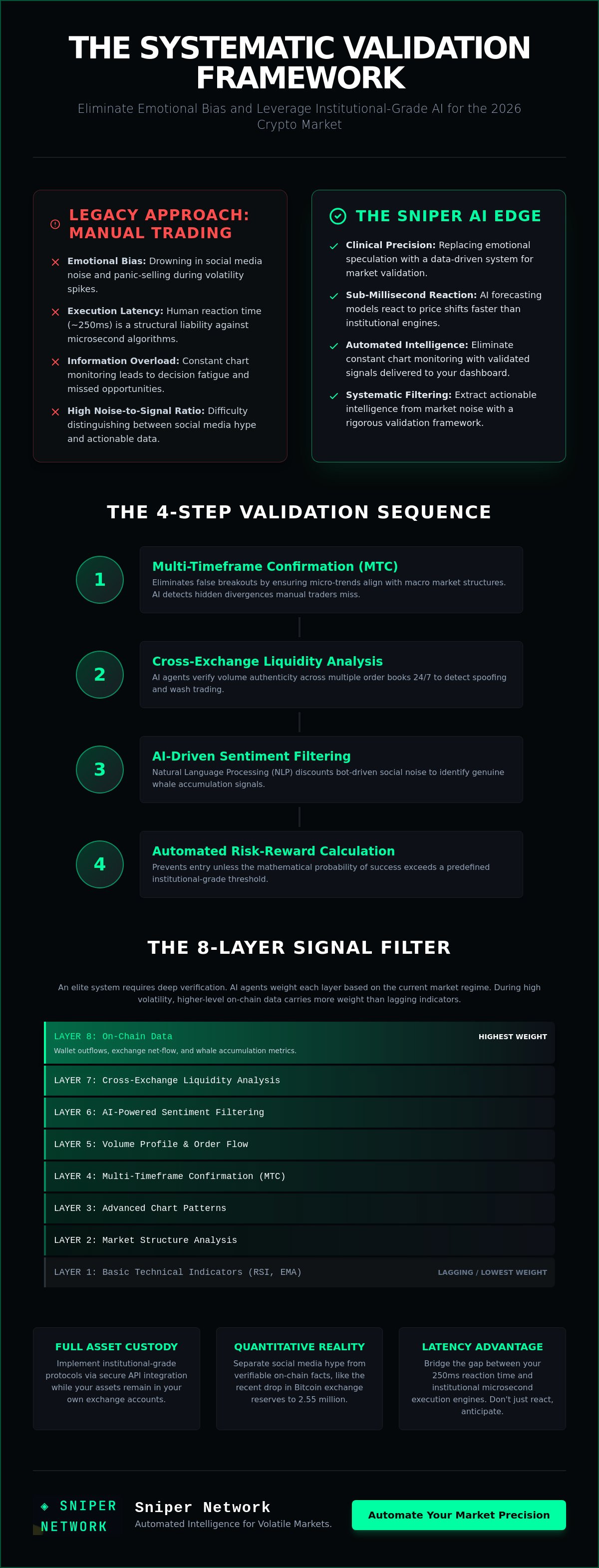
Thin order books, especially in mid-cap altcoins, exacerbate price swings during macro shifts. When the Federal Reserve maintains rates in the 3.50% to 3.75% range, liquidity often tightens. Institutional "stop-hunting" algorithms exploit these gaps. They trigger clusters of retail stop-loss orders to create the liquidity needed for large position entries. Human reaction time averages 250ms. Institutional execution engines operate in microseconds. If you're reacting to a candle close, you've already lost the entry. Real-time validation is the only defense against institutional latency advantages.
Narrative Contagion vs. Quantitative Reality
Narrative contagion spreads through global markets with unprecedented speed, yet it often lacks quantitative backing. You must distinguish between social media hype and on-chain whale movements. Current data shows Bitcoin exchange reserves have fallen to 2.55 million, indicating a potential supply squeeze. This is a quantitative fact, not a narrative. Using AI for crypto volatility forecasting helps separate organic volume from bot-driven wash trading. AI agents monitor exchange APIs 24/5 to verify if buy walls are legitimate or mere spoofing. Quantitative reality always outlasts the narrative loop.
Implementing a Systematic Validation Framework to Filter Market Noise
Volatility is not an emotional hurdle. It is a data-processing problem. To survive the 2026 market, you need a clinical approach to asset entry that removes human hesitation. This requires a Systematic Validation Framework designed to withstand high-frequency noise. Using AI for crypto volatility forecasting allows you to process multi-layered data points simultaneously, ensuring every trade meets institutional-grade criteria before execution.
The framework operates through a rigorous 4-step sequence:
- Step 1: Multi-timeframe confirmation (MTC). This eliminates false breakouts by ensuring micro-trends align with macro structures.
- Step 2: Cross-exchange liquidity analysis. AI agents verify volume authenticity across multiple order books to detect spoofing.
- Step 3: AI-driven sentiment filtering. Natural language processing (NLP) discounts "bot-driven" social noise and identifies genuine whale accumulation.
- Step 4: Automated risk-reward calculation. The system prevents entry unless the mathematical probability of success exceeds a predefined threshold.
Multi-Timeframe Confirmation (MTC) Protocols
Single-signal trading is a structural failure. A 15-minute price surge is irrelevant if it contradicts the 4-hour and daily structural shifts. MTC protocols force alignment across the hierarchy. AI agents detect hidden divergences in these timeframes that manual traders often miss. If the daily trend is bearish, a 15-minute "moon shot" is likely a liquidity trap. You don't guess. You wait for the system to validate the shift across all layers. This is how you automate market precision without the anxiety of manual monitoring.
The 8-Layer Signal Filter
Technical indicators like RSI and EMA are merely Layer 1. They are lagging. An elite system requires deeper verification. Layer 8 involves on-chain data, such as wallet outflows and exchange net-flow metrics. AI agents weight these layers differently based on the current market regime. During high volatility, on-chain movements carry more weight than simple price action. Integrating ai for crypto market analysis tools allows for this multi-dimensional validation. The result is a cold, calculated signal. One filter. Eight layers. Zero emotion. Using AI for crypto volatility forecasting turns market chaos into a predictable execution queue.
Quantitative Scanners vs. Manual Emotional Trading
The "Anxious Retailer" operates on hope. They monitor three tokens, paralyzed by social media noise and the fear of missing out. Conversely, the "Elite Technician" treats the market as a series of data points. Using AI for crypto volatility forecasting allows for a transition from reactive guessing to clinical execution. Manual trading is inherently slow. It's limited by biological processing speeds and cognitive bias. A human can effectively track five assets at most. A quantitative scanner monitors 1000+ tokens simultaneously, 24/5, without fatigue.
The efficiency gap between these two personas is vast. Manual signal groups rely on a "guru" to identify a trend, type a message, and wait for subscribers to react. By the time you see the notification, the institutional move is finished. Quantitative scanners utilize AI-generated sentiment and liquidity flow to trigger alerts in real-time. AI identifies structural reversals by analyzing order book imbalances seconds before they appear on standard retail candles. You aren't chasing the wick. You're positioned before the candle prints.
Eliminating FOMO with Algorithmic Discipline
Biological "fight or flight" responses have no place in a trading engine. FOMO is a chemical reaction to perceived scarcity. Systematic crypto trading removes this vulnerability by enforcing a strict "No-Trade" zone. If the AI doesn't validate the entry, there is no trade. Staying in cash is a tactical decision, not a missed opportunity. Reframing "missing out" as "avoiding unvalidated risk" preserves capital for high-probability setups. Using AI for crypto volatility forecasting ensures that every entry is backed by a mathematical edge rather than a gut feeling.
Speed of Execution and Co-location
Execution speed is a technical requirement, not a luxury. Manual clicking is a losing strategy against automated agents. Professional systems utilize co-located infrastructure, such as GCP Tokyo, to achieve sub-millisecond server response times. This proximity to exchange matching engines is critical during volatility spikes. When a liquidity gap opens, the co-located agent captures the price before the retail lag resolves. 5 AI agents. Sub-millisecond execution. This is the baseline for institutional-grade performance in 2026. If your infrastructure isn't co-located, you're trading with a handicap.
Institutional Risk Management Protocols for 2026
Traditional diversification fails in the cryptocurrency market. During systemic liquidations, asset correlations often converge to 1.0. Everything drops in lockstep. You need advanced crypto risk management tools that react to hard data rather than optimistic projections. Using AI for crypto volatility forecasting enables dynamic position sizing based on Average True Range (ATR) scaling. If volatility exceeds a calculated threshold, the system automatically reduces exposure. This isn't a manual guess. It's a mathematical necessity. Every connection to Tier-1 exchanges utilizes AES-256 encrypted API tunnels to ensure execution speed never compromises security.
The foundation of professional risk management is the Non-Custodial Mandate. Your API key, your funds. We never hold your assets. This eliminates the counterparty risk inherent in centralized signal groups or managed funds. Automated stop-loss triggers adjust in real-time to liquidity shifts. If an order book thins, the system tightens the exit to prevent slippage. Using AI for crypto volatility forecasting allows the engine to identify these liquidity gaps before they result in a capital drain. Clinical precision is your only defense against market shifts.
Non-Custodial Intelligence: Security First
Never trust a service that requires direct asset custody. It's a fundamental structural risk. Sniper Network operates as a silent, secure engine. We establish trust through technical proof and "trust markers" rather than exuberant marketing. ◈ 24/5 monitoring ensures alignment with institutional trading hours. Third-party validation from sources like Reuters and Claude AI provides the external confirmation required for high-stakes execution. We focus on what the system produces. Reliability is the only metric that matters.
Dynamic Asset Allocation
Static "HODL" strategies are legacy approaches that ignore 2026 market realities. You must transition to data-driven crypto trading to survive narrative-driven cycles. AI agents rebalance portfolios based on risk assessment metrics, not arbitrary calendar dates. When the market regime shifts from bullish to high-variance, the system triggers "Stablecoin Parking." This preserves your principal while retail traders struggle with drawdown. The engine monitors macro contagion and on-chain whale movements to determine when to re-enter. Data triggers the move. The system executes the result.
Build your clinical defense against market chaos. Access the institutional risk engine today.
Sniper AI Weekly: Automated Intelligence for Volatile Markets
Using AI for crypto volatility forecasting requires a delivery mechanism that matches market speed. Data without a filter is just more noise. Sniper AI Weekly serves as the ultimate volatility filter for the professional trader. It converts complex market variance into actionable intelligence. 5 AI agents. 8 signal filters. This is institutional-grade precision delivered to your dashboard. You maintain full control. There is no "black box" risk here. You receive validated data, and you decide the execution. ◈ Action-Result: Deploy AI agents, receive validated data, execute with confidence.
Manual reports and brokerage calls are too slow for 2026 market reversals. While competitors rely on human analysts to interpret events, our system operates at the speed of code. It's a clinical transition from emotional speculation to data-driven execution. You don't need a high-tier financial advisor. You need a powerful tool that works in the background, 24/5, to monitor sub-millisecond price shifts.
How the Sniper AI Weekly Report Works
The system scans thousands of data points across global liquidity pools to generate a single, high-conviction intelligence report. It validates trends through multi-source intelligence, including GCP infrastructure, Reuters news feeds, and on-chain whale metrics. This isn't a simple price alert. It's a comprehensive structural analysis. We've found that a weekly cadence is the optimal balance between execution speed and structural trend identification. It filters out the "choppy" micro-volatility while capturing the major liquidity shifts that define profitable cycles. Using AI for crypto volatility forecasting at this level ensures you're positioned for the move, not reacting to the aftermath.
The "No Card Required" Trial: Clinical Transparency
Transparency is our structural baseline. We've removed the friction of entry with a "no card required" trial. You start validating market moves in sub-millisecond time without upfront commitment. Our mantra remains clear: Your API key, your funds. We never hold user assets. This is a recurring verbal seal of security for every partner. You gain access to the same data used by institutional trading floors, delivered with the blunt clarity required for professional decision-making. The system monitors the market. You monitor the results. It's time to replace anxiety with automation. Start your trial and see the data for yourself.
Transitioning to Clinical Market Execution
Manual trading is a structural liability in a 2026 market defined by sub-millisecond shifts and algorithmic liquidity. The transition from emotional bias to data-driven precision is no longer optional. By using AI for crypto volatility forecasting, you replace reactive guessing with a clinical validation framework. You've seen how 8-layer signal filters and multi-timeframe confirmation eliminate the noise that drains retail capital. This is about structural survival and institutional-grade efficiency. Every micro-pattern the engine identifies is a data point that manual traders simply cannot process in real-time.
The Sniper Network engine works in the background to monitor, validate, and trigger entries with uncompromising speed. ◈ 5 AI Agents. ◈ 8 Signal Filters. ◈ Your API key, your funds. You maintain full asset custody while leveraging the infrastructure of an elite technician. It's time to automate your market edge and reduce execution friction. Precision is the only metric that matters when volatility spikes. Start your Sniper AI Weekly trial, no card required. Secure your data-driven future today.
Frequently Asked Questions
Is crypto volatility decreasing in 2026?
No. Volatility is evolving rather than decreasing. In 2026, price variance is driven by high-frequency algorithmic liquidity and global macro contagion. With the Federal Reserve maintaining rates between 3.50% and 3.75%, liquidity remains tight, which exacerbates price swings. This environment creates a permanent state of high-velocity data that requires automated filtering rather than manual observation.
How can AI help me manage crypto trading anxiety?
AI manages anxiety by replacing emotional speculation with clinical, data-driven execution. Using AI for crypto volatility forecasting eliminates the biological "fight or flight" response that leads to panic selling. When a system validates every entry through an 8-layer filter, you no longer guess about market direction. Automation provides the calm confidence of an institutional-grade technician.
What is a non-custodial crypto intelligence tool?
A non-custodial tool provides high-tier data and execution signals without ever holding your assets. You connect the intelligence engine to your exchange via AES-256 encrypted API tunnels. This architecture follows the "Your API key, your funds" mandate. It removes counterparty risk while providing sub-millisecond market access. You retain 100% control over your capital at all times.
Can AI predict crypto market reversals during high volatility?
AI identifies reversals by analyzing order book imbalances and on-chain whale movements seconds before they appear on retail charts. It uses multi-timeframe confirmation to detect hidden divergences that manual traders miss. By processing thousands of data points simultaneously, the system recognizes when a trend has lost structural support. This allows for clinical exits before a full liquidation event occurs.
Why is manual technical analysis failing in current markets?
Manual technical analysis is too slow for 2026 execution speeds. Human reaction time is approximately 250ms, while institutional algorithms operate in microseconds. Legacy indicators like RSI are lagging and easily manipulated by stop-hunting bots. Using AI for crypto volatility forecasting is necessary because manual observation cannot scale to monitor 1000+ tokens across fragmented global liquidity pools.
What are the risks of using automated crypto signal groups?
Signal groups often rely on biased human "gurus" and lack technical validation. They introduce execution latency that makes the signals obsolete by the time you receive them. Many of these groups also require direct asset custody or use unencrypted channels. This creates significant security vulnerabilities and counterparty risks that professional financial tools like Sniper AI Weekly specifically avoid.
How does Sniper AI Weekly protect my assets from market swings?
The system protects assets by triggering "Stablecoin Parking" during high-risk regime shifts. It uses an 8-layer validation framework to distinguish between organic volume and bot-driven wash trading. When the AI detects a supply squeeze or a macro liquidity gap, it adjusts position sizing automatically. This clinical approach preserves principal capital while retail traders struggle with unvalidated drawdown.
What is the difference between a trading bot and an AI intelligence service?
A standard trading bot follows static, "if-then" rules that fail when market regimes change. An AI intelligence service like Sniper AI Weekly uses multi-source validation from GCP Tokyo, Reuters, and Claude AI to adapt dynamically. It doesn't just execute; it validates. This provides a bridge between professional trading floors and individual traders through automated, institutional-grade research.