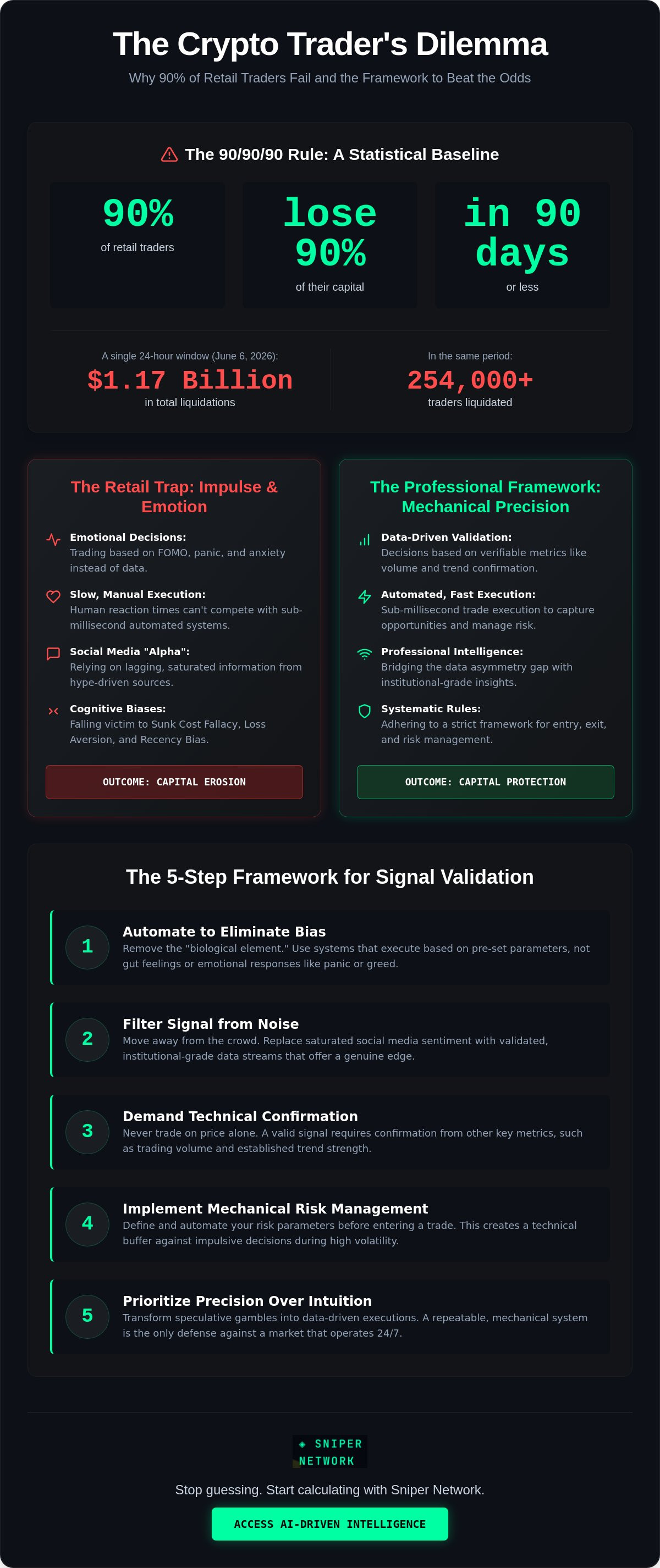
On June 6, 2026, over 254,000 crypto traders were liquidated in a 24-hour window. Total losses reached $1.17 billion. This isn't an anomaly; it's the mechanical reality of the 90/90/90 rule. Most failures stem from a fundamental lack of technical rigor. To survive, you must understand how to validate crypto trading signals before capital is committed. Emotional decision-making leads to capital erosion. The market operates at sub-millisecond speeds while retail traders rely on slow, manual processing.
This analysis identifies the specific triggers behind these failures. You'll learn the institutional-grade framework used to filter out noise and protect your assets in the current $59,800 Bitcoin environment. We'll also examine the data asymmetry that separates professional desks from the retail crowd. Precision is the only defense against volatility. We'll detail the specific filters required to transform speculative gambles into data-driven executions. It's time to stop guessing and start calculating.
Key Takeaways
- Analyze the 90/90/90 rule to see why it's the primary reason retail participants lose capital in volatile environments.
- Identify the specific psychological triggers, such as the sunk cost fallacy, that lead to suboptimal manual execution.
- Learn how to validate crypto trading signals using a rigorous, institutional-grade framework focused on volume and trend confirmation.
- Bridge the data asymmetry gap by moving from social media sentiment to professional-level market intelligence.
- Protect your capital through an automated approach that's designed to remove emotional bias from every trade.
The 90/90/90 Rule: Quantifying Retail Trader Failure
The 90/90/90 rule isn't a theory; it's a statistical baseline for retail market participation. Data shows that 90% of retail traders lose 90% of their capital within 90 days. In the cryptocurrency sector, this cycle is significantly compressed. The 24/7 nature of digital asset markets, combined with high-leverage products like perpetual futures, accelerates capital erosion. On June 6, 2026, over 254,000 traders were liquidated in a single day. This happens because most participants operate on speculative impulse rather than technical rigor. To break this cycle, you must learn how to validate crypto trading signals using a systematic, institutional-grade framework. The point of failure is rarely the market itself. It's usually a mechanical breakdown in entry logic, exit discipline, or risk management.
The Anatomy of a Losing Trade
Retail losses often begin with market noise. This noise triggers premature entries based on unvalidated data. Institutional algorithms frequently create liquidity traps. These are sharp, low-volume price movements designed to lure retail capital before a reversal. When Bitcoin trades near $59,800, these traps become highly frequent. Manual execution is a structural disadvantage here. Human reaction times can't compete with sub-millisecond automated systems. By the time a manual trader clicks "buy," the institutional move is already being offloaded. This delay turns a potential profit into a high-risk entry at the top of a range.
Signal vs. Noise in 2026
Social media alpha has reached a point of diminishing returns. Twitter threads and manual signal groups are saturated with lagging indicators. Retail traders often fall victim to Psychological Bias, mistaking social hype for actual market momentum. While many attempt to use sentiment as a lead indicator, sentiment analysis in cryptocurrency is often misinterpreted by the human brain. We are evolutionarily wired to seek patterns where none exist. In a market where retail volume has fallen to $679 billion as of April 2026, the remaining liquidity is highly sophisticated. Information that's five minutes old is already priced in. You don't need more information. You need faster, validated intelligence. Understanding how to validate crypto trading signals means moving away from the noise of the crowd and toward the precision of automated filters.
Psychological Bias vs. Mechanical Execution Failure
Trading isn't just a mathematical challenge; it's a biological one. The human brain hasn't evolved to process sub-millisecond price fluctuations without emotional interference. Cognitive biases like recency bias, loss aversion, and the sunk cost fallacy create a destructive feedback loop. Research from Harvard University on the behavior and performance of retail traders confirms that overconfidence and poor risk assessment are primary drivers of capital destruction. When you don't know how to validate crypto trading signals mechanically, you default to emotional triggers. This leads to the classic "buy high, sell low" trap that plagues 90% of participants.
Mechanical failure is equally lethal. A retail trader cannot monitor multi-timeframe confirmations across dozens of assets 24/7. Manual signal groups exacerbate this structural disadvantage. By the time a human moderator posts a "buy" signal, the institutional move is often reaching exhaustion. You aren't receiving alpha; you're providing exit liquidity for earlier, automated entrants. Understanding how to validate crypto trading signals requires removing the biological element entirely. Precision replaces intuition. Automation replaces anxiety.
Overcoming Crypto Trading Anxiety
Market volatility triggers a physiological "fight or flight" response. This cortisol spike impairs the prefrontal cortex, which is responsible for logical reasoning. You panic-sell at local bottoms or FOMO-buy during relief rallies. Utilizing crypto risk management tools creates a technical buffer against these impulses. These systems execute based on pre-set parameters, not gut feelings. Moving from a "gut feeling" to a data-backed validation protocol is the only way to survive a market that never sleeps.
The Limits of Manual Technical Analysis
Apophenia is the human tendency to perceive meaningful patterns in random data. Retail traders often see complex chart patterns where there is only market noise. Static indicators fail in dynamic regimes where AI agents control liquidity flow. Transitioning to systematic crypto trading ensures every entry is filtered through multiple layers of cold logic. If a signal doesn't meet eight specific technical criteria, the system discards it. This level of discipline is impossible for manual traders. To achieve institutional-grade results, you must replace human intuition with machine precision. You can start by exploring the automated intelligence frameworks designed for this environment.
Data Asymmetry: The Hidden Edge of Institutional Traders
Data asymmetry defines the structural gap between institutional desks and retail participants. While the retail crowd relies on fragmented social media threads and lagging alerts, professional entities utilize direct, low-latency feeds from sources like Reuters. This isn't just about information quality; it's about execution speed. Institutional infrastructure relies on co-location and sub-millisecond execution engines. These systems identify liquidity shifts before they reach public dashboards. Without professional tools, retail traders often serve as exit liquidity for high-frequency algorithmic systems. Learning how to validate crypto trading signals requires moving beyond manual research. You must adopt a framework for data-driven crypto trading to compete in a market controlled by machines.
The institutional edge is built on technical precision. 5 AI agents. 8 signal filters. Sub-millisecond validation. These aren't luxuries; they're requirements for capital preservation. When a signal is generated, an institutional system validates it against order book depth and historical volatility profiles instantly. Manual traders cannot replicate this level of rigor. They're often entering positions just as the smart money is preparing to rotate capital. Breaking this cycle requires a shift in how you process market data.
The Role of AI in Market Intelligence
AI agents provide the technical filter necessary to survive 2026 market conditions. These agents process eight layers of market noise in real-time, validating every signal against historical backtests and live liquidity profiles. Multi-timeframe confirmation is a core requirement. A signal on a 15-minute chart is irrelevant if it contradicts the 4-hour and daily trends. Manual processing cannot achieve this level of cross-reference at scale. Implementing ai for crypto market analysis tools allows you to verify a signal's validity within milliseconds. It converts raw data into actionable intelligence without the delay of human interpretation.
Removing the 'Human Premium' from Trading
Human traders are limited by biology. The cost of sleep is a structural disadvantage in a 24/7 global market. While you sleep, institutional bots monitor order books across every major exchange. Manual research often consumes over 40 hours weekly, yet it still results in lagging entries and missed reversals. Automated intelligence removes this "human premium" by maintaining constant vigilance. By leveraging high-tier infrastructure like GCP Tokyo, you gain the technical edge of proximity and speed. This isn't about working harder. It's about deploying a silent engine that validates and monitors while you focus on capital allocation. Precision is the only variable that matters when calculating how to validate crypto trading signals effectively.
The 5-Layer Framework: How to Validate Crypto Trading Signals
Generic trading advice often suggests dollar-cost averaging as a universal solution. This approach ignores market regime changes and high-risk volatility events. To maintain capital, you must implement a rigorous protocol for how to validate crypto trading signals. This framework moves beyond human intuition, utilizing five layers of technical and sentiment-based confirmation.
- Layer 1: Trend Confirmation. Distinguish a temporary relief rally from a true structural reversal. Use multi-timeframe analysis to ensure the signal aligns with the macro trend.
- Layer 2: Volume Validation. Price movement without volume is a trap. Ensure moves are backed by significant capital inflow from institutional-grade participants.
- Layer 3: Sentiment Filtering. Use AI agents to measure the fear/greed delta. This filters out signals driven purely by social media hype or retail panic.
- Layer 4: Risk-to-Reward Calibration. Perform a clinical calculation of position sizing. Every trade must have a mathematically viable exit before the entry is triggered.
- Layer 5: Systematic Exit. Remove the greed factor. Execute the exit at pre-defined profit targets without hesitation or manual interference.
By applying these filters, you eliminate the speculative gambling that causes 90% of retail failure. The goal is to act as a technician, not a spectator. This systematic approach ensures that only high-probability setups reach your execution engine. Understanding how to validate crypto trading signals is the difference between providing liquidity and extracting it.
Building Your Personal Intelligence Stack
Relying on a single indicator is a recipe for catastrophic failure. Markets are too dynamic for static tools. Your stack should integrate multiple non-custodial tools to maintain absolute asset security. The "Your API key, your funds" protocol is the baseline for safety. This architecture ensures that while you leverage institutional intelligence, you never relinquish custody of your assets. It provides a secure bridge between professional-grade data and your private account without introducing third-party custody risks.
Executing Without Emotion
Hesitation at the point of entry is a byproduct of psychological bias. Rules-based triggers bypass this biological bottleneck. Instead of reacting to daily noise, focus on high-density weekly reports that provide a macro view of market liquidity. You can utilize Sniper AI Weekly to automate this research process. This system delivers institutional-grade market intelligence directly to your inbox, allowing for calm, data-driven execution. Stop reacting to social media threads. Start executing based on backtested logic. You can access these automated frameworks to begin your transition to systematic trading today.
Sniper AI Weekly: Clinical Intelligence for the Modern Trader
Manual processing is the primary bottleneck for retail success. Sniper AI Weekly removes this friction by delivering automated intelligence directly to your inbox. This isn't a speculative signal group. It's a clinical research engine designed for institutional-grade performance. The system utilizes ◈ 5 AI agents and 8 rigorous signal filters to process market data at speeds unattainable by human analysts. By the time a manual trader begins their research, our engine has already backtested the setup against historical liquidity profiles. This is how to validate crypto trading signals in a market dominated by algorithmic desks.
The architecture is strictly non-custodial. We provide the intelligence; you keep the keys. This ensures absolute asset security while bridging the gap between professional trading floors and individual accounts. There is no exuberant "moon" talk or marketing hype. Every report is a cold, data-backed analysis of market structure. We prioritize reliability over persuasion. Results are based on backtested data and real-time liquidity monitoring, providing a transparent view of market health without emotional bias.
The Sniper AI Advantage
Manual research often consumes over 40 hours weekly. Sniper AI Weekly compresses this effort into a single, high-density intelligence report. Our infrastructure integrates Claude AI and GCP Tokyo co-location to ensure data accuracy and sub-millisecond relevance. By moving away from social media sentiment and toward transparent, data-backed reports, you gain a structural edge. The system monitors the market 24/5, aligning your trading window with institutional hours. This objective approach ensures you're reacting to verified liquidity shifts rather than retail noise. It's about technical precision, not speculative guessing.
Securing Your Trading Future
Ethical AI trading must be non-custodial. We never hold your funds. The "Your API key, your funds" mantra is our core security protocol. Onboarding is designed to be frictionless; no credit card is required for initial discovery. This allows you to audit the clinical precision of our framework without financial commitment. Precision is the only variable that matters in 2026. Stop relying on unvalidated alerts and start utilizing a system that understands how to validate crypto trading signals through cold, technical logic. Capital preservation is the priority. Systematic execution is the method.
◈ Start your automated intelligence journey with Sniper AI Weekly
Transitioning to Systematic Market Execution
The 90/90/90 rule remains a mathematical certainty for those who rely on manual intuition. Most participants fail because they lack a technical framework for how to validate crypto trading signals in a sub-millisecond environment. By moving beyond psychological bias and addressing data asymmetry, you shift from providing liquidity to extracting it. Institutional success is built on clinical precision and automated filters rather than speculative hope. You don't need to work harder; you need to execute with better data.
Sniper AI Weekly provides this structural edge through a non-custodial architecture. Your API key, your funds. The system utilizes 5 AI agents and 8 signal filters to deliver transparent, data-driven intelligence every week. This framework removes the "human premium" and the associated emotional fatigue of 24/7 monitoring. There is no hype, only backtested results and institutional-grade infrastructure like GCP Tokyo and Claude AI integration. It's time to replace gut feelings with machine-speed validation.
Access Institutional-Grade AI Intelligence with Sniper AI Weekly
Precision is the only variable you can control in a volatile market. Deploy the right tools to protect your capital and trade with clinical confidence.
Frequently Asked Questions
Is it really true that 90% of crypto traders lose money?
Yes, the 90/90/90 rule is a documented reality in high-volatility markets. It describes how 90% of retail participants lose 90% of their capital within 90 days. This failure isn't caused by market volatility but by a lack of systematic validation. Most traders operate on speculative impulse rather than technical rigor. This makes them easy targets for institutional liquidity traps and automated high-frequency systems.
Can AI actually predict crypto market movements?
AI doesn't predict the future; it calculates probabilities. By processing millions of data points across order books and historical price action, AI agents identify setups where the technical edge is statistically significant. This removes the guesswork. It allows for a clinical approach to market participation where every entry is backed by backtested results rather than human intuition or social media hype.
Why is manual crypto trading considered high-risk compared to automated intelligence?
Manual trading is high-risk because of biological limitations. Humans cannot monitor global liquidity across multiple exchanges 24/7. Fatigue leads to cognitive decay and emotional decision-making. Automated intelligence operates at sub-millisecond speeds with zero emotional interference. It executes based on hard data and pre-defined risk parameters. This structural advantage is why manual retail traders often serve as exit liquidity for sophisticated algorithmic desks.
What is a non-custodial crypto intelligence tool?
A non-custodial intelligence tool provides market data and signals without ever touching your capital. You maintain absolute control of your assets on your preferred exchange. The tool connects via API keys with restricted permissions. This follows the "Your API key, your funds" protocol. It ensures that you benefit from institutional-grade intelligence while keeping your private keys and assets entirely under your own custody.
How do institutional traders get an edge over retail traders?
Institutional traders exploit data asymmetry. They utilize high-tier infrastructure like GCP Tokyo and direct feeds from Reuters to see market shifts before they reach retail dashboards. Co-location allows them to execute trades in sub-millisecond windows. This technical edge, combined with AI-driven sentiment filtering and order book depth analysis, creates a structural gap that retail traders cannot bridge through manual effort alone.
What is the most common mistake made by beginning crypto traders?
The most common mistake is over-reliance on social media alpha without a verification framework. Beginners often enter positions based on hype rather than technical confirmation. Learning how to validate crypto trading signals is the first step toward capital preservation. Without 8 layers of signal filters and multi-timeframe confirmation, you're essentially gambling against automated systems that are designed to extract value from unvalidated retail entries.
How does Sniper AI Weekly help reduce trading anxiety?
Sniper AI Weekly reduces anxiety by replacing uncertainty with data. It delivers institutional-grade research directly to your inbox, removing the need for 40+ hours of manual chart monitoring. When you trade based on 8 signal filters and backtested logic, the emotional weight of volatility disappears. You're no longer guessing; you're executing a systematic plan. This clinical approach allows for calm decision-making even in high-volatility environments.
Do I need to give Sniper Network access to my funds?
No, Sniper Network never holds or manages your funds. We are a market intelligence provider, not a custodial service. You execute trades on your own exchange account. We simply provide the data and AI-driven validation required to make informed decisions. This non-custodial architecture is the only ethical way to provide high-end financial tools while ensuring your capital remains 100% under your control.