By May 2026, the market capitalization of AI-focused cryptocurrency tokens surpassed $20.94 billion. This growth signals a transition toward an agentic economy where autonomous decision-making replaces manual charting. You've likely experienced the exhaustion of 24/7 monitoring. Information overload and emotional bias often lead to poor execution, especially when you're fighting fatigue against sub-millisecond execution engines. It's a biological bottleneck in a digital environment that never sleeps.
You deserve a validation framework that operates with institutional precision. This guide provides a roadmap for automated crypto market analysis that filters noise and identifies key reversals with clinical accuracy. We'll show you how to transition from manual guesswork to an AI-driven system that reduces screen time while increasing analytical depth. We'll preview the systematic shift toward multi-agent validation and the high-tier infrastructure required to navigate the post-MiCA landscape. You'll learn to treat market data as clinical evidence, ensuring your strategy remains as rigorous as a professional trading floor.
Key Takeaways
- Transition from reactive manual charting to proactive systematic intelligence. Algorithmic engines interpret price action data without human intervention.
- Utilize multi-timeframe confirmation. Analyze the 1H, 4H, and 1D charts simultaneously to establish high-probability technical confluence.
- Implement an 8-layer validation hierarchy. Filter market noise by aligning trend, momentum, and volume support before any trade validation.
- Master automated crypto market analysis through a 5-step setup. Define your market thesis and deploy non-custodial intelligence tools for maximum precision.
- Prioritize asset security with non-custodial architecture. Institutional-grade insights and AES-256 encryption ensure you maintain full control of your funds.
What is Automated Technical Analysis in the 2026 Crypto Market?
Automated technical analysis is the deployment of specialized algorithmic engines to scan, validate, and interpret price action data without human intervention. It represents the final transition from reactive manual charting to proactive systematic intelligence. In 2026, sub-millisecond data processing is the baseline requirement. You can't compete with institutional desks using 15-minute delayed indicators or visual estimations. While basic bots rely on rigid "if/then" rules, modern automated crypto market analysis leverages multi-agent frameworks to synthesize raw data into clinical evidence. This institutional approach utilizes a sophisticated Automated Trading System to remove the variability of human performance from the equation.
Proactive intelligence means the system doesn't wait for a trader to wake up or check a notification. It monitors global markets in 24/5 cycles, identifying liquidity shifts before they manifest as large candles on a retail chart. This is about technical precision. It's about treating the market as a continuous data set rather than a series of emotional events. By the time a manual trader draws a trendline, the automated engine has already validated the breakout across multiple exchanges.
The Core Components of an Automated Engine
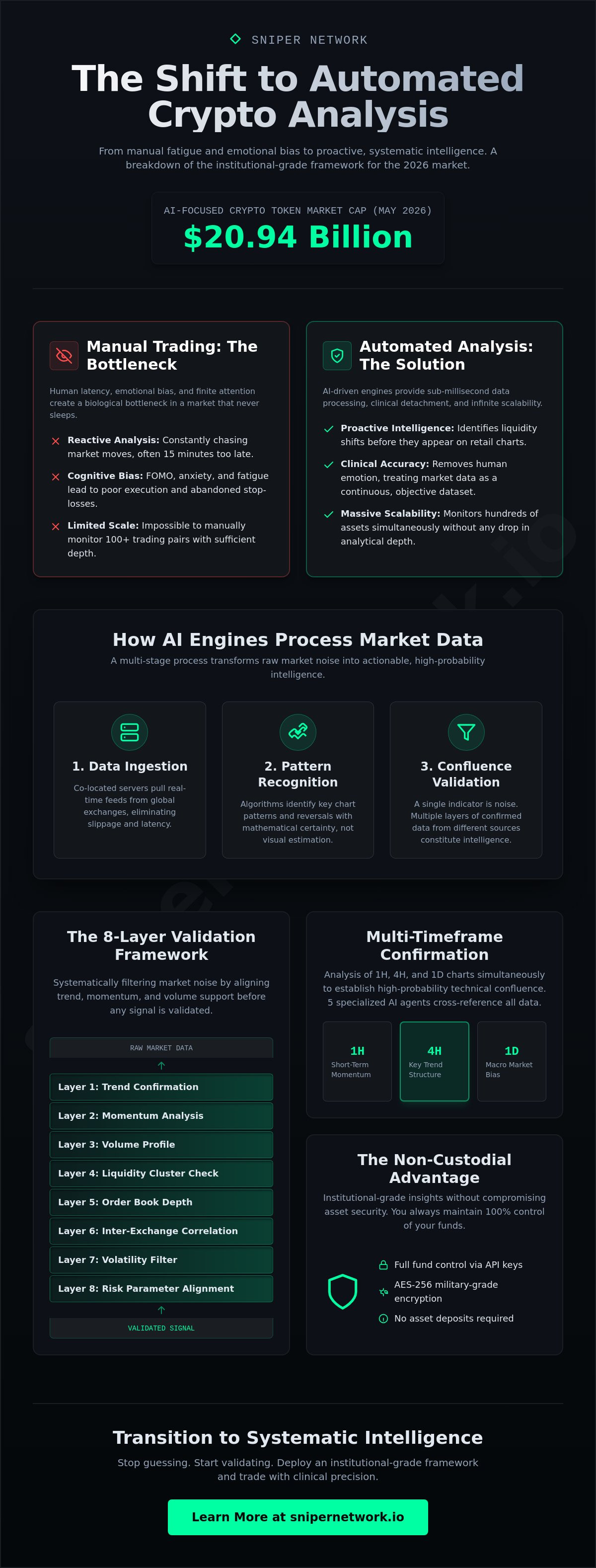
Precision requires high-tier infrastructure. Data ingestion starts with co-located servers in strategic hubs like GCP Tokyo. These servers pull real-time feeds from global exchanges to eliminate slippage and latency. Next, pattern recognition identifies triangles, wedges, and reversals with mathematical certainty. There's no guessing if a candle wick constitutes a valid breakout. Finally, validation layers provide the necessary filter. A single indicator is just a noise-heavy signal. Three confirmed layers of data constitute intelligence. This hierarchy ensures every trigger is backed by multi-source confluence.
Why Manual Charting Fails in High-Volatility Environments
Human latency is your greatest liability in the 2026 market. By the time you spot a potential reversal, the institutional move is often complete. You're usually 15 minutes too late to the entry. Cognitive bias adds another layer of risk. FOMO and anxiety distort your perception of technical levels, leading to poor trade execution and abandoned stop-losses. Even the most disciplined trader faces the biological limits of fatigue.
Scaling is the final hurdle for manual efforts. You cannot manually perform quantitative crypto analysis across 100+ trading pairs simultaneously. Human attention is finite. Automated engines solve this through pure computational power. They monitor the entire market with clinical detachment, executing strategies across hundreds of assets without a drop in analytical depth. Your API key and your funds remain under your control while the engine handles the heavy lifting of data interpretation.
How AI Engines Process Automated Technical Analysis
Institutional-grade automated crypto market analysis relies on multi-timeframe confirmation. The engine doesn't look at a single chart in isolation. It analyzes the 1H, 4H, and 1D timeframes simultaneously. Confluence is the only metric that matters. Five specialized AI agents cross-reference price action with real-time volume profiles. This isn't a static rule set. It's a dynamic validation process where 5 AI agents and 8 signal filters work in parallel. This sophisticated architecture is a primary driver behind AI reshaping crypto markets in 2026. The system doesn't guess; it validates.
Filtering noise is the engine's primary objective. Algorithms distinguish between a "fakeout" and a "breakout" by analyzing order book depth and liquidity clusters. If volume doesn't support a price move, the signal is discarded as noise. Strategies undergo rigorous backtesting against years of historical data to ensure viability across different market regimes. They then move to forward testing in live environments using paper funds. Only frameworks that maintain performance under live volatility reach production. For traders requiring this level of technical depth, utilizing automated intelligence tools ensures you aren't trading against the wind.
The Role of Machine Learning in Trend Detection
Modern engines use crypto predictive analytics to model future price ranges with clinical precision. AI agents like Claude AI assist in interpreting complex market narratives that traditional indicators miss. Dynamic adaptation allows the engine to adjust parameters based on current volatility. If the market shifts from a trending to a mean-reverting regime, the system pivots automatically. It's about maintaining a constant edge.
Technical Indicators Optimized for Automation
Automation moves beyond lagging retail indicators. It focuses on Volume-Weighted Average Price (VWAP) and Order Flow Delta to identify institutional positioning. Liquidity mapping detects "stop hunts" and "liquidity grabs" before they trigger your exit. The system also correlates technical levels with sentiment analysis in cryptocurrency. High-conviction setups require both technical structure and social alignment. Every trigger is backed by data, not hope.
The 8-Layer Validation Framework: Filtering Market Noise
Most retail trading bots fail because they lack a rigorous validation hierarchy. They operate on binary triggers. If A crosses B, then buy. This simplicity is a liability in a 2026 market defined by high-frequency noise and liquidity traps. Effective automated crypto market analysis requires a tiered approach where a signal must survive multiple layers of scrutiny before validation. Research into automated crypto trading strategies confirms that multi-layered systems significantly outperform single-indicator models by reducing false positives and improving risk-adjusted returns.
The first three layers establish the foundation. Trend alignment across multiple timeframes, momentum confirmation, and volume support must align perfectly. If the trend is bearish on the daily chart but momentum appears bullish on the hourly, the engine remains neutral. It waits for confluence. Layers four through six address execution risk. Volatility filtering, liquidity checks, and exchange-specific spread analysis ensure you don't enter positions where slippage destroys your projected margin. Finally, layers seven and eight act as the circuit breakers. They monitor macro sentiment and real-time news feeds from sources like Reuters to pause execution during high-impact global events. This hierarchy transforms a simple bot into a sophisticated intelligence engine.
Eliminating the 'Black Box' Anxiety
Transparency is the hallmark of professional tools. You shouldn't wonder why a signal was generated. Institutional-grade engines provide the logic path for every interpretation. Audit trails allow you to review the decision-making process after the fact. This ensures the system adheres to your systematic crypto trading framework without deviation. It's about data-driven confidence. It's about clinical results. You maintain full control over the parameters. The engine simply provides the mechanical discipline required to follow them.
The Power of Multi-Signal Filtering
An ai crypto trend scanner prevents the trap of entering trades during low-probability chop. By setting specific confidence thresholds, the system only triggers when the probability of success reaches a mathematical peak. This is the clinical advantage of unemotional execution. You aren't watching a chart. You're monitoring a high-performance engine that filters noise with sub-millisecond precision. It removes the fatigue-driven errors that plague manual traders. It delivers institutional-grade technical insights directly to your dashboard without the need for 24/7 screen time.
How to Implement Automated Technical Analysis: A 5-Step Setup
Implementing an institutional-grade setup requires more than connecting an exchange to a template. It demands a systematic architecture. Follow these five steps to deploy a professional-grade automated crypto market analysis framework. First, define your market thesis. Don't trade everything. Choose between Trend Following or Mean Reversion based on current market regimes. Second, select a non-custodial intelligence tool. Asset control is non-negotiable. You must maintain possession of your private keys at all times. Third, configure your 8-layer filters. Adjust these parameters to match your specific risk tolerance and capital allocation. Fourth, execute a mandatory 14-day paper trading simulation. This validates the engine's logic path without risking principal. Finally, transition to live monitoring. Use sub-millisecond alerts to ensure you're acting on the most recent data possible.
This process removes the exuberance of manual trading. It replaces hope with a clinical execution engine. By the time you reach step five, your system should operate as a silent background process. It monitors, validates, and triggers based on mathematical confluence rather than intuition.
Selecting Your Infrastructure
Latency is the silent killer of technical strategies. Server location matters. Co-locating your engine in hubs like GCP Tokyo minimizes the distance between your logic and the exchange matching engine. This ensures your data ingestion is as close to real-time as possible. Security protocols must follow the "Your API key, your funds" mantra. Use AES-256 encryption for all data transmissions. Align your monitoring with the 24/5 institutional cycle. While crypto trades 24/7, the highest liquidity and volatility often align with global financial hours. Your system must be optimized for these high-impact windows.
Refining Your Strategy for 2026
Continuous optimization is a baseline requirement. Integrate ai for crypto market analysis tools into your daily workflow to interpret emerging narratives. Static rules fail during black swan events. You need automated circuit breakers that pause execution during "Flash Crash" scenarios. Review your performance using weekly reports. Use this data to tweak filter sensitivity. If your slippage is increasing, tighten your liquidity filters. If you're missing entries, re-evaluate your momentum thresholds. Precision is a moving target. Deploy your systematic intelligence engine today to stay ahead of the curve.
Institutional-Grade Insights: The Non-Custodial Advantage
The final pillar of a professional framework is the separation of intelligence from custody. Sniper AI Weekly prioritizes intelligence delivery over direct asset management for a specific reason. Security. Direct custody creates a centralized point of failure. By focusing on a non-custodial architecture, the system streamlines automated crypto market analysis without ever touching your principal. You maintain possession of your private keys. The engine provides the data. This "intelligence-first" model ensures that your strategy remains as secure as it is precise. It utilizes AES-256 encryption for all signal transmissions, providing a bridge between institutional data centers and your private execution environment.
Moving beyond simple "buy" and "sell" signals is essential for surviving the 2026 market regime. You need comprehensive market intelligence reports that explain the logic behind every validation. Leveraging Sniper AI Weekly allows you to access automated trend detection that has been filtered through a rigorous validation hierarchy. This isn't a manual signal group. It's a systematic intelligence framework. It delivers the "why" behind the market move, allowing you to execute with the confidence of a professional desk. Your API key and your funds remain yours. The engine simply provides the clinical evidence required for high-probability execution.
The Future of Systematic Intelligence
The 2026 landscape is defined by the rise of the agentic economy. Autonomous AI agents now execute complex research tasks 24/7, scanning for liquidity shifts and macro correlations that human traders miss. This democratization of institutional-grade data allows retail traders to compete on a level playing field. A clinical, data-first approach is no longer optional. It's the only way to navigate the volatility of a market where AI-focused tokens and decentralized exchanges dominate the volume. Reliability is the new alpha. Precision is the baseline.
Getting Started with Sniper Network
Technical proof should always precede commitment. Sniper Network offers a "No Card Required" trial to demonstrate the depth of our analytical engine. You gain immediate access to the 8-layer validation framework via automated reports. This allows you to witness the logic path of our 5 AI agents before deploying live capital. Review the backtested results. Monitor the real-time accuracy. When you're ready to transition from manual guesswork to systematic precision, the infrastructure is ready. ◈ Start your automated analysis trial with Sniper Network and secure your edge in the evolving digital asset market.
Deploying Your Systematic Edge
The transition from manual charting to a systematic framework is a technical necessity in the post-MiCA landscape. You now understand how 5 AI agents and an 8-layer validation hierarchy eliminate the emotional bias that leads to poor execution. By leveraging co-located GCP Tokyo infrastructure, you align your data ingestion with the institutional benchmarks required for 2026. This proactive approach to automated crypto market analysis ensures you filter market noise with clinical precision. Data over intuition. Your API key and your funds remain secure within a non-custodial architecture that prioritizes intelligence over custody.
It's the most powerful tool for navigating high-volatility environments without the biological limits of human fatigue. Start your 14-day clinical intelligence trial; no card required. Maintain your edge through data-driven discipline and institutional-grade insights.
Frequently Asked Questions
Is automated technical analysis better than manual charting?
Automated systems outperform manual charting by eliminating human latency and cognitive bias. Manual traders are often 15 minutes late to entries due to the time required for visual confirmation. An automated crypto market analysis engine monitors hundreds of pairs with clinical detachment. It ensures every trade aligns with a backtested thesis rather than an emotional impulse or fatigue-driven error.
Do I need coding skills to use an automated crypto market scanner?
Coding skills aren't required for high-tier intelligence tools. Sniper AI Weekly provides a streamlined interface where the algorithmic heavy lifting is handled by 5 AI agents. You define the risk parameters and market thesis. The system delivers validated technical insights directly to your dashboard. This allows you to focus on strategy while the engine handles the sub-millisecond data processing.
How does AI improve technical analysis accuracy?
AI enhances accuracy by moving beyond rigid, static rules. It uses multi-agent frameworks to synthesize price action with volume profiles and order flow delta. This process identifies confluence across the 1H, 4H, and 1D timeframes simultaneously. The result is a clinical validation that filters out the "fakeouts" common in retail charting, ensuring triggers are backed by mathematical evidence.
Can automated analysis tools predict crypto market reversals?
These tools identify reversals by mapping liquidity and detecting institutional "stop hunts" before they manifest on retail charts. By analyzing order flow delta, the engine spots where large players are positioning. It identifies the mathematical exhaustion of a trend. This allows for entries based on clinical probability rather than speculative guesswork or hope.
What are the risks of using automated trading intelligence?
Risks include API latency, connectivity drops, and extreme market regimes that defy historical patterns. Systematic automated crypto market analysis mitigates this by using co-located servers in GCP Tokyo and automated circuit breakers. These safeguards pause signals during black swan events. They protect your principal from irrational volatility that simple, rule-based bots often ignore.
Is my data secure when using a non-custodial AI tool?
Data security is a core feature of non-custodial architecture. Your funds stay in your wallet. The system only interacts with your exchange via encrypted API keys. AES-256 encryption protects all data transmissions. The "Your API key, your funds" mantra ensures you remain the sole custodian of your assets while receiving institutional-grade intelligence.
How often should I update my automated analysis parameters?
You should optimize your parameters during a weekly review cycle. Market regimes aren't permanent. Trends eventually fade into mean-reversion. Use the weekly intelligence reports to adjust filter sensitivity and confidence thresholds. This continuous optimization ensures the engine adapts to current liquidity and volatility levels rather than relying on outdated market assumptions.
What is the 8-layer validation framework in crypto analysis?
The 8-layer validation framework is a hierarchical filtering system designed to eliminate false signals. Every setup must pass through trend, momentum, and volume checks before moving to liquidity and spread analysis. Finally, macro sentiment and news filters act as circuit breakers. This rigorous process ensures only high-conviction data survives the filter, providing you with clinical evidence for execution.