
The era of emotional trading is over. While social media noise triggers retail panic, institutional desks deploy multi-agent frameworks to isolate signal from volatility. You've likely felt the sting of lagging indicators that fail during rapid reversals. Information overload isn't a research problem; it's a filtering failure. To compete in a market with 173 regulated ETPs and a $323 billion stablecoin economy, you need more than a chart. You need crypto predictive analytics built on systematic intelligence.
This article provides the technical blueprint for institutional-grade models. You'll learn how to validate AI-generated signals and reduce research time through automation. We'll examine the 2026 landscape, including the impact of the GENIUS Act implementation and the shift toward non-custodial intelligence. Expect a deep dive into the architecture that separates high-frequency execution from speculative gambling. 5 AI agents. 8 signal filters. This is the framework for modern market precision.
Key Takeaways
- Shift from reactive technical analysis to proactive systematic intelligence using multi-agent AI frameworks.
- Discover how co-located server infrastructure and specialized agents for sentiment and on-chain metrics eliminate execution latency.
- Master the 8-layer validation framework to filter market noise through multi-timeframe confirmation and volume-price divergence checks.
- Leverage crypto predictive analytics to monitor over 1,000 asset pairs simultaneously with clinical, data-driven objectivity.
- Implement non-custodial intelligence via the Sniper AI Weekly protocol to ensure security remains under your direct control.
What is Crypto Predictive Analytics in 2026?
In the current market, crypto predictive analytics is the clinical synthesis of historical data, real-time on-chain metrics, and multi-agent AI modeling to forecast market probabilities. It's a departure from the "guesswork" of early retail trading. By May 2026, the digital asset landscape has matured through the growth of 173 exchange-traded products and a $323 billion stablecoin economy. This scale demands a shift from reactive charting to proactive systematic intelligence. Predictive analytics frameworks now process millions of data points to identify high-probability outcomes before they manifest on a standard candlestick chart.
The 2026 market environment doesn't forgive latency. High volatility requires sub-millisecond data processing and multi-timeframe confirmation to filter out fakeouts. While speculative "signals" often rely on the gut feeling of a manual trader, clinical predictive intelligence relies on backtested validation. It's the difference between a gamble and a statistical edge. Institutional desks don't look for "the next big thing." They look for the next validated move.
The Evolution from Technical Analysis to AI Modeling
Traditional indicators like RSI and MACD are insufficient in high-frequency environments. These tools are lagging by nature; they tell you what happened, not what's likely to happen next. As market cycles shift and institutional players dominate, machine learning identifies non-linear patterns that human eyes simply miss. Integrating quantitative crypto analysis is now a prerequisite for modern portfolio management. AI models analyze the hidden correlations between liquidity flows, social sentiment, and whale wallet movements. They don't suffer from fatigue or emotional bias. They execute on data.
Core Components of a Predictive Engine
A functional crypto predictive analytics engine requires three technical pillars to maintain institutional-grade performance:
- Data Ingestion: The system must pull raw data from global exchanges and on-chain protocols simultaneously. Speed is the primary metric here.
- Feature Engineering: This involves selecting the most relevant variables for price movement. Not all data is useful; the engine must discard the noise to focus on high-impact triggers like exchange inflows or smart money positioning.
- Model Validation: Every model undergoes rigorous backtesting against historical volatility. If a strategy can't survive a rapid 20% reversal, it's discarded.
The goal isn't to be right 100% of the time. The goal is to maintain a verifiable edge through technical precision and automated execution.
The Technical Architecture of Institutional-Grade Models
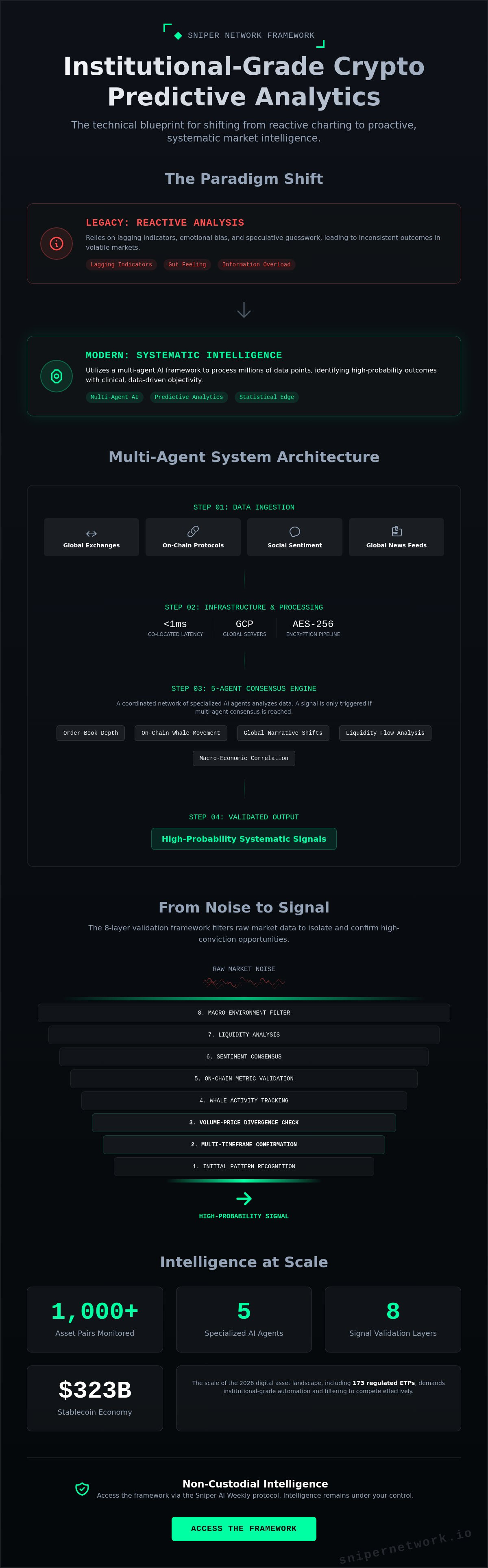
Institutional-grade crypto predictive analytics rely on a decentralized multi-agent architecture. This isn't a single bot; it's a coordinated network of specialized AI agents. One agent monitors order book depth. Another tracks on-chain whale movements. A third processes global narrative shifts. This AI-Driven Predictive Analytics Framework ensures that no single data point dictates a decision. Instead, the system requires multi-agent consensus before triggering a signal. It's a cold, clinical approach to probability.
Infrastructure matters as much as the algorithm. Co-located servers in GCP Tokyo reduce latency to sub-millisecond levels. This proximity to exchange matching engines is critical when rapid reversals occur. All data travels through AES-256 encrypted pipelines. Security isn't an afterthought; it's the foundation. High-tier LLMs like Claude AI process natural language market data in real-time. This allows the system to understand the nuance of a central bank statement or a breaking Reuters report within seconds. The result is a silent engine working in the background, providing a level of precision retail traders can't replicate.
Data Sources: Beyond the Price Chart
Price action is a lagging result of deeper market forces. To get ahead, the framework monitors on-chain activity, specifically exchange inflows and outflows. Large Bitcoin movements to cold storage suggest accumulation. Conversely, stablecoin inflows to exchanges signal potential buying pressure. Integrating sentiment analysis in cryptocurrency allows the model to gauge crowd psychology across social platforms. By the time a trend is obvious to retail, the systematic engine has already validated the move through macro indicators and global financial feeds.
Machine Learning Techniques in Crypto
Recurrent Neural Networks (RNNs) are the standard for time-series forecasting. They excel at identifying the cyclical nature of crypto markets. Reinforcement learning optimizes trade entry and exit timing by constantly simulating millions of market scenarios. This creates a self-improving loop. Natural Language Processing (NLP) handles automated news analysis. It filters the noise, focusing only on verified facts that move markets. For those seeking this level of precision without managing the infrastructure, Sniper AI Weekly provides these institutional insights directly. Crypto predictive analytics are no longer a luxury; they're a requirement for survival in 2026.
Predictive Analytics vs. Traditional Signal Groups
The transition from manual signal groups to crypto predictive analytics marks the end of the "guru" era. Manual groups rely on human intuition, which is inherently flawed. A manual trader suffers from fatigue, ego, and the need to be right. In contrast, institutional-grade AI maintains clinical objectivity. It doesn't hope for a breakout; it calculates the probability of one based on 8-layer validation frameworks. While a human analyst is limited to monitoring 5 or 10 asset pairs, an automated system scans 1,000+ pairs simultaneously. This scalability is the baseline for modern institutional performance.
Transparency is the primary differentiator. Most manual groups hide their losing trades or delete history to maintain an illusion of success. Systematic intelligence relies on verifiable backtesting and real-time performance data. The "Elite Technician" persona prioritizes technical precision over hype. This approach replaces "get-rich-quick" exuberance with a cold focus on risk-adjusted returns. If a model cannot prove its edge through historical volatility, it's not deployed. It's that simple.
Identifying the Risks of Manual Analysis
Cognitive biases are the silent killers of retail portfolios. Confirmation bias leads traders to ignore data that contradicts their current position. The sunk cost fallacy keeps them in losing trades far longer than a machine would allow. Manual groups often exacerbate these issues by creating "signal noise," leading to chronic overtrading. Adopting systematic crypto trading is the only effective defense against market manipulation. By removing the human element, you remove the emotional vulnerability that market makers exploit.
The Edge of Automated Intelligence
Institutional markets don't stop, but humans must. Systematic frameworks provide 24/5 monitoring, aligning crypto intelligence with the hours of traditional financial floors. This consistency removes the "FOMO" factor. Every decision is backed by data, not the fear of missing a sudden pump. An ai crypto trend scanner identifies reversals before they hit the mainstream by spotting volume-price divergence in real-time. This early detection is impossible for manual traders who are distracted by social media sentiment. Crypto predictive analytics provide the silence and speed required to execute with precision in a $323 billion stablecoin economy.
The 8-Layer Validation Framework: Filtering Market Noise
Raw data is a liability; validated intelligence is an asset. In the 2026 market, crypto predictive analytics must survive a rigorous 8-layer validation framework before any signal reaches the execution engine. This systematic approach filters out the high-frequency noise that often traps retail traders. The objective is clinical precision. We don't guess. We validate. The framework operates through five primary technical steps to ensure every probabilistic outcome is backed by multi-dimensional proof.
- Step 1: Multi-timeframe confirmation. The system analyzes everything from M15 to D1 charts. This ensures short-term volatility doesn't contradict the macro trend.
- Step 2: Volume-price divergence check. Price increases on declining volume are flagged as potential fakeouts. This layer identifies exhaustion before a reversal occurs.
- Step 3: On-chain liquidity verification. The engine monitors stablecoin flows and exchange reserves. If an asset lacks the liquidity to support a move, the signal is discarded.
- Step 4: Sentiment extreme analysis. AI agents scan social narratives to identify overcrowded trades. When the crowd is too bullish, the risk of a "long squeeze" increases.
- Step 5: Macro-correlation filtering. No asset exists in a vacuum. The model calculates the correlation between Bitcoin and traditional indices like the S&P 500 to account for global liquidity shifts.
Applying Risk Management to Predictive Outputs
Intelligence without control is dangerous. Every predictive output must be paired with crypto risk management tools to protect capital. The system calculates a "Probability of Success" alongside a "Potential Drawdown" for every setup. Automated stop-loss and take-profit intelligence triggers based on real-time volatility rather than arbitrary percentages. This ensures your exit strategy is as data-driven as your entry. Access the Sniper Network terminal to deploy these validation layers in your own research workflow.
Reducing False Positives
More data isn't always better. A "Signal Filter" approach prioritizes the quality of inputs over the quantity. Multiple AI agents cross-validate each other to eliminate outliers and statistical anomalies. If the sentiment agent disagrees with the on-chain liquidity agent, the system pauses. The Validation Threshold is the minimum confidence score required for an actionable insight. By maintaining a high threshold, the crypto predictive analytics engine ignores 95% of market noise to focus only on high-probability events.
Sniper AI Weekly: Non-Custodial Market Intelligence
Security is the primary constraint of modern digital asset management. Sniper Network operates on a specific mantra: "Your API key, your funds." Institutional crypto predictive analytics shouldn't require you to surrender custody of your assets. By delivering intelligence without holding funds, we eliminate the counterparty risk inherent in centralized signal groups or custodial trading desks. This protocol ensures that while you receive high-tier market intelligence, you maintain absolute control over your private keys. Clinical precision shouldn't come at the cost of asset safety.
Sniper AI Weekly functions as the direct delivery mechanism for this systematic framework. The intelligence cycle is powered by 5 specialized AI agents working in constant synchronization. One monitors the CLARITY Act's progress in the Senate. Another tracks $323 billion in stablecoin liquidity flows. The remaining agents process volume-price divergence across 173 regulated ETPs. This transition from speculative guessing to data-driven crypto trading is the only way to compete with institutional liquidity providers who dominate the 2026 landscape.
Institutional-Grade Intelligence for the Individual
Manual research is a bottleneck. Traders often spend 20 or more hours per week filtering through social media noise and lagging indicators. We automate this process. Every weekly report distills millions of sub-millisecond data points into a clinical, actionable summary. You get the output of a professional quant desk without the overhead. Transparency is non-negotiable. The "No Card Required" trial allows you to validate the framework's precision before committing to the service. No friction. Just data.
The Future of Systematic Intelligence
Speed remains the ultimate edge. Sniper Network utilizes GCP Tokyo and multi-region co-location to ensure our data ingestion is faster than the retail market can react. The 2026 roadmap includes integrating even more complex validation layers, such as real-time sentiment processing of Senate Banking Committee hearings and deep-liquidity mapping of new Solana and XRP spot ETFs. The market is maturing. Your research tools must mature with it. Join the Sniper AI Weekly intelligence service for institutional-grade market reports and stop trading on emotion. Deploy crypto predictive analytics as your primary weapon.
Deploying Systematic Intelligence in 2026
The era of speculative guessing is finished. Navigating the 2026 market requires a shift from reactive manual trading to proactive systematic intelligence. You've seen how institutional-grade crypto predictive analytics rely on multi-agent frameworks to filter out volatility and isolate high-probability signals. Success now depends on the clinical application of 8-layer validation and sub-millisecond data processing. By removing emotional bias, you align your strategy with the technical precision used by global institutional desks.
Security remains the foundation of this framework. Our non-custodial protocol ensures you never surrender control of your assets. Your API key. Your funds. With 5 AI agents and 8 signal filters validated by GCP Tokyo and Claude AI, the system provides the transparency and speed required to execute during rapid reversals. It's time to stop fighting the noise and start leveraging the data. Access Institutional-Grade Crypto Intelligence with Sniper AI Weekly. Professional-grade precision is now within your reach.
Frequently Asked Questions
Is crypto predictive analytics accurate enough for professional trading?
Accuracy is measured in probabilistic edge rather than absolute certainty. Professional traders use crypto predictive analytics to identify setups where the statistical probability of a successful outcome outweighs the potential drawdown. Models are validated through rigorous backtesting against historical volatility and real-time market conditions. This provides a clinical advantage over manual analysis by removing human error and emotional fatigue from the equation.
Can AI predict crypto market crashes before they happen?
AI models identify the structural weaknesses that precede a market crash. By monitoring volume-price divergence, liquidity exhaustion, and whale wallet movements, these systems flag high-risk environments before price collapses. It isn't about seeing the future; it's about calculating the increasing probability of a rapid reversal based on deteriorating on-chain metrics and overcrowded sentiment. This early detection allows for proactive risk management.
How much data does a predictive model need to be effective?
Effective models require millions of data points ingested across multiple timeframes. This includes years of historical price action, order book depth, and real-time social sentiment. High-tier infrastructure, such as GCP Tokyo, ensures that this data is processed with sub-millisecond latency. Without sufficient data volume and variety, a model cannot differentiate between a legitimate trend and temporary market noise.
What is the difference between predictive analytics and a crypto signal group?
Predictive analytics relies on clinical objectivity, while signal groups rely on human intuition and bias. Automated systems can monitor 1,000+ asset pairs simultaneously, whereas a manual trader is limited by physical constraints. Systematic intelligence uses multi-layer validation frameworks to filter out false positives. This replaces the "get-rich-quick" hype of manual groups with a cold focus on data-driven performance.
Do I need to be a programmer to use crypto predictive analytics tools?
You don't need to be a programmer to leverage institutional-grade intelligence. Services like Sniper AI Weekly deliver complex quant data through clinical reports designed for direct application. The underlying multi-agent AI handles the heavy lifting, including data ingestion and feature engineering. This allows you to focus on strategic execution without writing a single line of code or managing server infrastructure.
What are the risks of relying solely on AI for crypto trading?
The primary risk is a "black swan" event that falls outside historical data parameters. While crypto predictive analytics excel at identifying patterns, they can struggle with unprecedented regulatory shifts or massive infrastructure failures. This is why models must be paired with automated risk management tools. Relying on AI requires a baseline understanding that the system manages probabilities, not certainties.
How does sentiment analysis impact crypto price predictions?
Sentiment analysis serves as a critical contrarian indicator during extreme market conditions. By processing natural language from social platforms, AI agents identify overcrowded trades where retail exuberance has peaked. This data allows the model to predict potential "long squeezes" by recognizing when crowd psychology has reached an unsustainable extreme. It provides the psychological context that raw price charts often miss.
Is non-custodial AI safer than traditional trading bots?
Non-custodial AI is significantly safer because it eliminates counterparty risk. Unlike traditional bots that may require you to deposit funds into a third-party platform, a non-custodial framework operates via API. You maintain absolute control over your private keys. Your API key, your funds. This protocol ensures that your intelligence service never becomes a point of failure for your capital or security.