The $4 trillion cryptocurrency market is no longer a playground for retail intuition. If you are relying on basic RSI crossovers or social media sentiment, you are the liquidity for high-frequency algorithms. You have likely felt the exhaustion of being front-run by sub-millisecond execution engines while drowning in the noise of a 24/5 market. Understanding how to get an edge in crypto in 2026 requires a shift from manual guesswork to systematic, institutional-grade data processing.
You need a repeatable validation framework that replaces emotional fatigue with technical precision. This article details the 2026 Systematic AI Framework. 5 AI agents. Multi-timeframe confirmation. We will show you how to move beyond standard retail indicators by using the same intelligence used by institutional desks. You will learn to secure a technical advantage that reduces manual research time and prioritizes backtested results over speculative market hype.
Key Takeaways
- Define a modern edge as a repeatable, data-backed probability of success rather than a hype-driven event.
- Discover how to get an edge in crypto by utilizing multi-agent AI architectures to cross-validate market trends across multiple timeframes.
- Abandon manual signal groups to eliminate human bias and the risk of being front-run by delayed alerts.
- Apply a 5-layer validation framework that integrates macro sentiment analysis with on-chain liquidity verification.
- Transition to institutional-grade infrastructure with Sniper AI Weekly, leveraging Reuters data feeds and GCP Tokyo's sub-millisecond environment.
Defining 'Edge' in the 2026 Cryptocurrency Market
In the 2026 market, an edge is a clinical calculation. It's a repeatable, data-backed probability of success that exceeds random chance. Forget the 2020 era of hype-driven entries. Back then, a single social media post could move markets. Today, the systematic edge dominates. Mastering data-driven crypto trading has replaced manual pattern recognition because the market is too fast for the human eye. The rise of algorithmic trading means you aren't competing against other people; you're competing against math. If you want to know how to get an edge in crypto, you must build your strategy on three pillars: speed, noise filtration, and rigorous validation. Without these, you aren't trading; you're gambling against a house that sees your cards.
The Death of Retail Indicators
Lagging indicators are now liquidity traps. Tools like RSI, MACD, and Bollinger Bands are the primary signals used by institutional bots to identify retail clusters. When retail traders see an "oversold" RSI, they buy. Institutional algorithms recognize this pattern and trigger further sell pressure to hunt those stop losses. This creates the liquidity they need to fill large orders. Sub-millisecond execution has turned traditional chart patterns into predictable targets. To survive, you must move from lagging indicators to leading data-driven insights that track institutional flow in real-time. You need to see where the money is going, not where it has been.
Speed as a Barrier to Entry
Infrastructure is the invisible divider. Institutional desks utilize co-located servers in regions like GCP Tokyo to minimize latency. This allows them to see and react to market shifts before the data even reaches a retail terminal. Manual research is no longer a virtue; it's a liability. In a 24/5 high-frequency market, the time you spend drawing trendlines is time the market has already moved against you. Automated intelligence is the only way to reduce reaction time. You need a system that validates and executes with technical precision, removing the bottleneck of human hesitation. If your process isn't automated, you're already behind the curve. Precision requires speed. Speed requires automation.
The Infrastructure of an Edge: AI and Data Processing
Technical superiority is the foundation of any sustainable advantage. In the 2026 landscape, obtaining institutional grade crypto data is no longer restricted to hedge funds. You can now access the same sub-millisecond feeds and co-located infrastructure once reserved for elite trading floors. This shift has redefined how to get an edge in crypto. It's no longer about who has the data, but who processes it with the highest precision. By utilizing co-located servers in GCP Tokyo, the latency gap between retail and institutional execution is effectively neutralized. This infrastructure ensures that the market intelligence you receive is accurate to the millisecond, preventing the slippage that destroys manual strategies.
The core of this system is a multi-agent AI architecture. Instead of relying on a single model, the framework employs distinct agents, such as Claude and GPT-4, to cross-validate every market movement. One agent monitors on-chain liquidity while another analyzes order book depth. This collaborative approach ensures that a signal is only triggered when multiple high-tier models reach consensus. This level of Revolutionising Cryptocurrency Trading through automated cross-validation removes the single point of failure inherent in solo-model analysis. It's a clinical, technical filter designed for high-frequency environments.
Noise Filtration via Machine Learning
The 2026 market is saturated with noise. Social media hype and bot-driven trends are designed to create exit liquidity for larger players. Our framework utilizes Natural Language Processing (NLP) to quantify sentiment without human bias. It identifies and discards "paid shills" by analyzing account history and coordination patterns. By focusing on genuine institutional accumulation rather than retail noise, the system detects reversals before they appear on a chart. Using specialized ai for crypto market analysis tools allows for the detection of "whale" movements that are often hidden behind complex transactional layers. You can monitor these movements autonomously to stay ahead of the crowd.
Multi-Timeframe Confirmation (MTC)
Single-timeframe signals are statistically insignificant noise. A breakout on a 1-minute chart is irrelevant if the 1-hour and 1-day trends are bearish. The Systematic AI Framework automates the confirmation process by monitoring 1m, 5m, 1h, and 1D charts simultaneously. Each timeframe acts as a filter. A trade only proceeds if all timeframes align with the primary signal. This Multi-Timeframe Confirmation (MTC) removes the emotional hesitation that often plagues manual traders during high volatility. It executes based on hard data, ensuring that every entry meets a strict technical threshold. 5 AI agents. 8 signal filters. No human error.
Systematic Intelligence vs. Manual Signal Groups
Understanding how to get an edge in crypto involves distinguishing between a "signal" and "intelligence." Most traders mistake static alerts for an advantage. A signal is a single, often delayed data point from a manual provider. Intelligence is a dynamic, multi-layered validation stream. Manual signal groups are inherently flawed. They rely on the perception of a human admin who is susceptible to the same fear and greed as any other retail trader. These groups often suffer from delayed alerts, where the admin has already entered the position, effectively using their followers as exit liquidity. This front-running risk makes manual groups a liability rather than a tool.
True systematic crypto trading requires objective, automated reporting. The architecture must be non-custodial to ensure security. The Sniper Network mantra is simple: "Your API key, your funds." This eliminates the "black box" risk associated with custodial bots that require you to deposit assets into their platform. By keeping control of your funds, you remove the counterparty risk that has historically plagued the crypto industry. Security isn't just about encryption; it's about maintaining asset autonomy while leveraging institutional-grade data.
The Human Bias Problem
Fear and greed destroy manual trading strategies during high volatility. A human provider might hesitate on a valid entry or chase a pump out of FOMO. AI remains clinical. It monitors the market 24/5 without emotional fatigue or physical limitations. Academic research into deep learning applications in cryptocurrency demonstrates that automated models are significantly more effective at identifying complex patterns in volume and liquidity. For example, while a manual trader might chase a price breakout, an AI agent detects the lack of supporting on-chain volume and identifies the move as a fake-out. It validates the "why" before triggering the "what."
Transparency and Backtesting
Manual groups rarely provide verifiable, long-term data. Their results are often cherry-picked screenshots of winning trades that ignore the drawdowns. A systematic framework demands clinical, third-party validated reporting. You need to see how a strategy performs across different market cycles, not just during a bull run. Sniper Network maintains a commitment to transparency with a "No Card Required" trial. This allows users to validate the technical specifications and backtested results before any commitment. In the 2026 market, how to get an edge in crypto is a question of data verification. If a provider cannot show you a clinical history of performance, they don't have an edge. They have a guess.
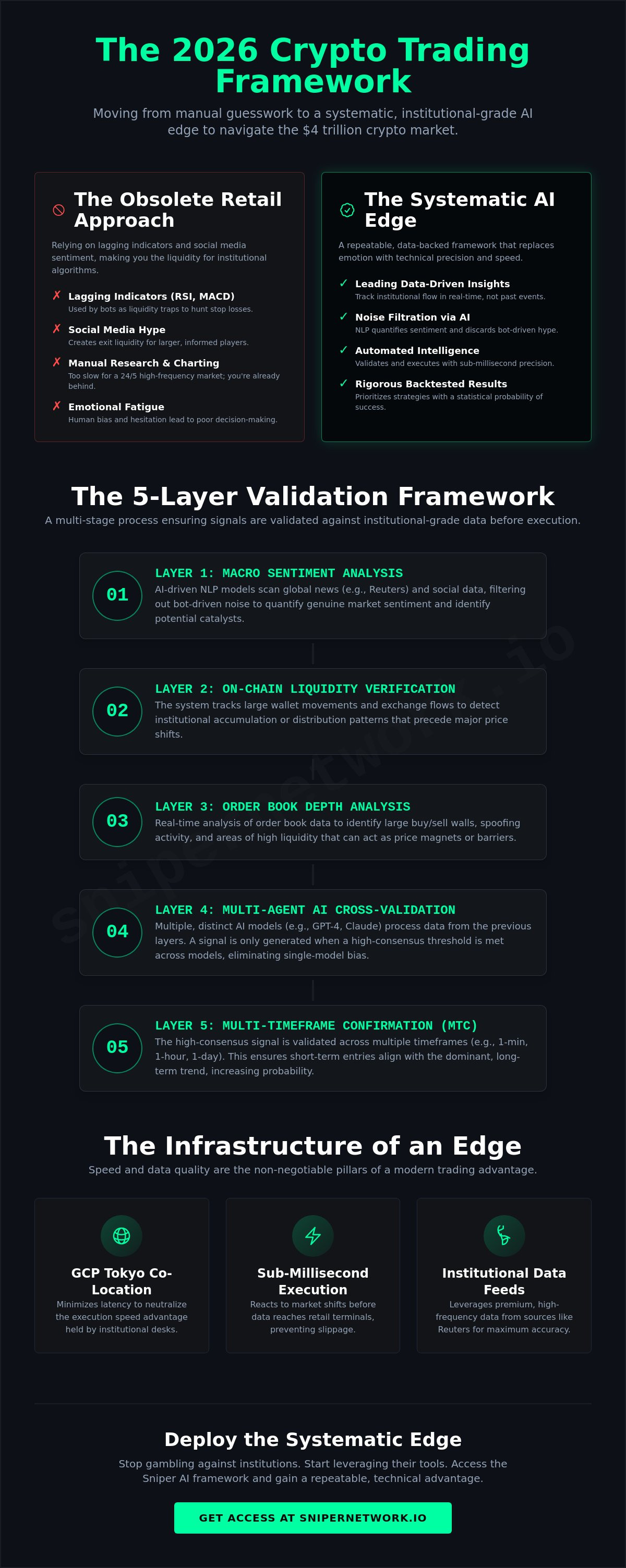
The 5-Layer Validation Framework for Crypto Traders
A systematic edge is not a single indicator. It's a process of elimination. To understand how to get an edge in crypto, you must implement a multi-layered filtration system that removes human error from the equation. Most retail participants fail because they enter trades based on a single data point. Our framework requires five distinct layers of confirmation before any execution occurs. This clinical approach ensures that every position is backed by institutional-grade logic rather than speculative hope. If an asset fails even one layer, it's discarded. No exceptions.
The framework operates through a sequential validation process. Layer 1 analyzes Macro Sentiment, distinguishing between institutional accumulation and retail noise. Layer 2 focuses on On-Chain Liquidity Verification. This tracks the movement of large capital blocks on the ledger to ensure the price action is supported by real volume. Layer 3 utilizes Multi-Agent Technical Confirmation, where different AI models cross-validate pattern recognition as previously detailed. Layer 4 handles Risk-to-Reward Ratio Calibration by automating position sizing based on real-time volatility. Finally, Layer 5 triggers Exit Strategy Automation. This pre-defines the conclusion of the trade, removing the emotional hesitation that often leads to heavy drawdowns.
Implementing the Framework
Implementing these layers requires a shift in your weekly routine. Use institutional intelligence reports to set your technical bias for the next 7 days. This macro-level view prevents you from chasing intraday noise that contradicts the larger trend. By setting up automated filters, you can ignore any asset that doesn't meet all 5 layers of the validation protocol. The Validation Framework is the ultimate technical barrier against FOMO and emotional impulsivity. It forces you to wait for the highest-probability setups, effectively mirroring the patience of a professional trading desk.
Risk Management Integration
Capital protection is the primary objective of any elite technician. An edge is useless without a systematic exit protocol. We utilize crypto risk management tools to automate stop-losses and take-profit levels at the moment of entry. This infrastructure is secured with AES-256 encryption to protect your API keys and trading data. By automating the exit strategy, you eliminate the "hope" factor that keeps manual traders in losing positions for too long. Technical precision requires a system that monitors the market 24/5 and executes without bias. You can access the 5-layer validation framework to begin automating your technical edge today.
Deploying the Sniper AI Weekly Edge
Deploying a systematic advantage requires moving from theory to execution. Sniper AI Weekly automates the entire 5-layer validation framework established in previous sections. It removes the latency of manual observation. By integrating Claude AI with sub-millisecond data feeds from Reuters, the system identifies high-probability setups before they are visible to retail participants. This is how to get an edge in crypto. You stop reacting to price action and start anticipating it through institutional-grade infrastructure. The system operates within the GCP Tokyo environment to ensure sub-millisecond data processing speeds, effectively neutralizing the advantage once held exclusively by hedge funds.
Security is not an afterthought in this deployment. The framework is strictly non-custodial. We operate on the "Your API key, your funds" principle. This ensures you maintain full control of your assets while leveraging our technical intelligence. Unlike custodial "black box" bots that require asset deposits, our architecture acts as a transparent layer of intelligence. It validates, monitors, and triggers alerts based on your pre-defined risk parameters. This non-custodial advantage is the only viable path for serious traders who prioritize security alongside performance. It's a clinical tool designed for professionals.
Institutional Tools for the Retail Individual
We are bridging the gap between professional trading floors and personal portfolios. The 2026 market doesn't sleep, but it does follow institutional hours. Sniper AI Weekly provides 24/5 monitoring to align with global financial cycles. This ensures that your technical bias is always synced with institutional liquidity flows. Trading like an Elite Technician means making decisions based on data, not emotion. You're no longer guessing at reversals; you're following a system that has already cross-validated the trend across multiple AI agents and timeframes. Precision is the only metric that matters.
Your Path to a Systematic Edge
Transitioning from a manual trader to a systematic technician is a streamlined process. Our onboarding is designed to move you from curiosity to technical execution in minutes. You can leverage our "No Card Required" trial to validate the framework's accuracy yourself. This transparency is a core trust marker of the Sniper Network. You'll receive the same weekly intelligence reports used to set institutional bias, giving you a clear roadmap for the next 7 days of market action. Don't let high-frequency algorithms dictate your results. Get your edge with Sniper AI Weekly and start trading with clinical precision today.
Secure Your Technical Advantage
The transition from a manual trader to a systematic technician is a requirement for survival in the 2026 market. You have seen that how to get an edge in crypto depends on clinical noise filtration and institutional-grade infrastructure. By moving beyond lagging retail indicators and adopting a 5-layer validation framework, you remove the emotional fatigue that leads to drawdowns. The objective is clear. You need speed, precision, and data-backed confirmation.
Sniper Network provides the tools to execute this shift. 5 AI agents. 8 signal filters. Our GCP Tokyo co-located infrastructure ensures your intelligence arrives with sub-millisecond accuracy. Because the framework is non-custodial, you maintain full autonomy. Your API key, your funds. This is the institutional standard brought to the individual level. It's a silent, powerful engine working in the background to validate every move before you pull the trigger.
Start your institutional-grade intelligence trial ◈ No card required
Begin your journey toward technical precision. The market is moving. It's time to trade with the speed and clarity of an elite technician.
Frequently Asked Questions
What does it actually mean to have an 'edge' in crypto trading?
An edge is a repeatable, data-backed probability of success that exceeds random chance. It's the core of how to get an edge in crypto in a market dominated by high-frequency algorithms. This advantage relies on clinical execution and the removal of human intuition. You're looking for a technical imbalance where the risk-to-reward ratio is mathematically in your favor over a significant sample size.
How is Sniper AI Weekly different from a standard crypto signal group?
Standard signal groups rely on human admins who often front-run their own members. Sniper AI Weekly provides systematic intelligence validated by 5 AI agents. It uses high-tier infrastructure like GCP Tokyo and Reuters data feeds to ensure precision. This isn't a "tip" group; it's an institutional-grade validation engine designed to filter noise from actual on-chain liquidity movements.
Do I need to be a professional coder to use AI for a crypto edge?
You don't need coding expertise to operate our systematic framework. We provide the technical stack, including Claude AI and multi-timeframe confirmation, in a streamlined interface. The goal is to empower the "Elite Technician" to make data-driven decisions without needing to write a single line of Python. You focus on the strategy while our sub-millisecond architecture handles the heavy processing.
Is my capital safe when using automated AI intelligence tools?
Safety is maintained through a strictly non-custodial architecture. We never hold user funds or require direct asset deposits. Your capital remains on your exchange, secured by your own protocols. We use AES-256 encryption for all data transmissions. This setup ensures that even if our infrastructure is targeted, your assets remain under your exclusive control. Your API key, your funds.
Can AI really predict crypto market movements better than humans?
AI processes vast datasets, such as on-chain volume and macro sentiment, faster than any human team. It identifies how to get an edge in crypto by detecting subtle shifts in institutional flow that manual traders miss. By using multi-agent architectures, the system cross-validates trends across 1m, 5m, 1h, and 1D timeframes simultaneously, eliminating the emotional fatigue and bias that compromise human decision-making.
What is a non-custodial trading tool and why does it matter?
A non-custodial tool acts as an intelligence layer without taking possession of your assets. This matters because it removes the risk of platform insolvency or theft. You keep your API keys and your funds. This architecture ensures that you benefit from automated validation while maintaining 100% asset autonomy. It's the only secure way to integrate AI into a professional trading routine in 2026.
How much time does it take to implement a systematic trading framework?
Implementation is rapid and designed for immediate utility. Our onboarding process takes minutes, allowing you to transition from manual guesswork to systematic validation quickly. Once active, the framework reduces the hours spent on manual research by automating the noise filtration process. You receive a weekly technical bias that sets your roadmap, allowing you to trade with clinical efficiency without constant monitoring.
What happens if the market becomes too volatile for the AI?
The AI uses 8 signal filters to monitor market health. If volatility exceeds backtested safety parameters or liquidity drops below institutional thresholds, the system stays flat. It doesn't "guess" in chaotic conditions. Protecting capital is the primary technical objective. This clinical approach ensures that entries only occur when the 5-layer validation framework confirms a high-probability environment with sufficient order book depth.